My Durbin, Gaul, Kalish, Krokvica, Logsdon, Malec, and Walko ancestry
Introduction
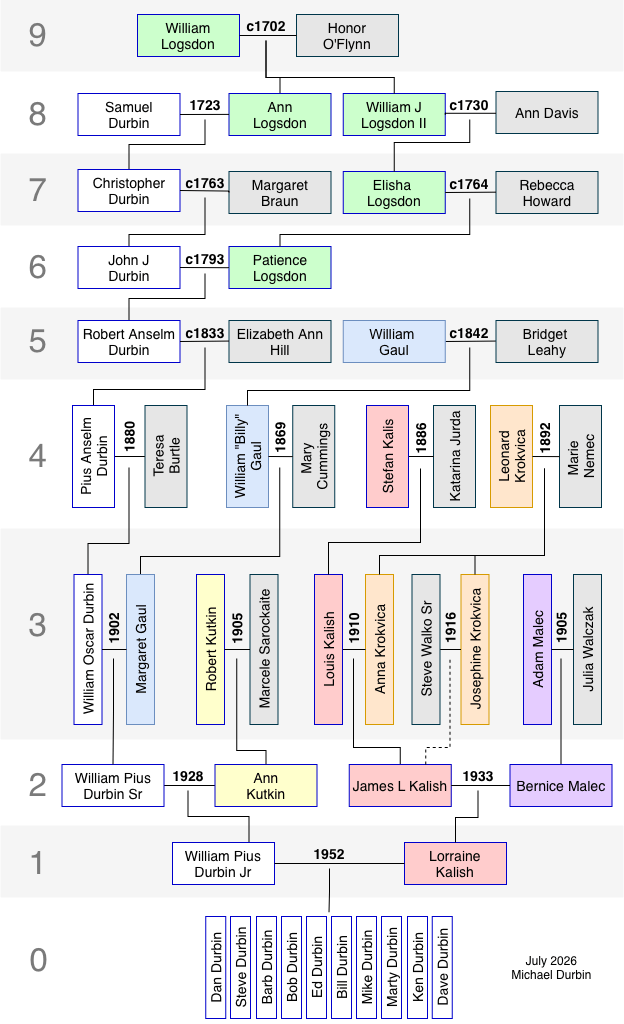
This is a collection of information—a compendium if you will—about the twenty families illustrated in the family tree above, starting with the family I was born into at the bottom and branching upward to families who came before us. Each is indicated with the pre-marriage name of the mother and father and the year they married. Surnames are color-coded to help illustrate various genealogical branches.
You’ll notice a dotted line to the Walko family, which is not in our direct ancestral line but is included for another important reason. They adopted the orphaned James “Jimmy” Kalish in 1927. This Walko family experience was so closely intertwined with that of the Kalish and Krokvica families that no history of this family would be complete without them.
The information below is organized chiefly around the families. For each there is a profile consisting of a simple listing of family members (with parent sibling names, known birthdates and locations, and other such basics) followed by one or more narrative sections of varying lengths. Like most families, we know at least a little—and in many cases quite a lot—about the families who came before us. The narrative blocks are meant to convey what we know.
In the profiles and elsewhere, a surname in bold indicates a direct ancestor. Family member names are followed by the years in which that person lived. A letter “c” or tilde “~” preceding a date indicates an approximation. The abbreviation “unk” indicate an unknown date. Hyperlinks refer to WikiTree entries for the person indicated. There is more about WikiTree at https://www.wikitree.com.
I maintain this compendium for anyone who might find it of interest, but please know it is imperfect. One certain thing about genealogy is that, the farther back you go, the less certain things get. But I’ve done my best to only include what I reasonably believe to be true.
I began collecting this information when I was about ten, on the evening I asked my mom and dad to write on a piece of paper the names of all the ancestors they could think of. That first family tree went back perhaps 90 years. Today, thanks to the efforts of many, as listed in the Acknowledgments and Sources section, we can reliably trace back more than 300 years.
Our history in a nutshell
Over a span of more than 200 years, our immigrant ancestors came to America from five European countries: England, Ireland, Lithuania (when it was part of the Russian Empire), Slovakia (when it was part of Austria-Hungary), and Poland (when it too was part of Austria-Hungary). The original English and Irish ancestors started out in Maryland and worked their way to Kentucky and eventually Illinois. Everyone else went pretty much straight to Illinois.
At the dawn of the 20th century, all eight of our great-grandparents happened to arrive in the same Illinois city on the banks of the Mississippi: East St. Louis. Across the river from the more affluent St. Louis, Missouri, this once-booming industrial town is our ancestral nexus — the trunk of the family tree where all roots and branches converge.
Our parents, grandparents, and maternal great-grandparents all met there because in the early 1900s, East St. Louis was a popular destination for unskilled job-seekers. Few of our arriving ancestors spoke English, but ESL had jobs for all of them.
In 1905, Polish immigrants Adam Malec and Julia Walczak met at an ESL boardinghouse for meatpacking workers. A few years earlier, Adam had fled an abusive stepmother in the Polish region of Galicia, then part of the Austro-Hungarian Empire. He walked more than six hundred miles to the port city of Hamburg, Germany, where he worked as a cobbler’s apprentice until he could afford passage to America, eventually finding his way to ESL.
Teenaged Julia was a victim of human trafficking. Deceived into believing she would be taken in by supposed “cousins” in East St. Louis, she left Galicia with her parents’ reluctant consent. When she arrived to find no cousins waiting, she had no choice but to work long hours at a packinghouse to pay for room and board.
Adam and Julia married soon after meeting. Their youngest daughter was Bronislava Malec, who went by Bernice.
In 1906, Slovaks Stefan and Katarina Kalish left the Austro-Hungarian Empire with their three youngest children for East St. Louis, where their eldest daughter, Annie, had fled a few years earlier. Their eldest son had also already made his way to ESL in search of work; in America, he went by Louis Kalish.
In 1908, another Slovak, Marie Krokvica, departed the empire with her two daughters in search of her missing husband, Leonard. She found him in East St. Louis. Their eldest daughter was Anna.
In 1910, Louis Kalish married Anna Krokvica. For several years they worked low-wage jobs in the packinghouses—until fortune struck in 1920 with the start of Prohibition. Teaming up with siblings and in-laws, they made a small fortune peddling bootleg liquor and running a brothel, only to lose it all after a series of misfortunes.
Louis and Anna had one son, James Kalish. In 1933, James married Bernice Malec, daughter of Adam and Julia. Their eldest child was our mother, Lorraine Kalish.
In 1911, one-year-old Ona Kutkaite arrived in East St. Louis from Lithuania. She traveled with her mother, Marcele, and two step-siblings to join her father, Rokus Kutka, who was already living there under the name Robert Kutin, working at a steel foundry. Ona’s childhood was marked by poverty, alcoholism, and neglect. Yet as the adult Ann Kutkin, she applied determination and intellect to forge her own path in life.
In 1912, six-year-old William Pius Durbin arrived in East St. Louis with his parents, William Oscar and Margaret Durbin. They had abandoned a failed farm in downstate Dahlgren, Illinois, where the family was nearing starvation. In ESL, William Oscar found far better fortune, first as a streetcar operator, then as a bus driver. His son, William Pius Sr., went on to build a career in the railroads.
In 1928, after meeting on a blind date, William Pius Durbin married Ann Kutkin. Their first son was William Pius Jr. His 1952 marriage to Lorraine Kalish marked the beginning of our immediate family.
William and Ann’s second son was Robert Emmet Durbin, our Uncle Bob. Their third was Richard Joseph Durbin—known in the family first as Uncle Joe, then as Uncle Dick, and to the rest of the world as U.S. Senator Dick Durbin.
Most of our East St. Louis ancestors arrived as first-generation immigrants. One exception was William Oscar Durbin, already a sixth-generation American. His father, Pius Anselm Durbin, had been born in Kentucky to Robert Anselm Durbin, who was also born in Kentucky, the son of John Durbin. John’s father, Christopher Durbin, had moved the Durbin line from Maryland, where his own father, Samuel Durbin, was our earliest confirmed ancestor in America. He married Ann Logsdon in 1723, starting the Durbin branch of our family tree from their home in Owings Mills, Maryland.
When our ancestors arrived, East St. Louis was a rough place. Unless you were desperate for a job and willing to live anywhere to get one—as they all were—it was not a desirable destination. “Only those who must,” it was said, “live in East St. Louis.” In 1913, John Chamberlain was elected mayor after campaigning on a promise “to make East St. Louis a little more like home and a little less like hell.”
By the late 1940s, when Bill Durbin and Lorraine Kalish were teenagers, conditions had improved dramatically. Meatpacking was a major and thriving industry, as was rail transportation. At one time, twenty-seven rail lines converged here, meeting at the foot of the marvelous Eads Bridge—the first to span the Mississippi River when it opened in 1874.
Mid-century was a good time for many children and grandchildren of Eastern European immigrants like ours, who had arrived decades earlier at this flood-prone bend of the Mississippi. Life was not so good for the African Americans of East St. Louis. In 1917, race riots ravaged the city when mobs of angry—and tragically misled—white residents feared that Southern Black migrants were taking their jobs. For many of those born with dark skin, ESL would remain a kind of hell.
The 1950s brought another change of fortune to East St. Louis. Industries began shifting operations south in search of cheaper labor, and ESL—like many industrial cities—fell into steep and lasting decline. To offer just one stark metric: today the median home price in the United States is about $450,000. In East St. Louis, it is only $40,000.
In 1962, Bill and Lorraine Durbin moved their growing family out of East St. Louis, past Cahokia—where pre-Columbian Native America once thrived—and up the ancient Mississippi bluffs to a rural area known then as Fairview and later incorporated as Fairview Heights.
In 1973, our parents moved the family from Illinois to Maryland, unknowingly completing a genealogical round trip: The town of Kensington, where we settled, was only a short drive from Owings Mills—where Samuel and Ann Durbin had started a family exactly 250 years earlier.
Over the decades that followed, some of the ten kids remained in Maryland to make homes and start families of their own. Some relocated to other states. As of this writing in 2026, Bill and Lorraine’s can could be found raising families in Maryland, Illinois, Indiana, Pennsylvania, Virginia, and North Carolina.

contents
The Durbin/Logsdon/Gaul Branch
The Kutkin Branch
Austria-Hungary
The Kalish/Krokvica/Walko Branch
The Malec Branch
Bill and Lorraine’s Family
Timeline
Acknowledgments and Sources
The Durbin/Logsdon/Gaul Branch

William Logsdon & Honor O’Flynn (c1702)
Family Members
William Logsdon [Logsdon-276] was born c1663 in Bedfordshire, England and died c1736 in Maryland.
Honor (O’Flynn) Logsdon [O’Flynn-16] was born c1681 in Ireland and died c1742 in Maryland. Her given name also appears as Honora.
William and Honor were married c1702 in Maryland.
Children
- Ann (Logsdon) Durbin [Logsdon-378] was born 1703 in Westminster, Maryland and died 1770 in Frederick, Maryland. In 1723 she married Samuel S Durbin in Baltimore, Maryland.
- William J Logsdon II [Logsdon-318] was born 1705 in Baltimore, Maryland and died c1745 in Baltimore, Maryland. In c1730 he married Ann (Davis) Logsdon in Maryland.
- Honora (Logsdon) Fowler [Logsdon-258] was born 1708 in Baltimore, Maryland and died c1802 in Baltimore, Maryland. In 1730 she married Richard Fowler.
- Lawrence Logsdon [Logsdon-293] was born c1709 and died 1797.
- Prudence (Logsdon) Kelley [Logsdon-281] was born 1712 in Baltimore, Maryland and died 1799 in Baltimore, Maryland. She married James Kelley in 1735.
- Thomas S Logsdon Sr [Logsdon-259] was born c1713 in Westminster, Maryland and died c1918 in Barren, Kentucky. He married Mary Vaughn in 1735.
- Edward I Logsdon I [Logsdon-312] was born c1714 in Baltimore, Maryland and died c1793 in Virginia. He married Sarah McQueen in 1742.
- John Logsdon [Logsdon-262] was born 1716 in Westminster, Maryland and died 1797 in Frederick, Maryland. He married Margaret Wooley in 1735.
Image above: John Thornton’s Map of the Chesapeake Region, c. 1706. Source: old.lva.virginia.gov
About
William Logsdon was born around 1663 in England. By the early 1700s, William was living in Maryland. There, according to family lore, he met a ship of women who had been transported across the Atlantic to join the colonists. How much choice those women had in the matter is unclear. Sadly—and horrifically—it appears to have been very little.
Oral tradition holds that Honor O’Flynn was kidnapped as a teenager from the Irish coast and taken to Maryland. Around 1702, she became the wife of William Logsdon and the mother of his eight children. Their first child, Ann Logsdon, was born in 1703. William died around 1736. Honor’s death date is less certain.

Samuel Durbin & Ann Logsdon (1723)
Family Members
Samuel S Durbin [Durbin-127] was born c1698 in Baltimore, Maryland and died 19 Sep 1752 in Frederick, Maryland.
Ann (Logsdon) Durbin [Logsdon-378] was born c1703 in Westminster, Maryland and died 8 Jul 1770 in Frederick, Maryland.
Samuel and Ann were married on 4 Jul 1723 in Baltimore, Maryland
Children
- Sarah (Durbin) McKenzie [Durbin-9] was born 1724 in Baltimore, Maryland and died 1795 in Allegany County, Maryland. She married Gabriel McKenzie in 1742.
- William Durbin [Durbin-98] was born in 1726 in Baltimore, Maryland and died c1789 in Frederick County, Maryland. He married Mary Margaret Poulson in c1746.
- Samuel Thomas Durbin Jr [Durbin-112] was born 1727 in Westminster, Maryland and died 1808 in Allegany County, Maryland. He married Comfort Logsdon.
- Ann Durbin [Durbin-76] was born 1730 in Baltimore, Maryland and died c1750.
- Thomas Durbin [Durbin-102] was born 1732 in Baltimore, Maryland and died 1810 in Westminster, Maryland. He married Honor Erbough.
- John Durbin [Durbin-113] was born 1734 in Baltimore, Maryland and died 1797 in Harrodsburg, Kentucky. He married his first cousin Ann Logsdon [Logsdon-911] in c1765.
- Margaret (Durbin) Brown [Durbin-83] was born 1736 in Baltimore, Maryland and died 1975 in Virginia. She married Edward Brown.
- Mary (Durbin) Logsdon [Durbin-95] was born 1739 in Baltimore, Maryland and died c1818 in Allegany County, Maryland. She married her first cousin Rapheal Logsdon [Logsdon-381] in 1756.
- Christopher Durbin [Durbin-71] was born 1741 in Baltimore, Maryland and died 1825 in Boonesborough, Kentucky. He married Margaret Braun around 1763.
- Benjamin Franklin Durbin [Durbin-90] was born 1748 in Baltimore, Maryland and died 1813 in Westminster, Maryland. The sharing of a name with the historical figure Benjamin Franklin is interesting. The founding father of that name was only 42 years old at the time of our Benjamin’s birth, just entering politics, but already quite wealthy as a printer of Poor Richard’s Almanack and other publications. It’s possible that Samuel and Ann honored the well-known Benjamin Franklin by choosing this name, or the name sharing may be nothing more than coincidence.
Image above: Homann’s ‘Virginia, Marylandia et Carolina’, c. 1700. Source: Fine Art America
About
In 1723, Benjamin Franklin was seventeen years old. John Adams and Thomas Jefferson had not yet been born. With the signing of the Declaration of Independence still more than fifty years away, the Fourth of July came and went like any other day for the roughly half million British colonists scattered across the Thirteen Colonies.
But it was a significant day for two Maryland residents: Samuel Durbin, a toll road watchman in the town of Owings Mill (now spelled Owings Mills, with the second “s”) and Ann Logsdon, the daughter of the successful farmer William Logsdon and his wife Honor O’Flynn. On this future national holiday, the couple exchanged wedding vows at St. Paul’s Church in Baltimore. Ann was about twenty. Samuel was about twenty-five.
We know nothing certain about Samuel’s parents or his life before marriage. According to oral history, he may have been one of two brothers from Wales who brought this line of Durbins to the colonies by way of the Caribbean island of Nevis—the same island that would become, decades later, the birthplace of Alexander Hamilton.
Some family historians speculate that Samuel was the son of a Thomas Durbin who was living in Maryland (also by way of Nevis) at roughly the right time to be his father. But this is little more than wishful genealogy. Beyond chronological and geographic plausibility, there is no firm evidence connecting Samuel to Thomas.

William J Logsdon II & Ann Davis (1730)
Family Members
William J Logsdon II [Logsdon-318] was born 1705 in Baltimore, Maryland and died c1745 in Baltimore, Maryland.
Ann (Davis) Logsdon [Davis-11044] was born c1710 in Baltimore, Maryland and died c1754 in Maryland.
William and Ann were married c1730 in Maryland.
Children
- Comfort (Logsdon) Durbin [Logsdon-377] was born 1731 in Baltimore, Maryland and died 1822 in Westminster, Maryland. She married Samuel Thomas Durbin Jr c1753.
- Ann (Logsdon) Durbin [Logsdon-1621] was born 1732 in Westminster, Maryland and died 1800 in Barren County, Kentucky. She married John Durbin c1765.
- Ann (unknown) McLain [Unknown-440227] was born c1733 in Baltimore, Maryland and died c1804 in Springfield, Pennsylvania. This person’s speculative inclusion in this family in WikiTree is based on DNA matching only.
- Lawrence Logsdon [Logsdon-1747] was born c1735 in Baltimore, Maryland and died 1818 in Maryland.
- Elisha Logsdon [Logsdon-298] was born c1745 in Westminster, Maryland and died c1815 in Madison County, Kentucky. He married Rebecca Howard c1764 and Susannah Lackey in 1798.
Image above: Detail of Baltimore County region from Thornton’s 1706 Map. Source: Library of Congress Blogs
About
Little is known of this colonial family. We do know granddaughter Patience Logsdon would marry the grandson of Samuel & Ann Durbin around 1793.
There’s this about William in Wikitree (19 Jul 2026), though the 1754 date he is said to have owned Conner’s Delight cannot be right if he died nine years earlier around 1745:
William was born about 1705. William’s father William Logsdon and mother Honora OFlynn Logsdon were from Baltimore, MD. He was in the in the Revolutionary War. In 1754 owned estate called “Conner’s Delight. And also, Nancy’s Fancy” on Hunting Ridge, originally granted to Henry Davis, Ann’s father. Ann (Davis) Logsdon wife of William.

Christopher Durbin & Margaret Braun (c1763)
Family Members
Christopher Durbin [Durbin-71] was born 13 Jul 1741 in Baltimore, Maryland and died 19 Dec 1825 in Boonesborough, Kentucky.
Margaret Braun [Braun-1919] was born 1749 in Frederick, Maryland and died 1840 in Kentucky.
Christopher and Margaret were married around 1763 in Maryland before moving family to Kentucky
Children
- Joseph Pius Durbin [Durbin-119] was born 1765 in Frederick, Maryland and died 1836 in Christian County, Illinois. He married his second cousin Elizabeth Logsdon [Logsdon-306] in 1789 in Madison, Kentucky.
- Edward “Ned” Durbin [Durbin-120] was born 1768 in Maryland and died c1816 in Madison County, Kentucky. He married Elzabeth Porter in 1779 in Maryland.
- Susan (Durbin) Logsdon [Durbin-74] was born c1770 and died 1832 in Bowlesville Township, Illinois. She married her first cousin once removed Joseph “Bulger Joe” Logsdon I [Logsdon-597]. Joseph Logsdon I was first cousin to Susan Logsdon’s father Christopher Durbin, both being grandchildren of William Logsdon and Honor O’Flynn.
- John J Durbin Sr [Durbin-82] was born 1772 in Maryland and died c1859 in Sunfish, Kentucky. He married his second cousin Patience Logsdon [Logsdon-371] in 1793 in Madison County, Kentucky. Patience Logsdon and John J Durbin Sr were both great grandchildren of William Logsdon and Honor O’Flynn.
- Thomas Durbin [Durbin-108] was born 1774 in Maryland and died 1805 in Illinois.
- Christopher Durbin [Durbin-75] was born c1775 in Frederick, Maryland and died 1848 in Sunfish, Kentucky. He married his second cousin Honor Logsdon [Logsdon-332] in 1796. Honor Logsdon and Christopher Durbin were both great grandchildren of William Logsdon and Honor O’Flynn.
- Philip S Durbin [Durbin-96] was born 1781 in Frederick County, Maryland and died 1866 in Gasconade County, Missouri. He married his second cousin Lucy Logsdon in 1800 in Madison County, Kentucky. Lucy Logsdon and Philip S Durbin were both great grandchildren of William Logsdon and Honor O’Flynn.
- Sarah Durbin [Durbin-886] was born c1783.
- Samuel Durbin [Durbin-67] was born 1784 in Maryland and died 1823 in Hardin, Kentucky. He married Hanna Brown in 1803 in Kentucky.
- Rebecca Durbin [Durbin-118] was born 1788 in Maryland and died in Missouri.
Image above: Kentucky’s three original counties established in 1780. Source: Kentucky Atlas and Gazetteer
About
Around 1763, Christopher Durbin, son of Samuel and Ann, married Margaret Braun. Beyond that, we know little about the life of this colonial-era couple. It is believed they had ten children. The fourth of these was John J. Durbin, born in 1769, from whom our branch of the family descends.
We do know one other important fact: Christopher and Margaret relocated our Durbin line from Maryland to Kentucky. Their son Edward was married in Maryland in 1779, while another son, Joseph, married in Kentucky in 1789. From this, we can infer that the family moved sometime during the 1780s—possibly alongside the family of Elisha and Rebecca Logsdon, whose daughter Patience would soon connect the Durbin and Logsdon families a second time.
Christopher lived until 1825. Margaret lived until 1840.

Elisha Logsdon & Rebecca Howard (c1764)
Family Members
Elisha Logsdon [Logsdon-298] was born c1745 in Westminster, Maryland and died c1815 in Madison County, Kentucky.
Rebecca Howard [Howard-1267] was born 1748 in Maryland and died 1798 in Kentucky.
Elisha and Rebecca were married c1764.
Children
- Honor (Logsdon) Durbin [Logsdon-332] was born c1765 in Maryland and died c1850 in Missouri. She married Christopher Durbin c1803.
- Patience (Logsdon) Durbin [Logsdon-371] was born c1771 in Madison, Kentucky (?) and died 1848 in Sunfish, Kentucky. She married John J Durbin Sr in 1793 in Kentucky. The reported birth location of Kentucky is suspicious. Her younger sibling Honor was born in Maryland, as were her next three older siblings. It is more likely she was born in Maryland, unless her parents made a relatively brief relocation from Maryland to Kentucky then returned to Maryland, which is certainly possible.
- Elisha Logsdon [Logsdon-1653] was born 1775 in Maryland and died 1838 in Lewis, Missouri. He married Susanna Skees in 1816.
- William Logsdon [Logsdon-303] was born c1776 in Allegany County, Maryland and died 1831 in Madison County, Kentucky. He married Mary Bradley in 1796.
- Mary Catherine (Logsdon) Bradley [Logsdon-863] was born 1780 in Maryland and died 1855 in Hardin County, Kentucky. She married Elijah Bradley in 1797.
- Peter Logsdon [Logsdon-1552] was born 1782 in Madison, Kentucky and died 1850 in Owaneco, Illinois. He married Honora Simons in 1800.
- Rebecca (Logsdon) Skees [Logsdon-2073] was born c1802 and died 1844. She married James Samuel Skees in 1816.
Image above: John Filson’s landmark 1784 map of ‘Kentucke’. Source: Kentucky Historical Society Digital Collections
About
Elisha and Rebecca relocated their family from Maryland to Kentucky. Based on the birth locations of children Mary (1780 in Maryland) and Peter (1782 in Kentucky) they may have moved in the early 1780s (notwithstanding the uncertainty around the birth location of daughter Patience noted above), possibly with the family of Christopher and Margaret Durbin.
Their daughter Patience married her second cousin John J Durbin in 1973.

John J Durbin & Patience Logsdon (c1793)
Family Members
John J Durbin Sr [Durbin-82] was born 1769 (or c1772 according to some sources) in Maryland and died 1 Nov 1858 in Sunfish, Kentucky.
Patience Logsdon [Logsdon-371] was born c1771 in Madison County, Kentucky and died 1848 in Sunfish, Kentucky.
John and Patience were married 8 Apr 1793 in Madison County, Kentucky
Children
- Christopher Nichols Durbin [Durbin-351] was born c1795 in Madison County, Kentucky an died 1877 in Sunfish, Kentucky. He married his second cousin Mary Elizabeth Durbin [Durbin97] in 1813 in Madison County, Kentucky. Mary Elizabeth Durbin and Christopher Nichols Durbin were both great grandchildren of Samuel S Durbin and Ann (Logsdon) Durbin.
- Margaret (Durbin) Decker [Durbin-1277] was born 1795 in Kentucky and died 1880 in Edmondson County, Kentucky. She married Ezekiel Decker in 1840 in Edmonson County, Kentucky.
- John Durbin [Durbin-1299] was born c1798. He married Susan Ellen Skees.
- Elisha John Durbin [Durbin-526] was born 1800 in Madison County, Kentucky and died 1887 in Edmonson County, Kentucky. Known as the “Pioneer Priest of Kentucky,” Elisha Durbin was a well-known Catholic priest said to have traveled a half million miles on horseback. According to baptismal and death records, Father Durbin enslaved 13 men and women in his lifetime, some of whom took the surname Durbin.
- Joseph C Durbin [Durbin-978] was born 1805 in Kentucky and died in Edmonson County, Kentucky. He married Martha Jane Bush in 1855 in Kentucky.
- William Richard Durbin [Durbin-896] was born 1811 in Madison County, Kentucky and died 1890 in Edmonson County, Kentucky. He married his second cousin Rachel Logsdon [Logsdon-940] in 1832 in Edmonson County, Kentucky. Rachel Logsdon and William Richard Durbin were both great grandchildren of William J Logsdon II and Ann Davis.
- Robert Anselm Durbin [Durbin-177] was born 1812 in Madison, Kentucky and died 1892 in Newton, Illinois. He married Elizabeth Ann Hill in 1833 in Madison County, Kentucky. He married Corinna Wise in 1858. He married Mahala Perry in 1861.
Image above: Elihu Barker’s influential map of Kentucky, used widely around 1800. Source: Boston Rare Maps
About
In 1793, John J. Durbin married his second cousin, Patience Logsdon, daughter of Elisha and Rebecca Logsdon, granddaughter of William J. Logsdon II, and great-granddaughter of William Logsdon and Honor O’Flynn—who were also great-grandparents to John.
At some point in adulthood, John lost his eyesight and became known as “Uncle Blind Johnny.” He was also an enslaver of African Americans. One disturbing story passed down through the family tells that when Johnny ordered the whipping of an enslaved person, he could not carry it out himself. Instead, he would command another enslaved worker to do it. According to the tale, the second worker would crack the whip against a nearby tree, while the intended victim pretended to be tied and cried out in pain—convincing anyone listening that the punishment had been carried out.
Was Johnny aware of the ruse? No one knows. What is certain is that we descend from a man who enslaved others, an uncomfortable truth all by itself.
Another story suggests that Johnny’s views on slavery may have been conflicted. He had donated land for a Catholic cemetery where his family was buried, yet, according to tradition, he refused to be buried there because the church forbade enslaved people from being interred alongside white parishioners. Instead, he requested burial in the adjacent cemetery where the people he had enslaved were laid to rest. If this tale is accurate, his objection was recorded in a most permanent way.
Uncle Blind Johnny Durbin died in 1858. His wife, Patience, had died a decade earlier, in 1848.

Robert Anselm Durbin & Elizabeth Ann Hill (c1833)
Family Members
Robert Anselm Durbin [Durbin-177] was born 20 Oct 1812 in Madison, Kentucky and died 23 Jan 1892 in Newton, Illinois.
Elizabeth Ann Hill [Hill-5538] was born 8 Oct 1817 in Edmonson County, Kentucky and died c1855 in Lawrence County, Illinois.
Robert and Elizabeth were married 1833 in Madison County, Kentucky
Elizabeth Ann Durbin is not listed on WikiTree as of August 2025. The information above is from Robert Ross Durbin. WikiTree does list an Anna Elizabeth (Durbin) Cecil [Durbin-176] with the same birthdate as Elizabeth Ann Durbin, who married Noah Milton Cissell and died in 1878 at age 32. It is not clear which of these conflicting accounts is more reliable.
Children
- Theresa Joan Durbin [Durbin-2675] was born 1835 in Kentucky.
- Mary Isabella (Durbin) Ritman [Durbin-325] was born 1837 in Henderson, Kentucky and died 1908 in Newton, Illinois. She married Peter S Rittman Sr in 1858 in Illinois. She married Thomas Shephard in 1900. Ross Durbin spells her surname Rittman.
- John Thomas Durbin [Durbin-2676] was born 1839 in Sunfish, Edmonson, Kentucky and died 1919 in Miltonvale, Kansas.
- Richard Stephen Durbin [Durbin-1663] was born 1843 in Kentucky. He married Helena Cecil in 1867 in Randolph, Illinois.
- Martha Elizabeth (Durbin) Cornelius was born 1841 in Sunfish, Kentucky and died 1917 in Laporte, Indiana. She married Joseph Charles Cornelius, a veteran who served in the Union Army 1864-1865 in the Civil War. Martha Elizabeth Durbin is not listed on WikiTree as of August 2025. This information is from Robert Ross Durbin, who also notes that Joseph Cornelius enlisted at Alton, IL, Camp Butler, 17 Oct. 1864, Company “B” 51 IL Infantry. He was wounded and received a medical discharge at Irvin, TX, 25 Sept. 1865.
- Elizabeth Ann Durbin was born 1845 in Sunfish, Kentucky and died 1864 (age 19) in Ruma, Illinois.
- Pius Anselm Durbin [Durbin-606] was born 1847 in Edmonson County, Kentucky and died 1909 in Dahlgren, Illinois.
Photo above: Robert Anselm Durbin c1875
About
Robert Durbin, the seventh and youngest child of John and Patience Durbin, was born in Kentucky in 1812. He married Elizabeth Ann Hill in 1833, and together they had nine children. Their seventh child, Pius Anselm Durbin, was born in 1847.
Elizabeth died around 1855 at the age of thirty-eight. Robert remarried Corinna Wise in 1858 and, after her death around 1861, married Mahala Perry. Little is known about his second and third marriages.
Robert lived a long life, dying in 1892 at the age of eighty.

Pius Anselm Durbin & Teresa Burtle (1880)
Family Members
Pius Anselm Durbin [Durbin-606] was born 1847 in Edmonson County, Kentucky and died 1909 in Dahlgren, Illinois.
Teresa Burtle was born 1 Jun 1858 in Sangamon County, Illinois and died 22 Dec 1938 in Dahlgren, Illinois.
Pius and Teresa were married in 1880 in Sangamon County, Illinois
Pius and Teresa married following the death of Teresa’s sister Elizabeth. They moved their family from Kansas to Missouri around 1882 and then to Dahlgren, Illinois around 1891.
Children
- William Oscar Durbin [Durbin-607] was born 26 Jan 1881 in Sherman Township, Dickinson County, Kansas and died 4 Jan 1950 in East St. Louis, Illinois. He married Margaret Ellen Gaul [Gaul-178] 18 Nov 1902 in Dahlgren, Illinois.
- Margaret Elizabeth Durbin was born 9 Jan 1883 in Richie, Missouri and died 18 Jul 1961 in Dahlgren, Illinois. She married John Loehr 19 Nov 1902 in Dahlgren, Illinois.
- Clara Loretta (Durbin) Bartley was born 11 Jan 1886 in Lebanon, Missouri and died 18 May 1969 in Olney, Illinois. She married William Oscar Bartley 14 Jul 1909 in Newton, Illinois.
- Katherine (Durbin) Loehr was born 16 Jun 1888 in Lebanon, Missouri and died 20 Sep 1960 in Dahlgren, Illinois. She married John “Young John” Loehr in 1907 in Dahlgren, Illinois.
- Leo Douglas Durbin was born 14 Aug 1890 in Lebanon, Missouri and died 8 Jul 1957 in St. Louis, Missouri. He married Cecile Violet Hoerrmann 31 Jul 1917 in Pacific, Missouri. Leo and Cecile Durbin were the parents of the prolific family historian Robert Ross Durbin of St. Louis, Illinois.
- Anna Christina (Durbin) Farmer was born 4 Nov 1892 in Dahlgren, Illinois and died 28 Aug 1962 in St. Louis, Missouri. She married Ralph Thomas Farmer 26 Nov 1913 in Taylorville, Illinois.
- Francis Fidalis “Dalis” Durbin was born 1894 in Dahlgren, Illinois and died 1937 in Dahlgren, Illinois. He married Matilda “Tilly” Anselment in 1922 in Mount Vernon, Illinois.
Photo above: Children of Pius Anselm Durbin, c1891. William Oscar Durbin is standing in the back row, second from the left.
About
Pius Anselm Durbin, born in Kentucky in 1847, was the seventh child of Robert and Elizabeth Durbin. For reasons unknown, he left his home state as a young man and moved one state north to Illinois. There, in 1870, at the age of twenty-three, he married Elizabeth Ellen Burtle of Sangamon County. She was twenty-two.
Their first child, Charlotte, was born in 1870. In 1872, Elizabeth was eight months pregnant with their second child when little Charlotte, not yet two, died. Three weeks later, the grieving mother gave birth to a son. They named him Charles, in honor of the big sister he would never know.
In 1873, Pius and Elizabeth took little Charles and headed west, crossing the Mississippi River the only way one could at the time—by ferry—to settle in Kansas and start a farm.
By then, the slave-free state of Kansas had dispossessed most of its Native American inhabitants and was actively enticing settlers of European descent onto its wide-open plains. Its state motto, ad astra per aspera—Latin for “to the stars through difficulties”—was both a promise and a warning.
In Kansas, Elizabeth bore four more children, one of whom died at birth. In 1879, she succumbed to an unknown illness and died at just thirty-one years old.
Pius traveled back to Illinois to break the news and console his sister-in-law, Teresa Burtle—then asked for her hand in marriage. They wed in 1880, and he returned to Kansas with his new wife, the sister of his late wife. In 1881, they welcomed a son: William Oscar Durbin.
Life on the Kansas frontier proved too harsh for Pius and Teresa, as it did for many. A brutal Midwest drought brought dust storms, grasshopper plagues, and despair—giving rise to a wry motto of the times: “In God We Trusted, In Kansas We Busted.”
Pius and Teresa cut their losses and moved to Missouri around 1882, where they had four more children. But farming life there was not much easier. After experiencing earthquakes along the New Madrid fault line, they grew fearful and decided to return to Illinois. With nine children in tow, they made the journey the only way they could afford: on foot.
This time, when they crossed the Mississippi, there was a bridge.
Completed in 1874, the Eads Bridge—designed by engineer James Buchanan Eads—was a technological marvel: the longest arch bridge in the world and the first to employ steel on such a scale. It was so daunting that many refused to cross it, until a circus elephant was marched across to prove its strength.
Around 1890, nine-year-old Oscar Durbin crossed that bridge into East St. Louis for the first time. Barefoot, he would later recall how the metal grillwork hurt his feet, and how he could see the brown water of the Mississippi—”the Big Muddy”—eighty-eight feet below.
After crossing, the weary Durbin family passed through East St. Louis and continued south to Dahlgren, Illinois, about a hundred miles away. There, they once again took to farming. They had two more children in Dahlgren, bringing their total number of surviving children to eleven.
Another family in Dahlgren at the time were the Gauls, who had also failed to make a go of it in Kansas. Whether the two families had known each other out west is unknown, but their paths converged definitively in 1902, when twenty-one-year-old Oscar Durbin married Margaret Gaul, a second-generation immigrant from Monmouth, Illinois, whose father and paternal grandparents were born in Ireland.
In later years, Pius Anselm Durbin went simply by “P.A.” He died in Dahlgren in 1909 at the age of sixty-two. Teresa lived until 1938, dying at the age of eighty.


William Gaul & Bridget Leahy (c1842)
Family Members
William Gaul was born c1820 in County Kilkenny, Ireland and died 1848 in Jerseyville, Illinois.
Bridget Leahy was born c1830 in County Kilkenny, Ireland and died 1902 in Dahlgren, Illinois
William and Bridget were married c1842 in Ireland
Children
- Helen Marie (aka Nellie, aka Ellen) Gaul was born 1842 in Ireland. She married Barney Kelly in 1871 and lived until 1907.
- William “Billy” Gaul Jr was born 1843 in Ireland and died 1929 in Illinois. He married Mary E Cummings in 1869 in Jerseyville, Illinois.
- John Gaul was born in 1850, en route from Ireland. He married Elizabeth Moreland in 1870 and lived until 1924.
Image above: 1850 full-state map of Illinois by Thomas, Cowperthwait & Co.. Source: Wikimedia Commons – Wikimedia.org
About
In the 1840s, the microorganism Phytophthora infestans began killing potato plants across Europe. The blight devastated crops for years, and nowhere was harder hit than Ireland. The resulting Irish Potato Famine, also known as the Great Hunger, changed history in a big way. Nearly half of Ireland’s eight million residents either died of starvation or fled to the United States.
Among the refugees were William and Bridget Gaul. They had married in Ireland and started a family there. William emigrated first, perhaps in 1850, settling in Jerseyville, Illinois. In 1851, Bridget, known also as Fanny, emigrated with their son William, born 1843, who would go by Billy his entire life. Bridget was apparently quite pregnant at the time, as Billy’s brother John was born en route from Ireland. William and Bridget’s eldest child was Helen Marie, born in 1842, who would go by Nellie or Ellen. We don’t know when exactly she emigrated.
The entire Gaul family was together in Jerseyville, but sadly not for long. Billy’s father, William, died around 1853. Bridget may have had no choice but to break up the family, as Billy was then taken in by the family of William Massey, a prominent landowner, who put him to work as a farmhand. The widowed Bridget married Dennis Hennessey in 1863. She lived until 1902 and is buried in Dahlgren, Illinois, as Fanny Hennessey.

William “Billy” Gaul & Mary Cummings (1869)
Family Members
William “Billy” Gaul Jr was born 1843 in Ireland and died 1929 in Illinois.
Mary E Cummings was born c1850 in Jerseyville, Illinois and died 1930 in Dahlgren, Illinois.
William and Mary were married in 1869 in Jerseyville, Illinois
Children
- John Gaul died at birth in 1869
- Delia Gaul was born 1870 in Jerseyville, Illinois and died in 1937 in Dahlgren, Illinois.
- Mary “Mame” Gaul was born 1872 in Jerseyville, Illinois and died 1964 in Belleville, Illinois. She married John “Jack” McGlynn.
- William Gaul was born 1873 in Jerseyville, Illinois and died 1966 in Illiopolis, Illinois.
- Ellen “Nell” Gaul was born 1875. She married Pat Hargrove.
- Patrick Henry Gaul was born 1877 in Jerseyville, Illinois, and died in 1950.
- Peter C Gaul was born 1879 in Jerseyville, Illinois and died 1954 in East St. Louis, Illinois.
- John Gaul was born 1881 in Jerseyville, Illinois and died 1964 in East St. Louis, Illinois.
- Margaret Ellen “Ma” Gaul was born1883 in Monmouth, Illinois and died 1961 in East St. Louis, Illinois. She married William Oscar “Pa” Durbin in 1902 in Dahlgren, Illinois.
- Lawrence Gaul was born 1885 in Monmouth, Illinois and died 1968 in East St. Louis, Illinois.
- Kathryn (Gaul) McPherson was born 1887 in Dahlgren, Illinois and died 1954 in East St. Louis, Illinois. She married Ira McPherson.
- Josephine “Josie” Gaul was born in 1889 in Dahlgren, Illinois and died in 1897 in Dahlgren, Illinois. Mysteriously, the name on her gravestone is Johanna Gaul.
Photo above: William “Billy” Gaul and Mary (Cummings) Gaul in undated photos
About
In November 1861, eighteen-year-old Billy answered President Abraham Lincoln’s call for volunteers to suppress the southern rebellion. Many early enlistees in what was then known as the War of the Rebellion saw service as a chance to elevate their status from immigrant American to simply American. Billy’s reasons may have been less patriotic. According to what he later told his grandson William Durbin, he was paid—perhaps as much as $400 (over $15,000 today)—to enlist in someone else’s place.
After mustering in at the fairgrounds of Carrollton, Illinois, Billy and the rest of Company C, 61st Illinois Infantry Regiment, survived one of the war’s first major engagements at Shiloh, Tennessee, in April 1862. Although Billy left no written record, another member of the regiment, Leander Stillwell, published a full memoir, giving us a good sense of where Billy was and when.
Billy nearly died later that year—not in combat, but while passing a halted wagon train during a long march between battlefields. A mule kicked him in the head. The injury, according to surgeon affidavits from his pension file, was severe and bone-shattering. Yet he not only finished his three-year enlistment, he re-enlisted in 1864.
His sense of duty had limits. In August 1865, four months after Lee’s surrender, when his superiors refused to send his regiment home, Billy deserted. His departure was duly recorded, along with a notation that he owed the U.S. government sixty-nine cents—for the waist belt, plate, and cartridge box he took with him. In 1884, Congress passed a law removing desertion charges from soldiers who had left service after the war had ended. Billy’s status was changed from dishonorable to honorable. We don’t know if he ever paid back the sixty-nine cents.
In 1866, Billy took advantage of the Homestead Act, acquiring 160 acres in Kansas for a $10 fee and a promise to live on it for five years. One year later, he sold the land for $2,200—a more than 20,000% return and a complete violation of his homestead pledge. By numerous accounts, honorability would never be one of Billy Gaul’s long suits.
Sometime after the war, he married Mary Cummings. They would have twelve children, one of whom was Margaret Gaul, born in 1883 in Monmouth, Illinois—the future wife of Oscar Durbin.
Many of the Gaul children, like the Durbins, would eventually settle in East St. Louis. In addition to Margaret and her husband Oscar, these included Delia Gaul, Mary “Mame” Gaul (who married John “Jack” McGlynn), Ellen “Nell” Gaul (who married Pat Hargrove), Patrick Henry Gaul, Peter Gaul, John Gaul, Lawrence Gaul, and Kathryn “Kate” Gaul (who married Ira McPherson).
Billy himself was rarely around. When interviewed in the 1980s, his granddaughter Margaret Petterson referred to him as a rounder.
“What’s a rounder?” she was asked.
“It’s a drunkard who leaves his family and only comes around to pick up his pension check,” she answered through pursed lips. And that’s the last she wanted to say about Billy Gaul.
William “Billy” Gaul died in 1929 at age eighty-six. Mary Gaul died the following year in Dahlgren.

William Oscar Durbin & Margaret Gaul (1902)
Family Members
William Oscar Durbin [Durbin-607] was born 26 Jan 1881 in Sherman Township, Dickinson County, Kansas and died 4 Jan 1950 in East St. Louis, Illinois.
Margaret Ellen Gaul [Gaul-178] was born 21 Jun 1883 in Monmouth, Illinois and died 25 Nov 1961 in East St. Louis, Illinois.
William Oscar and Margaret were married 18 Nov 1902 in Dahlgren, Illinois
To their children and grandchildren, William Oscar was known as “Pa” (rhymes with paw) and Margaret was known as “Ma” (rhymes with maw).
Children
- An unnamed son was born c1903 in Dahlgren, Illinois and died six hours after his birth.
- Helen Durbin was born 1904 in Dahlgren, Illinois and died in 1905.
- William Pius Durbin Sr [Durbin-608] was born 24 Jun 1906 in Dahlgren, Illinois and died 13 Nov 1959 in East St. Louis, Illinois. He married Ann Kutkin in 1928 in East St. Louis, Illinois.
- Margaret Durbin was born 1908 in Dahlgren, Illinois and died 1910 in Dahlgren, Illinois.
- John Owen Durbin was born 20 Oct 1916 in East St. Louis, Illinois and died 13 Feb 1987 in San Diego, California. He married Delphine Marie Salisbury in 1944 in East St. Louis, Illinois. They would have four children: Jett Ellen married and had two children. John Owen, Jr. died in 1971 at age 24. Patrick Hugh Durbin married and had three children. Their youngest is Leslie James “Jim” Durbin.
- Mary Catherine (Durbin) Petterson—pronounced like Peterson—was born 1918 in East St. Louis Illinois and died 2001 in Indianapolis, Indiana. She married George Petterson in 1940 in East St. Louis, Illinois. They had five children: Margaret “Peggy” Petterson, Thomas “Tom” Petterson, Dennis “Mike” Petterson, Katherine “Kathy” Petterson, and George “Bill” Petterson
Photo above: William Oscar Durbin and Margaret (Gaul) Durbin, c1940
About
William Oscar Durbin and Margaret Gaul married in Dahlgren, Illinois, in 1902. Starting a family proved difficult. Their first child died at birth that same year. Two years later, their daughter Helen lived only a few months.
Their son, William Pius Durbin, born in 1906, also appeared unlikely to survive. Frail and ill, he was fed with an eyedropper and slept on a pillow. But he recovered, and his parents finally had a healthy child. The relief was short-lived.
In 1908, Margaret gave birth to another daughter, also named Margaret. She died at age two. In 1916 came John Owen Durbin (he went by Owen), and in 1919, Mary Catherine Durbin (later Mary Petterson).
Grateful for their three surviving children but struggling financially, Oscar and Margaret left their Dahlgren farm in 1912 and moved to East St. Louis, where Oscar found work as a streetcar operator. At some point they returned to Dahlgren for another attempt at farming, but again gave it up and moved a final time to East St. Louis, where Oscar became a bus driver. His family never went hungry again.
To everyone in the family, Margaret and Oscar were Ma and Pa—pronounced “maw” and “paw.” The relentless work ethic they’d developed on the farm served them well in the city. Pa didn’t earn much as a bus driver, but he was careful, patient, and inventive.
He built a garage behind their house at 484 29th Street with his own hands, and once fashioned an electric fan from scrap metal. It moved air impressively but had no protective guard, which terrified Ma. She raised chickens in the backyard until the city told her it was against municipal rules. Then she raised them in the basement until Pa objected and convinced her to stop.
Ma and Pa established the Durbin family passion for baseball that continues today. It was understood that Pa was never to be disturbed while listening to the St. Louis Cardinals on the radio—and the same courtesy was given to Ma, whose loyalty belonged firmly to the St. Louis Browns.
They rooted for different teams but worshipped in the same pew. The family went to Mass every Sunday at St. Elizabeth’s Catholic Church. Ma went every day, regardless of weather. Kneeling in prayer, she surely thanked God for the prosperity East St. Louis had brought them after their years of hunger—and perhaps slipped in the occasional heavenly plea for the pitching arm of Dixie Davis.
Their eldest surviving son, William, was a model child. Strong and healthy, modest despite his good looks, devout and well-mannered, he played bugle in the Knights of Columbus Drum & Bugle Corps. In the early 1920s, he went to work as a stevedore for the Pennsylvania Railroad.
At that time in East St. Louis, if you didn’t work at a packinghouse, you probably worked on the railroads. The junction of so many rail lines—twenty-seven at one point—had attracted the meatpacking industry in the first place. And what brought the railroads was coal: vast reserves beneath the Illinois bluffs, mined furiously in the decades after the Civil War.
William would spend his entire career on the railroad. In November 1922, at age sixteen, he took a job with the Pennsylvania Railroad. Fifteen months later, in February 1924, he received $67.10 in wages for that month. The following month, he switched to the rival New York Central Railroad, which paid him $77.80. Whether the modest raise was the reason for his change in employers is unknown, but he never switched again. He eventually rose to the coveted position of Chief Clerk.
All three of Ma and Pa’s children married. In 1926, on a blind date, William Pius Durbin met Anna Kutkin, a Lithuanian immigrant; they married in 1928. Their first child, William Pius Durbin, Jr., was this writer’s father. Their second was Robert Emmet Durbin, and their third was Richard Joseph Durbin—U.S. Senator Dick Durbin.
Mary Catherine Durbin married George Petterson in 1940. They would have five children: Peggy, Tom, Mike, Kathy, and Bill.
John Owen Durbin married Delphine Salsbury in 1944. They would have four children: Jett Ellen, John Owen, Jr., Patrick, and Leslie James “Jim” Durbin.
William Oscar Durbin died in 1950 at age sixty-nine. Margaret died in 1961 at age seventy-nine.


William Pius Durbin Sr & Ann Kutkin (1928)
Family Members
William Pius Durbin Sr [Durbin-608] was born 24 Jun 1906 in Dahlgren, Illinois and died 13 Nov 1959 in East St. Louis, Illinois.
Ann (Kutkin) Durbin [Kutkin-1] was born Ona Kutkaite in 1909 in Jurbarkis, Lithuania and died 1997 in Bethesda, Maryland.
William and Ann were married 7 Feb 1928 at St. Elizabeth’s Church in East St. Louis, Illinois
Children
- William Pius Durbin Jr [Durbin-613] was born 1929 in East St. Louis, Illinois and died 2001 in Kensington, Maryland. He married Lorraine Kalish in 1952 in East St. Louis, Illinois. They would have ten children.
- Robert Emmet Durbin [Durbin-614] was born 1931 in East St. Louis, Illinois and died 2009 in Long Beach, California. He married Nancy Anne Bennett in 1956 in California. They would have two children.
- Richard Joseph “Dick” Durbin [Durbin-609] was born 1944 in East St. Louis, Illinois. He is now (August 2025) the senior US Senator from the state of Illinois. He married Loretta Schaefer in 1967. They would have three children.
Photo above: William Pius Durbin Sr and Anna (Kutkin) Durbin, 1928
About
After they married in 1928, the first home of William and Ann Durbin (at some point she trimmed her name from Anna to Ann) was an apartment on 30th Street in East St. Louis above the home of a Mrs. Lyons, who took an immediate liking to the young couple and made every effort to look after them.
Their first child, William Pius Durbin Jr. (hereafter Bill Durbin), was born in 1929—just in time for the stock market crash and the Great Depression that followed. His first bed was a dresser drawer. Mrs. Lyons gave William and Ann a sterling silver cup—no trivial gift in those days—engraved with their son’s name.
Bill’s first brother, Robert Emmet Durbin (hereafter Bob Durbin), was born in 1931. He was named for the Irish nationalist leader Robert Emmet, whose 1803 “Speech from the Dock,” delivered just before his hanging for treason, stirred the people of Ireland much the way Martin Luther King Jr.’s Letter from Birmingham Jail would stir Americans a century and a half later. Irish schoolchildren were made to memorize it. As an adult, Bob once watched a London bartender, one of those former schoolchildren, stand atop a beer box and recite it from memory.
Around the time Bob was born, the family moved to the 500 block on the east side of 33rd Street, where they lived for about a year, and then to Belleview Avenue, two doors from 29th Street. Bill entered first grade at the parochial school at St. Elizabeth’s Catholic Church while they lived there.
Money was always tight. Fortunately, Bill and his brother were lucky to have a father with a good job on the railroad and a mother who was as strong, smart, and determined as any woman who ever stepped foot in East St. Louis. No economic downturn, no matter how great, was going to defeat Ann Durbin.
One thing the family never ran out of was eggs. William ran the feed house at the New York Central Railroad and came home with an armful every day. Bill and Bob got hooked on fried egg sandwiches, and their mother sold extras to neighbors.
In 1935, Ann Durbin was naturalized as a U.S. citizen. She missed one question on her exam, saying that presidents were elected by popular vote rather than the electoral college. The examiner agreed the question was unnecessarily tricky and let it slide.
In 1936, the family moved to 484 29th Street—next door to Ma and Pa (Margaret and Oscar) at 486. Unfortunately, Ann did not like living beside her in-laws. Tensions between her and Ma, and with her sister-in-law Mary, grew quickly. After less than a year at 484 they moved to 1531 North 41st Street.
There, in 1937, William brought home for eight-year-old Bill a library card and a book on Roman mythology. The surprise gift turned Bill into a voracious reader and lifelong lover of books. That same year a traveling salesman convinced his parents to buy an accordion for next to nothing, in exchange for a commitment to pay for lessons.
Knowing the sacrifice his parents were making, Bill took the lessons seriously. He mastered the complicated instrument and for decades thereafter could play any number of tunes by heart. It made his mother happy to hear him play, so he performed whenever asked. And when he went into the Navy years later, the accordion went with him.
In mid-1939, the family moved a few blocks to North 40th Street—the house number might have been 1341, but we’re not sure. Bill would recall it as the nicest house they ever lived in. Apparently it was too nice, because within months they could no longer afford the rent.
When William’s father, Oscar, found out, he bought them an affordable house at 441 North 33rd Street. It was a shotgun house, so-called because one could supposedly fire a shotgun from the front door and have the buckshot exit the back door without hitting anything. They moved there in January 1940.
The house sat across the street from the so-called Acid Hills, where ALCOA, the aluminum producer, was said to have dumped its industrial waste into piles, which became favorite terrain for neighborhood boys on their bikes. Bill and Bob were among them, instructed to keep an eye out for huge clouds of chemical dust that would occasionally roll across the street. When they saw one, they were instructed to run home and shut the windows.
These were war years. Indeed, World War II was the defining event of Bill’s childhood. He had a paper route and would read the East St. Louis Journal before delivering it. One afternoon he read that sugar was about to be rationed. On his way home he stopped at several stores and bought up as much as he could carry on his bike—nearly thirty pounds of it.
His mother gave him the 1940s equivalent of a high five. His father did not, pointing out that hoarding in wartime could land you in serious trouble with the law. Bill never did that again.
In 1944, Oscar brokered a truce between his wife and daughter-in-law. Later that year, William and Ann moved their family back to 484 29th Street, next door to Ma and Pa. That was also the year Bill and Bob got a little brother: Richard Joseph Durbin. He would go by Joe for much of his youth, and later by Dick Durbin.

For the three sons of William and Ann Durbin, one of the defining features of their ESL youth was the sheer number of extended family members nearby—eight aunts and uncles, and more than a dozen great aunts and uncles. Adding in all the cousins, there were more relatives than they could possibly keep track of. But some of those relatives left lasting memories.
Ma’s sister Mary—Aunt Mame to the kids—had the most wealth of anyone in the family, chiefly from a settlement after her husband was killed working on the railroad. But you would never know of her ample money from her modest home and miserly lifestyle. When needing to cross the Eads Bridge to St. Louis, she paid the five cents to walk—the bus cost fifteen cents. She had her nephews save up old newspapers, then wind them into tight rolls and bind them with wire, which she burned in the furnace to stretch her coal supply. Only after she died, when survivors found bank accounts she had forgotten about and enough assets to give even distant nephews hundreds of dollars each, was her hidden wealth revealed.
Ma’s brother Lawrence was at the other end of the financial spectrum, hitting up even the littlest kids in the family for pocket change. Lawrence came and went, working menial jobs at railroad restaurants, then disappearing and reappearing, living with Ma when he was in ESL.
Ma’s brother Pete was also known for being forever low on funds, and what little funds he did come across were likely to be spent drinking. When Pete developed severe cataracts, he decided he’d rather be blind than spend money on their removal. He moved in with Ma, and liked to sit on her front porch during electrical storms because he could tell when lightning bolts went off.
John was another of the Gaul siblings to lose his eyesight. Athletic as a youth, winning one county running race after another, he went off to join an artillery unit of the U.S. Army. Something went wrong and he came home blind. Ma took him in.
Ma’s sister Kathryn, Aunt Kate, married Ira McPherson, and by 1948 would have three grandchildren in the pool of ESL cousins, all related in one way or another. John McPherson was eight, his brother Gerald was six, and their cousin Thomas Schmitt was seven.
On September 11, 1948, those three boys learned the carnival was in town. As the elated trio bolted across State Street, a car struck all three kids at once. None survived. It was the kind of tragedy—all but forgotten now, as relatively few people alive in 1948 ESL are still with us—that sent a wave of unbelievable shock through countless relatives, no matter how distant.
The three sons of William and Ann Durbin, growing up in the 1940s in their modest home on 29th Street in East St. Louis, would be excused for taking for granted the bounty of nearby family and the range of experiences that came with it. They also had front-row seats to three of the nation’s great domestic battles of the twentieth century—for women’s rights, civil rights, and union rights.
Ann Durbin was a feminist before anyone used the word, demonstrating at any opportunity she could do both a woman’s work and a man’s. She would not hesitate to paint a room or repair a lamp, and took business school classes so she could work in an office. She eventually got a job as a clerk at the New York Central Railroad, where her husband William was Chief Clerk. Typical for the day, his desk was on a raised platform facing out on a large room of symmetrically arranged desks facing his. Ann worked at one of those desks.
William Durbin was a union man to the core. He took a stand for the rights of workers—of any skin color—as he rose through the ranks on the railroad, even after his promotion into management, when passions for worker rights are often put to the test. He navigated well the fine line between the interests of management and worker and decided at the age of thirty-eight to apply his skills in the political arena. He was elected to the County Board of Supervisors in 1944 and within three years found himself chairman of the Finance Committee. He also found himself in a battle between personal ethics and government corruption.
William Durbin was offered bribes more than once, from people hoping to curry favor with this public official, one time accepting a cigarette and noticing just before lighting it the tobacco had been replaced with a $50 bill—about a week’s pay. Struggling with whether he should accept it, he went to a priest for advice.
We don’t know what the priest advised, but we do know William took an all-or-nothing stand in the 1949 election for Chairman of the County Board, when he refused to back a long-time family friend who apparently had no problem at all with the rampant corruption.
Another bribe, for nearly half a year’s pay, which he turned down, wouldn’t sway William Durbin. It appears bribery did sway others. His candidate lost, narrowly, and the very day after the election his former friend stripped William Durbin of his committee chairmanship. The foray into politics, for this Durbin family, was over. Or so it seemed in 1949.
Bill Durbin attended eight years of elementary school at St. Elizabeth’s. He struggled academically, earning generally poor grades, but he excelled in composition, penmanship, and oratory. Those strengths may have helped him earn a scholarship to St. Henry’s Preparatory Seminary in Belleville. The so-called minor seminary provided young men with a high school education while preparing them for major seminary and, ultimately, the Roman Catholic priesthood.
For his mother—who had long prayed that one of her sons would become a priest—his enrollment at St. Henry’s was the fulfillment of a dream. For Bill, it was a mistake. He went through the motions for the first two years, but by the third, the strain of trying to please a mother who expected him to become a priest while knowing he did not want that life made him ill. He spent weeks in the infirmary before finally gathering the courage in 1945 to tell his parents he was leaving seminary.
He finished the remainder of high school—about a year and a half—at Central Catholic, which later became Assumption High School. To earn money, he worked nights and weekends at the New York Central Railroad, where his father William was by then Chief Clerk. His dad assigned a Black stevedore named Jesse to train him. Jesse knew everything there was to know about the job and made clear to Bill the absurdity of judging someone by their skin color.
After graduating in 1947, Bill stayed on at the railroad while enrolling at Belleville Junior College, just outside East St. Louis. Working nights and attending classes after his shift left him sleep-deprived, and his mind foggy during lectures. His parents struggled to understand why he bothered with school. He was the first Durbin in this line to attend college, and his father was eager to groom him for a lifelong career at the New York Central.
But Bill Durbin wanted something different. Tensions with his mother helped him decide what that might be. Ann Durbin never got over her disappointment at his decision to leave the seminary. She refused to speak to him for months. Bill remained devoted to both parents, but for reasons no one could explain, nothing he did could ever seem to please his mother. One evening in 1948, some friends arrived to pick him up for a night out. As he reached the door, his mother stopped him and ordered him to stay and wash the dishes.
The humiliation helped him decide it was time to put distance between them. The country was still basking in the postwar euphoria of victory in World War II. Bill had long regretted being too young to serve in what people called the “Good War,” and he had already considered a military career. With no wars underway in 1948, the United States had dramatically reduced military spending but still maintained a standing Army, Navy, and Marine Corps. So one day he went to the Navy enlistment office.
The recruiting officer welcomed him with a smile, a handshake, and a cup of coffee. As he passed it over, he noticed Bill’s fingernails, chewed down to the quick.
“Son, you can’t join the Navy with fingers like that,” the officer said. “It’s a bad sign.”
Bill was momentarily crushed—until he realized it was a solvable problem. He let his nails grow back, trimmed and polished them until his hands looked like those of a movie star, and within a few weeks used them to sign his enlistment papers. At eighteen, Bill Durbin committed to serve three years in the United States Navy. It would prove to be a turning point in his life.
Although he knew it was possible, he did not expect to see combat; the nation was at peace when he enlisted in 1948. But in June 1950, North Korea—with support from China and Russia—invaded South Korea, igniting the Korean War. Bill Durbin found himself aboard a destroyer, firing guns in shore bombardments, clearing naval mines in the Yellow Sea, and wondering if he would make it home alive.
While home on leave in 1949, he met Lorraine Kalish. They married in 1952, eight weeks after his discharge, and eventually had ten children—nine boys and one girl. The family relocated briefly to Columbus, Ohio, in 1958 so Bill could pursue a graduate degree at Ohio University. In 1962 they moved from East St. Louis to nearby Fairview Heights, Illinois, and in 1973 to the Maryland suburbs of Washington, D.C., where they would spend the rest of their lives.
Bill’s brother Bob also enlisted in the Navy, and for nearly a year the brothers served on the same ship. After his discharge, Bob took a job at McDonnell Aircraft (later McDonnell Douglas) in St. Louis. In 1953, the company offered to relocate him to California. He accepted and moved to the state that would be his home for the rest of his life. In 1956, he married Nancy Bennett. They had two children.
Like nearly everyone in the 1940s, most members of William and Ann’s family smoked cigarettes. Reaching for a smoke then was as habitual as reaching for a water bottle or coffee today. William Durbin smoked two and a half packs a day. The habit soothed his nerves, but it also killed him. He was diagnosed with lung cancer in early 1959, while Bill and his family were still living in Ohio. By the time they had returned to East St. Louis, William was bedridden at St. Mary’s Hospital. Exploratory surgery confirmed the worst: at fifty-three, he had no chance of survival.
Bill visited his father every day, shaving him, reading him the newspaper, and doing anything he could to provide comfort. His brother Bob came too, slipping their father sips of gin when the nurses weren’t looking.
William Durbin spent eighty days in the hospital before dying on Friday, November 13, 1959, with his family at his bedside. He took his last breath at 12 p.m., just as the Angelus bells rang from nearby St. Henry’s Church.
Over five hundred mourners attended his wake. Among them was Maurice Tolden, a Black coworker, who stood outside on the sidewalk in deference to strict racial customs. When Bill noticed him, he immediately escorted him inside—a small act of defiance his father would have appreciated.
In 1962, William and Ann’s youngest son, Joe, graduated from Assumption High School and left for Washington, D.C., to attend Georgetown University. During his senior year he worked as an intern for Senator Paul Douglas of Illinois, who mistakenly called him “Dick.” The name stuck.
Dick stayed at Georgetown for law school, then returned to Illinois and settled in Springfield. He married Loretta Schaefer in 1967, and together they had three children.
He opened a law practice and served as legal counsel to Lieutenant Governor Paul Simon, who helped inspire Dick’s entry into politics. After losing races for the Illinois Senate in 1976 and for Lieutenant Governor in 1978, Dick narrowly won election to the U.S. House of Representatives, representing the same district once represented by Abraham Lincoln.
In 1996, he moved across the Capitol to the U.S. Senate, eventually becoming Assistant Majority Leader. From that position, he encouraged a first-term senator from Illinois—his friend and protégé—to run for president. His name was Barack Obama.
William Durbin never lived to see his youngest son become one of the most prominent Democratic politicians in the country. One can only imagine his pride. Among Dick Durbin’s early accomplishments in Congress was writing the law that banned smoking on airline flights under two hours, a change that helped set off a wave of anti-smoking legislation—too late for his own father, but life-saving for millions of others.
In 1964, Ann Durbin followed her son Bill to Fairview Heights, building a house for herself at 112 Primrose Lane—right next door to Bill and Lorraine at 114. She told no one of her plans beforehand.
For the Durbin kids, having Grandma next door was a delight. Her modest house was filled with treasures she was always eager to share: a coin collection, a stereo, a color TV, encyclopedias, and endless games. She was a master of crossword puzzles, completing one every day—not in pencil like most people, but in ink. She had no need for erasers.
As little Ona Kutkaite, she had arrived in America from Lithuania in 1911, disembarking in Baltimore. Maryland was the first place she ever set foot in the United States. It would also be the last. In 1986, she moved there once more—her grandson Ken drove the U-Haul, and Congressman Dick Durbin drove her car. She rented for a while, then bought a condominium in downtown Bethesda, near Bill in Kensington and just a few miles from the shared Capitol Hill rowhouse where Dick lived with three other members of Congress. That spartan residence later became known as the Animal House, immortalized in the 2013 TV series Alpha House, starring John Goodman.
Living in Maryland, surrounded by two of her three sons, Ann remained a radiant presence. She spent holidays at Bill and Lorraine’s house on Thornwood, arriving from her sunlit apartment several floors above the street, where she lived with her cat, Sammy.
During the Clinton administration, members of Congress were invited to bring their mothers to the White House for Mother’s Day. Bill and Lorraine helped Dick wheel Ann forward to meet the president and first lady. She took their hands and held them, stunned by the distance she had traveled—from a corner of a warehouse floor in East St. Louis to the carpeted corridors of 1600 Pennsylvania Avenue.
As a young mother, Ann had longed desperately for a priest among her sons. Fate, and her sons, had other ideas. We can only presume she ultimately felt extraordinary pride in how things turned out for her three sons, fifteen grandchildren, and dozens of great-grandchildren.
In 1997, Ann Durbin died at eighty-seven at Suburban Hospital in Bethesda. She had defied death many times before, surviving illness after illness, but at last her heart gave out. When nurses found her, she was slumped in bed, a crossword puzzle in one hand and a pen—of course—in the other.
Not long after her passing, Bill did something he could never bring himself to do while she was alive. The accordion she had sacrificed to buy him in childhood still sat in his closet. It had long since dried out and become unplayable. He took it to the county dump with his son Ken’s help. After setting down the case for the final time, he headed back to the car, then stopped. He turned around and went back. Crouching over the instrument that had meant so much to him and his parents, he pried off the name tag—”BILL”—and slipped it into his pocket. And then he went home.


The Kutkin Branch

Robert Kutkin & Marcele Sarockaite (1905)
Family Members
Rokas Kutka (later Robert Kutkin) was born in 1876 in Lithuania per oral history, and 16 Aug 1879 in the Soviet Union according to US Social Security records to father Egnotz Kutkin and mother Mary Rupkas. He died in 1960 in Hartford, Illinois.
Marcele Sarockaite was born in 1873 in what today is Lithuania and then was part of Russia. Her parents were Andriejus Sarocka and Leokadija Sarockiene, formerly Leokadija Spatkauskaite.
Rokus and Marcele were married in 1905 in Lithuania following the death of Marcele’s first husband, Tamosius Davlanski, with whom she had two children.
Children of Marcele Sarockaite & Tamosius Davlinkski
- Leo Thomas Davlanski (later Leo Davlan) was born in 1897 in Lithuania.
- Della Davlanski (later Della Davlan) was born in 1901 in Poland.
Children of Marcele Sarockaite & Rokus Kutka (Robert Kutkin)
- Ona Kutkaite (later Ann (Kutkin) Durbin) [Kutkin-1] was born in 1909 in Jurbarkis, Lithuania. She married William Pius Durbin Sr in 1928 in East St. Louis, Illinois.
- Louise Lorraine Kutkin was born in 1912 in East St. Louis, Illinois and died at the age of three in 1915 in East St. Louis, Illinois.
Photos above: Robert Kutkin, c1910. Anna Kutkin Marcele (Sarockaite) Kutkin, c1920
About
In 1873, Marcele Sarockaite (later Marcella Kutkin) was born in Lithuania, then part of the Russian Empire (it would not declare independence until 1918). Her parents were Andriejus Sarocka and Leokadija Sarockiene, formerly Leokadija Spatkauskaite. Little else is known about Marcele’s youth, other than that she would marry a Polish man named Tamosius Davlanski.
Their first child was Leo Thomas Davlanski (later Leo Davlan), born in 1897. Not long after Leo’s birth, the family moved from Lithuania to Poland, home country of Tamosius, where their second child, Della Davlanski (later Della Davlan), was born in 1901.
We’re not sure how they made money in Poland, but they apparently made a good amount of it. Sadly, Tamosius fell ill with tuberculosis when Della was still a baby and soon died. Marcele and the kids moved back to Jurbarkas, Lithuania.
By 1905, Marcele was running a tavern in Jurbarkas, fortunate to be in a decent financial position. Unfortunately, she soon met Rokas Kutka, who married Marcele that year and helped himself to much of his wife’s money, mostly to support a serious drinking habit. In 1909, their daughter Ona Kutkaite (later Anna Kutkin, then Ann Durbin) was born. Within months of her birth, father Rokas left the family for America, where he went by the name Robert Kutkin.
In 1911, Marcele boarded a train for Hamburg, Germany, with fourteen-year-old Leo, ten-year-old Della, and one-year-old Ona. On July 6, they boarded the steamship Main in Bremen, carrying enough food for the twelve-day passage—none was provided on board. To avoid seasickness, Marcele would go topside at dawn to secure a stable spot on the upper deck. Little Ona, with her blond curls, was a favorite among passengers—her brother Leo would carry her on his shoulders up and down the ship.
After landing in Baltimore with her three kids and $200—the last of the family money—Marcele brought everyone by train to East St. Louis to reunite with Robert. He had no home prepared for them. For about a month, Marcella (the Americanized form of Marcele) and her children slept on the floor of a corner in a building owned by Lithuanian immigrant Sam Yociss, who provided temporary shelter to newcomers.
By 1912, Robert, Marcella, and children Leo, Della, and Anna (the Americanized form of Ona) were all living at a house on Winstanley Avenue. That’s also the year three-year-old Anna got a baby sister, Louise Lenora.
In 1915, Marcella came down with measles. Bedridden, she begged little Louise to stop crying from a nearby rocking chair. The toddler may have been in agony herself. Louise soon developed measles as well, followed by pneumonia. Marcella recovered. Her younger daughter did not. Louise died at the age of three.
Robert Kutkin worked as a molder at the Durbin Foundry on Bond Avenue—an uncanny coincidence, as there is no known connection between this foundry and the Durbin family Anna would later marry into. Robert was a valued worker, so much so that the owner’s own son would come to fetch him for work. That may have been the only way to get him there. While Robert earned good money, he apparently handed it over to saloonkeepers as fast as he earned it.
To keep her children fed, Marcella fell back on her tavern experience from Lithuania and opened one in East St. Louis. She and the kids lived in the apartment above, at 9th and Winstanley. Despite modest tavern income, their life in America was one of immigrant poverty. In winter they crowded into one room for warmth. To heat it, Marcella walked railroad tracks collecting chunks of coal fallen from hopper cars. Train crews got to know her and would occasionally toss down a shovelful in sympathy.
It’s unclear when Robert stayed at home and when he lived elsewhere. Census records from 1920 list Marcella, Anna, Della, Leo, and Leo’s wife Mary living at 1229A 9th Street. Robert is missing. At other times he seems to reappear.
When the family moved from 9th Street to 1728 Gross Avenue, they failed to tell Anna. She came home from school to an empty house and sat weeping among her schoolbooks until Leo came to fetch her.
Some of their homes had no electricity. Anna drew pictures by gaslight, sometimes choosing chalk colors that looked correct under amber flame only to discover by daylight her artwork was ruined. At night she would look toward houses with electric light and cry herself to sleep, wondering what life was like in a normal family.
Sometime between 1920 and 1930, Leo and Della shortened their last name to Davlan. Leo became the family’s defender against their violent stepfather. One legendary story tells of Leo threatening Robert with a tire iron. Robert called the bluff—until Leo struck him, opening his skull. Drenched in blood, Robert staggered to the kitchen, plunged his hand into a barrel of salt, and slapped it onto the wound to cauterize it.
As Anna entered her teens, her home became too dangerous. Robert would chase her barefoot into the night. Neighbors, aware of his reputation, would take her in.
“You have to understand I never really had a home,” Anna would later tell family. Remarkably, she managed with time to reflect on her father’s cruelty with a kind of tragic empathy. She acknowledged that Robert himself had endured a brutal upbringing in Lithuania. “What could one expect,” she once sighed, “with him having had such a terrible childhood?”
Those reflections came decades later. As a teenager, Anna focused on escape. She tried to stay in school, walking three miles to East Side High after a breakfast of rye bread and chicory coffee, without proper winter clothing. Exhausted, she dropped out and took factory work—first at a bag factory, then a cookie factory, then at Switzer’s Licorice near the Eads Bridge. She made ten dollars a week, all of which she gave to her mother.
The labor was punishing, but Anna was sharp and hungry to learn. Denied schooling, she absorbed what she could from life. In one early job as a courtroom interpreter for Lithuanian defendants, she was challenged by a prosecutor who claimed she had mistranslated. She defended herself so skillfully that the judge overruled the objection on the spot.
In 1926, seventeen-year-old Anna Kutkin met twenty-year-old William Durbin on a blind date. Details are scarce, but given all she had survived, it is easy to imagine her seeing in the gentle, upright young railroad clerk something like a lifeline. He, in turn, offered it freely.
By 1928, Anna was working as a telephone operator at Bell Telephone Company, living with her half-sister Della and husband Rudy Lenz. She hadn’t lived with her parents in years. She would later credit that job with refining her speech, telling grandchildren how she learned to pronounce “nine” as “nigh-nuh.”
That same year she married William Durbin. His parents, Oscar and Margaret—Ma and Pa—were there to join in the celebration. Anna’s parents were not. They would not be in her life much longer.
Two years later, in 1930, her mother Marcella died mid-sentence of a heart attack at the age of fifty-seven. Anna never again acknowledged her father, Robert. When the city phoned around 1940 to tell her he was ill and needed help, she replied, “I don’t have a father.” They offered her his uncashed check. She declined and hung up.
Anna’s half-brother Leo Davlan and his wife Marie had three children: Leo Bernard (1921), Mary Darlene (1924), and Dorothy Jean (1929). Leo died in 1986 at the age of eighty-nine.
Her half-sister Della and husband Rudy had three children as well: Rudolph (1922), Ralph (1927), and Dolores (c. 1929). Della died in 1972 at the age of seventy-one.
As for Robert Kutkin, he spent his final decades estranged from family. He died in 1960 at the age of eighty. No relatives were notified. For most who ever knew him, that was probably just fine.
Austria-Hungary
The Austro Hungarian Empire

One doesn’t hear much nowadays about Austria-Hungary, the last dominion of the Habsburg Monarchy, which ruled over much of Central Europe for more than six centuries. Also known as the Austro-Hungarian Empire, or simply the Austrian Empire, the multiethnic monarchy was massive. It included what is today Austria, Hungary, Slovakia, the Czech Republic (parts of which were also known as Bohemia at the time), Slovenia, Croatia, Bosnia and Herzegovina, parts of Romania and Ukraine, and the southern part of Poland—an area then known as Austrian Galicia, or just Galicia.
The Habsburg monarch in the late 1800s, when our ancestors began emigrating from there, was a man named Franz Joseph. Beginning in 1867, he was hailed as both the Emperor of Austria and the King of Hungary. Today he is all but forgotten. The emperor-king’s heir apparent was Archduke Franz Ferdinand—and that name just might ring a bell. His assassination in 1914, during a visit to Sarajevo, sparked World War I. One of the outcomes of that global conflict was the collapse of the Habsburg Monarchy and its empire in 1918.
There was no shortage of Habsburg family drama in the lead-up to the Great War, as it was then known. The emperor’s original heir apparent, his son Rudolph, died by suicide in 1889. His wife, Elisabeth, was assassinated in 1898. The slaying in Sarajevo of Franz Joseph’s nephew and his nephew’s wife may have been one family tragedy too many. Nobody knows. But Austria-Hungary retaliated by declaring war on Serbia, and soon Austria-Hungary and Serbia’s ally Russia were at war as well—and soon the world was on fire.
Well before the start of World War I, in the waning decades of the dynasty, Austria-Hungary was the birthplace of each of the four grandparents of our mother, Lorraine Kalish.
Her maternal grandparents, Adam Malec and Julia Walczak, were born in 1881 and 1887, respectively, in Austrian Galicia, the Polish region of the empire. They and their descendants were intensely proud to be Poles, in part because for more than a century before World War I, there simply was no Poland. Its land had been parceled out among the Habsburgs, the Kingdom of Prussia, and the Russian Empire.
Lorraine’s paternal grandfather, Louis Kalish, was born in 1888 in a small village in Austria-Hungary. His parents, Stefan Kalis and Kata Kalish, were born in what is now Slovakia, before migrating to what is now Croatia. Mom’s paternal grandmother, Anna Krokvica, was born in 1894, also in Austria-Hungary. Her parents, Leonard and Marie Krokvica, were also born in what is today Slovakia before migrating to what is now Croatia.
As did many who moved around the Austro-Hungarian Empire in search of work, our Kalish and Krokvica ancestors took their Slovak ethnicity—and the Slovak language—wherever they went. “We are Slovaks,” James Kalish would remind his daughter Lorraine whenever the topic came up.
More broadly, Lorraine’s grandparents and great-grandparents were all Slavic, or Slavs. Each spoke one of several Slavic languages, Slovak and Polish among them. Zooming in a little further, their countries of origin were West Slavic. The East Slavic countries included Russia and Ukraine. The South Slavic countries included Croatia and Serbia, which would later be joined as Yugoslavia, or “Land of the South Slavs,” after World War I.
We don’t think any of Lorraine’s Slavic ancestors knew each other back in Austria-Hungary. It appears they met only after emigrating to the United States and finding their separate ways to East St. Louis, Illinois, for jobs in the meatpacking industry.
Those departures to America, from our ancestral cradle of Austria-Hungary, began at the very dawn of the twentieth century.
The Kalish/Krokvica/Walko Branch

Stefan Kalis & Katarina Jurda (1886)
Family Members
Stefan Kalis [Kalish-70] was born in 1861 in the Austro-Hungarian village of Rokoluby Okres Beckov in the state of Trenčianaska, now part of Slovakia. He died in 1925 in Daruvar, now part of Croatia.
Katarina Jurda [Jurda-3] was born in 1869 in the Austro-Hungarian village of Caskorce Okres in the state of Nitranska.
Stefan and Kata were married in 1886 in Slovakia
Children
- Annie Kalish [Kalish-71] was born in 1886 in Rokuluby Okres Beckov in the state of Trenčianaska, now part of Slovakia, and died in 1961. She married Frank Stengel in 1906. Their first son Frank Stengel Jr was born in 1906, and second son Charles in 1908. When Frank Stengel died, Annie married Mike Bukovich. They had a son Mike Bukovich Jr.
- Ludwich “Louis” Kalish [Kalish-69] was born in 1888 in Rokuluby Okres Beckov in the state of Trenčianaska, now part of Slovakia, and died in 1926 in East St. Louis, Illinois. He married Anna Krokvica in 1910 in East St. Louis, Illinois.
- Marija “Mary” Kalish [Kalish-72] was born in 1892 in Rokuluby Okres Beckov in the state of Trenčianaska, now part of Slovakia. She married Franz Kavalir in 1910. Their son Frantisck “Frank” Kavalir was born in 1912 (he would change his last name to Kavalier). Their daughter Emika Kavalir was born in 1919, in the region of Austria-Hungary shortly after its collapse, and died in 1923, shortly after the family’s return to ESL.
- Mijo “Mike” Kalish [Kalish-73] was born 1894 in the village of Krivaja, now part of Serbia. He died in 1962. He married Millie Roach and had sons Louis M Kalish in 1914, and Mike Kalish Jr in 1919. After Millie died, Mike remarried Rose Heisler in 1920. Their daughter Violet was born in 1921.
- Josif “Joseph” Kalish [Kalish-74] was born in 1901 in the village of Lipovljani, now part of Croatia, and died in 1958. He married Leah Brown in 1919 in Benton, Franklin County, Illinois. He married Goldie Eliot in 1927.
- Amalija “Mildred” Kalish [Kalish-75] was born in 1902 in the village of Lipovljani, now part of Croatia, and died in 1988. She was also known as Mika Kalish and Emma Kalish. She married Bronko Pavlovich and had a son Earl. After they divorced, Mildred married George Prebezac, who adopted her son, who then took the name Earl Prebezac.
Photo above: The Stefan and Kata Kalish family, c1908
About
Stefan Kalis was born in 1861 in the Austro-Hungarian village of Rokoluby Okres Beckov in the state of Trenčianska, today part of Slovakia. Katarina Jurda, who went by Kata, was born in June 1869 in the Austro-Hungarian village of Caskorce Okres in the state of Nitranska. They married in 1886, presumably in Rokoluby.
The Slovak region where the Kalis and Jurda families lived was comparable to twentieth-century West Virginia: mountainous, isolated, and with relatively few job opportunities. At some point, Stefan and Kata migrated about four hundred miles southwest into what is now Croatia.
Stefan had better luck finding work in this more populated region of Austria-Hungary, ultimately becoming the town notary in the village of Banova Jaruga. It was a powerful position for someone with his presumably limited education.
Stefan and Kata had six children: Annie Kalis in 1886, Louis (originally Ludwich) Kalis in 1888, and Mary (originally Marija) Kalis in 1892. We believe Annie, Louis, and Mary were all born in Rokoluby. Mike (originally Mijo) Kalis was born in 1894 in the village of Krivaja, now part of Serbia. Joseph (originally Josif) Kalis was born in 1901, and Mildred (originally Amalija or Milka) Kalis—who also went by Emma—in 1902. We think Joseph and Mildred were born in the village of Lipovljani, now part of Croatia.
In 1903, Annie at age seventeen fled the family, reportedly to escape her abusive father. After saving up money for passage, she got on a boat to New York. She worked there as a housemaid before moving on to East St. Louis. There, she earned enough money to send for her brother Louis, who arrived in ESL in 1904 at about the age of fifteen. He soon found work at the Swift meatpacking house.
Back in Austria-Hungary, Stefan may have suspected his eldest daughter was trying to break up the family. And Kata was no doubt grieving. She had been pregnant eleven times, miscarrying five times. Two of her six surviving children were now gone.
In 1906, Stefan and Kata emigrated with their remaining four children to join the others in East St. Louis. After many days at sea, they arrived at Ellis Island only to encounter a problem. The immigration official would not allow five-year-old Joe to enter the United States due to his physical condition. He had weak legs, apparently due to polio. After some special procedures—or maybe just pleading by his distraught mother—they finally let him through.
The officials at Ellis Island may also have been responsible for something else. After immigration, everyone in the Kalis family thereafter went by Kalish, adding an “h” to their surname. This may have been at the suggestion—or misunderstanding—of an immigration official.
Stefan Kalish had no trouble finding work in the meatpacking houses of ESL, but the manual labor was a step down from his position of respect as a notary public back in Banova Jaruga. He swallowed his pride and did his work.
In 1906, soon after her family’s arrival, eldest daughter Annie Kalish married Frank Stengel, a butcher. Their first son, Frank Stengel Jr., was born that same year. Their second son, Charles Stengel, was born in 1908. The elder Frank Stengel died when the children were very young. Annie then married Mike Bukovich, and they had a son, Mike Bukovich Jr.
In 1910, Stefan and Kata saw the marriage of daughter Mary to Franz Kavalir. He too had immigrated from Austria-Hungary. 1910 may indeed have been one of the happiest years in Kata’s life. The entire Kalish family, except for Annie and Frank Stengel—but including Mary and Franz Kavalir—lived under the same roof at 320 Winstanley Ave.
Just like immigrants in the United States today, our Slovak ancestors in the early 1900s suffered taunts and derision as a matter of course. After six years in East St. Louis, Stefan Kalish decided he could no longer tolerate being looked down upon. He especially disliked what coworkers called him.
“I’m no hunkee SOB!” he complained.
The hunkee part of the ethnic slur apparently came from the earlier bohunk, which referred to a Bohemian from Hungary. The SOB part requires no explanation. The term hunkee would later evolve into honkey, a slang American term used in the 1960s for any white person.
In 1912, leaving children Annie, Mary, Mike, and Joe in East St. Louis, Stefan and Kata returned to Austria-Hungary with ten-year-old daughter Mildred. Leaving eleven-year-old Joe behind was an agonizing decision. Six years after he had nearly been turned back at Ellis Island for being “a cripple,” to use the parlance of the day, Kata did not want to risk taking him out of the country for fear he would never be let back in.
We don’t know if they left before or after the birth that year of their grandson Frantisck Kavalir, son of daughter Mary and Franz Kavalir—who would later go by Frank Kavalier after a schoolteacher told him to add the “e” to make it sound better.
Back in Banova Jaruga, where the family had lived before, Stefan and Kata grew plum trees and made slivovitz, a kind of plum brandy, along with other goods.
In 1913, Franz and Mary Kavalir decided to travel back to Austria-Hungary with baby Frank, to visit Franz’s parents’ farm in Daruvar—a village located in what is now Croatia, not far from Banova Jaruga, where Mary’s parents and youngest sister were again living. We don’t know how long Mary and Franz intended to stay. But World War I erupted soon after their arrival, following the 1914 assassination in Sarajevo of Archduke Franz Ferdinand, which put any travel plans on indefinite hold.
Worse, because Franz was an Austro-Hungarian citizen, he was drafted into the army to fight alongside the Germans. Mary was left alone with Frank. Soon she got the worst news possible: her husband Franz had been killed in combat. Mary adjusted to her new reality as a war widow, taking the one-hour train ride to visit her parents with little Frank whenever she could.
Stefan and Kata Kalish’s family was also affected by the war, when they found their goods and horses confiscated by various armies. Stefan lost the family’s money to a wartime bank closing and rode a horse to Germany in a failed attempt to get it back.
Stefan, Kata, and little Mildred Kalish—and Mary and baby Frank Kavalir—were still in Austria-Hungary as it collapsed in 1918, finding themselves struggling in a country now known as the Kingdom of Serbs, Croats and Slovenes, which would later be renamed Yugoslavia. It would eventually be subdivided into Croatia, Slovenia, Macedonia, Bosnia and Herzegovina, and the Federal Republic of Yugoslavia (later renamed Serbia and Montenegro).
Back in East St. Louis, Joe Kalish—separated from his mother at the age of eleven—had a rough time transitioning into adulthood. The physical disability in his legs, due apparently to infantile paralysis or polio contracted as a child, certainly did not help. It’s doubtful he could have worked in the meatpacking houses without healthy legs.
As a young adult, Joe was known as a lively and resourceful guy who played the accordion and piano, rode a motorcycle, ran a filling station, liked to play checkers, and liked to drink. At some point, Joe acquired a Model T Ford and used it to shuttle prostitutes—for five dollars a ride—between ESL and the town of Zeigler, Illinois. And this was no short jaunt. It could take two and a half hours to get there in a Model T, and another two and a half to get back. Joe at this time was in his mid-teens.
Located about one hundred miles southeast of ESL, huge coal deposits had been discovered in Zeigler in the early 1900s. This led to the opening of mining operations. The town was incorporated in 1914, named for Levi Zeigler Leiter, father of Joseph Leiter, who founded the Zeigler Coal Company. It was, and remains, a relatively small town. Located midway between the Little Muddy River and Big Muddy River, it did not appear on the official state road map until 1926.
Mines require miners, and miners enjoy liquor and the company of women. Some miners are willing to pay for both. We have no idea how Joe learned about the little town of Zeigler and its need for services he could help provide. But help he did. East St. Louis had plenty of liquor and plenty of prostitutes, ready for loading into Joe’s car for the long and bumpy ride to Zeigler.
It’s not clear if Louis and Joe’s brother Mike Kalish was in on the Zeigler operation (described in Louis Kalish & Anna Krokvica below) or not. His first wife, Millie Roach, was mother to Louis M. Kalish, born in 1914. They had a second son, Mike Kalish Jr., in 1919. Sadly, Millie died the next year. Infant Mike was then sent to live with his maternal grandmother.
Mike remarried Rose Heisler in 1920. Their daughter Violet was born in 1921. Mike became a self-taught lawyer and East St. Louis bondsman. In 1928, he went to state prison after posting bond for a client who then fled the state.
Back in Europe, Stefan and Kata may have learned of the financial success of the Kalish brothers and their Zeigler operation. Indeed, it may have been a factor in their decision to emigrate to the United States a second time, in 1921. Louis certainly by then had the financial means to support them.
For whatever reasons, in 1921 Stefan’s family re-emigrated to the United States. Somewhere over the Atlantic, Kata contracted pneumonia. By the time they went through Ellis Island it had worsened. A few weeks after arriving back in East St. Louis, it turned fatal. After Kata’s death at the age of fifty-two, Stefan left the United States for good. This time Mildred refused to go with him. She moved in with siblings.
Back in Europe for the second time, Stefan remarried (to whom we don’t know) and died in 1925 in Daruvar, now part of Croatia and not far from Banova Jaruga, at the age of sixty-four.
Stefan and Kata Kalish did not live long enough to see much of what became of their children as adults.
Their eldest, daughter Annie Kalish, who had been singularly responsible for bringing her siblings and parents to East St. Louis in the first place, married Mike Bukovich after her first husband, Frank Stengel, died around 1910. Together they had a son, Mike Bukovich Jr. Annie moved to Portland, Oregon, in the 1950s but eventually returned to East St. Louis, where she died in 1961.
In 1934, Annie’s eldest son, Frank Stengel Jr., married Mary Holcat. They had three daughters: Joyce, Mary Ann, and Virginia. Frank spent his entire career at Swift Company and died in 1993.
Annie’s second son, Charles Stengel, served as best man at the wedding of his cousin James Kalish in 1933. Charles had a cousin who lived in Medford, Wisconsin. When that cousin died, Charles moved to Medford, married the cousin’s widow, and helped her run the farm. He lived there for the rest of his life and died around 1964.
Around 1933, Mary and Franz Kavalier moved from East St. Louis to Fairfax, Virginia, where their son Frank was then living. In 1944 the family moved to Portland, Oregon, where Mary lived near her sisters Annie and Mildred. She died in Portland in 1961.
Stefan and Kata’s youngest son, Joseph Kalish, died of jaw cancer in March 1958. Little is known of his life after running the Savoy Hotel. He married twice—first in 1919 to Leah Brown in Benton, Illinois, the county seat of Franklin County, where Zeigler is located. She was nineteen. We know nothing more of the marriage except that it did not last. In 1927 he married Goldie Eliot, and about that marriage we know no more, either.
The youngest daughter, Mildred Kalish, first married Bronko Pavlovich and had a son they named Earl. That marriage ended in divorce—for good reason. Bronko reportedly beat Mildred. When word reached her brothers, a group of them paid Bronko a visit and returned the favor. His behavior caught the attention of East St. Louis authorities, who supposedly ordered him out of the city and forbade him from ever returning. Given that East St. Louis tolerated a great deal of criminal behavior, being run out of town says a lot about a man.
Mildred then married George Prebezac, a much kinder man, who adopted Earl and gave him his last name. Mildred and George moved to Portland, Oregon, around 1944. George died in 1969. Mildred died in 1988.
Mike Kalish, the fourth child of Stefan and Kata, remained in the East St. Louis area and lived until 1962. We know little of his life after the early 1930s—and even less about his second wife, Rose Heisler, and their daughter Violet, whose married name was Rudolph.
In 1943, Mike and his first wife Millie’s son Michael Kalish Jr. married Ellen O’Neill. They had seven children. It appears they raised their family in the St. Louis / southern Illinois area, where some of their descendants still live. Michael died in 2002. Ellen died in 2011.
Mike and Millie’s son Louis M. Kalish had lived with his father and stepmother after his mother died. In 1928, when his father went to prison, fourteen-year-old Louis dropped out of high school to look for work. He found a job as a dishwasher at an illegal casino and restaurant on the outskirts of East St. Louis, run by a man named George Zackarakis. George quickly noticed Louis’s work ethic, eagerness to learn, and exceptional math skills. He let Louis live in a spare room above the restaurant and taught him the gaming business.
Before long, Louis was dealing craps. In 1939 he married Victoria Bukowski. Their daughter Marcia was born in 1942, shortly before Louis was drafted into military service. As a U.S. Marine in the Pacific, Louis distinguished himself both for valor under fire and for being one remarkable craps dealer. Bankrolled by his mentor Zackarakis—who sent him seed money and a felt layout—Louis ran a floating craps game, carefully recording his fellow Marines’ debts on a slip of paper he kept in his pocket. He collected on some of those debts—but not all.
A devout Catholic, Louis carried a rosary wherever he was stationed and kept a small Bible in the pocket over his heart. Before every invasion, huddled with fellow Marines wondering if they would survive, he did more than pray. He would take out that slip of paper and cross out some names. Trained to play the odds—and knowing he might not live through the next assault—he figured forgiving some debts would put him in good stead with God.
His generosity eased up once the war ended. While waiting to go home, his battalion gambled again, and he amassed a considerable wad of cash.
Back in East St. Louis, he went to the nicest part of town, across from Clark Junior High, where lawyers and judges lived. When he made an offer on a house on Post Street, the skeptical seller asked how he planned to secure a mortgage for the $12,000 home. “I don’t need one,” Louis replied.
In 1949, daughter Sheila was born, followed by son Louis F. in 1952—known today as Lou Kalish. After the war, the elder Louis continued working in illegal gambling operations around town, which caused some awkwardness when daughter Marcia was asked at school, “What does your father do for a living?”
Deciding to move somewhere he could use his talents legally, Louis and Victoria relocated to Las Vegas in 1954. He eventually rose to the coveted position of pit boss at the Tropicana Hotel, continuing a distinguished career throughout the city until retiring in 1987. He died in 1999. Victoria lived until 2006.
Louis and Victoria lived in several homes in Las Vegas. After the birth of their fourth child, Stephan Kalish, in 1957, they bought a house with a most improbable address—one that reminded them forever of their roots: 545 East St. Louis Avenue.


Leonard Krokvica & Marie Nemec (1892)
Family Members
Leonard Krokvica was born in 1867 in Austria-Hungary in what is today Slovakia and died in 1954 in East St. Louis, Illinois.
Mary Nemec was born in 1870 in Austria-Hungary in what is today Slovakia and died in 1956 in East St. Louis, Illinois.
Leonard and Marie were married in 1892 in Austria-Hungary
Children
- Anna Krokvica was born in 1894 in the village Subocka, today the Croatian village of Nova Subocka, and died in 1927 in East St. Louis, Illinois. She married Louis Kalish in 1910 in East St. Louis, Illinois.
- Josephine Krokvica was born c1899 in Austria-Hungary and died in 1957 East St. Louis, Illinois. She married Steve Walko in 1916.
- Mary Krokvica was born in 1909 in East St. Louis, Illinois and died c1993. She married Joe Broderick in 1933. Their daughter Dolores, who went by Dolly, was born in 1935.
Photo above: The wedding of Leonard Krokvica and Marie (Nemec) Krokvica, 1892
About
In 1867, Leonard Krokvica was born in what is today Slovakia. We don’t know who his parents were nor anything else about Leonard’s youth, but we do know that in 1892 he married Marie Nemec. She was born in 1870, also in what is today Slovakia. Her father’s name may have been Martin Neme. Their first child, Anna Krokvica, was born in 1894 in the village of Subocka, which we believe is today the Croatian village of Nova Subocka. Their second child, Josephine Krokvica, was born around 1899.
Leonard was drafted into the army, presumably not long after Josephine was born. Unhappy with this fate, he immediately looked for any chance to get out. He found one in 1903. That’s when he fled for America, his pockets bulging with family money, promising to find work and send money home to his wife and two children. He then broke both of those promises.
Years went by with no word from Leonard, and Marie could only wonder what had happened. Did he make it to America? Was he still alive? Around 1907 she got word from a relative that yes, he was alive, living in East St. Louis, doing quite a lot of drinking and not much else.
Demonstrating a sense of responsibility and resourcefulness for which she would be known her entire life, Marie at age thirty-seven raised money for passage on her own, in part by selling every family possession they had. She and daughters Anna and Josephine got on a boat and arrived at Ellis Island on February 21, 1908, before continuing to ESL.
Interestingly, Marie also brought a third young woman through Ellis Island: sixteen-year-old Maria Krokvica. But only Marie and her two girls, by then thirteen-year-old Anna and nine-year-old Josephine, continued to ESL. Maria’s identity (whose daughter was she?) and fate (did she go from Ellis Island to some other destination? did she survive?) remain a mystery.
Marie did indeed find her husband in East St. Louis, living in a flophouse, his pockets empty. Leonard had squandered the family money with nothing to show for it. The Krokvica family was back together—but broke.
Marie and both preteen daughters went to work at the meatpacking houses of ESL. School for the girls was out of the question. They and their mother worked for five to ten cents an hour, ten hours a day, six days a week. For extra money, Marie also raised chickens to make pillows. It’s not clear if Leonard went to work or not, but he lived with his family for at least a short while. Leonard and Marie’s third daughter, Mary Krokvica, was born in ESL in 1909.
As described in Louis Kalish & Anna Krokvica, Leonard and Marie spent a few years living in Zeigler, Illinois, as part of the multi-family operation there.
It is a miracle alcohol did not kill Leonard Krokvica at a young age. But Leonard and Marie—known as “Daddo” and “Bobby” to their grandchildren—lived well into their eighties. Unlike Stefan and Kata, they saw plenty of their children’s adult lives, as already described.
Their daughter Mary Krokvica was much younger than her sisters Anna and Josephine—closer in age to her nephew James Kalish, who was only three years older. Mary and James spent countless days together as children, with Mary always looking out for him. “Mary was Jimmy’s protector,” writes his granddaughter and family historian Ann Mahoney. “He needn’t worry about being picked on at school, as they would have to deal with her first.”
In 1933, Mary married the handsome Joe Broderick. They had apparently met at a meatpacking house—she worked in the sausage room, he was a calf buyer. Their daughter Dolores, called “Dolly,” was born in 1935.
Joe and Mary kept a small farm behind their house, not far from the East Side High School football field. James would take his daughters Lorraine and Jackie there to visit. The girls loved the flocks of pigeons raised on that little farm, which Mary and Joe sold to hotels in St. Louis to be served as squab in upscale restaurants.
Mary made a lasting impression wherever she went. “Mary could play the piano by ear and would delight everyone whenever she visited the Kalish household,” writes Ann Mahoney. “Although she was born in East St. Louis, she was fluent in Slovak and would sing traditional Slovak songs. She also loved Hawaiian music.”
Mary and Joe divorced, then reconciled and remarried sometime before Joe’s death in 1953. After the East St. Louis packinghouses closed, Mary moved across the river to St. Louis, took an apartment, and worked for years at the Missouri Athletic Club—one of the city’s most coveted private clubs. She delighted in the births of three grandchildren, but also endured tragedy when grandson Tom died of leukemia at age five.
Mary Broderick lived until 1980 and died at age seventy-one.
Her father, Leonard Krokvica, died in 1954 in East St. Louis at age eighty-six. His obituary listed his address as 1020 N. 13th Street—the same as Marie’s. After being kicked out years earlier, he had moved back at some point. Marie died in 1956 at age eighty-five.


Louis Kalish & Anna Krokvica (1910)
Family Members
Ludwich “Louis” Kalish [Kalish-69] was born in 1888 in Austria-Hungary in Rokuluby Okres Beckov in the state of Trenčianaska, in what is today (2025) part of Slovakia, and died in 1926 in East St. Louis, Illinois.
Anna Krokvica was born in 1894 in Austria-Hungary in the village Subocka, in what is today (2025) the Croatian village of Nova Subocka, and died in 1927 in East St. Louis, Illinois.
Louis and Anna were married in 1910 in East St. Louis, Illinois
Children
- Meri Kalish was born in 1910 in East St. Louis, Illinois. She died shortly after birth.
- James Louis Kalish [Kalish-68] was born in 1912 in Oklahoma City, Oklahoma and died in 2008 in Belleville, Illinois. He married Bernice Malec in 1933 in East St. Louis, Illinois. They had three children: Lorraine, Jacqueline, and Jim.
Photo above: Jimmy Kalish and his parents Anna and Louis Kalish, c1916
About
On September 3rd, 1910, Louis Kalish and Anna Krokvica were married in East St. Louis. They presumably met at the Swift meatpacking house. As they had both immigrated from Austria-Hungary, each with Slovak parents, a common language may have helped them find each other.
The ceremony was officiated by a justice of the peace, as they had no money for a traditional wedding—and because time was of the essence. On September 29th, Anna Kalish gave birth to a baby girl, Meri Kalish. She lived only a short time, but for how long exactly we don’t know.
By this time, Louis had been working at Swift for six years. He worked seven days a week, ten hours a day, for ten cents an hour. In 1912 he was offered a fifty percent raise, to fifteen cents an hour, if he would relocate to a plant in Oklahoma for a job as a supervisor. He and Anna, who was expecting a child at the time, seized the opportunity and boarded a train to Oklahoma City. Their son, James Kalish, was born there in August 1912.
It didn’t take long for Louis to learn something in Oklahoma that he hadn’t been told before leaving East St. Louis: the man who held his job before him, when he was fired, had vowed to kill anyone who tried to take his place. Apparently, the disgruntled ex-supervisor meant to make good on the promise.
The death threat, and the distance from family and others in their ethnic circle, was enough to convince Louis and Anna that Oklahoma was not working out. They left after less than six months with baby James.
After his return to East St. Louis from Oklahoma, Louis Kalish had grown increasingly unhappy about his return to a seventy-hour workweek at ten cents an hour. After learning about Zeigler from his younger brother Joe, and determined to change his young family’s fortune, he had an idea.
The miners down in Zeigler needed not just liquor and the company of women, but a place where they could enjoy both. Leaving behind his meatpacking career for good, he and Anna moved from ESL to Zeigler with young James around 1914. There, they opened a boardinghouse that may also have served as a restaurant, tavern, and brothel. We can’t be certain of all the services offered.
Whatever services were offered, they were apparently quite lucrative. Soon, Louis convinced other family members to relocate from East St. Louis to Zeigler to help run the place. Before long, Zeigler was also home to Anna’s parents, Leonard and Marie Krokvica; Anna’s little sister Mary; Anna’s other sister Josie and her husband Steve Walko; and the two Walko boys, Steve Jr. and Ed Walko. Their sister Dorothy Walko would be born there in 1924.
In 1920, Prohibition went into effect, banning the sale of alcohol in the United States. It would be repealed in 1933. We don’t know precisely how Prohibition affected the family operation in Zeigler and Joe’s taxi business. It sure didn’t hurt.
We don’t know how James Kalish liked living in Zeigler as a child, but we do know he liked going to school. Indeed he loved it. In 1921 he received an award for perfect attendance at the Zeigler elementary school.
In 1922, with both parents now gone, the six Kalish children—Annie, Louis, Mike, Mary, Joe, and Mildred—were on their own in East St. Louis and Zeigler. That’s the year Louis Kalish made an astonishing purchase, launching the next era of this family history.
The multi-family enterprise in Zeigler, Illinois, was wildly successful. For a time, Prohibition was very good for this family, proving that entrepreneurs will always find ways to satisfy widespread demand for just about anything.
Louis earned enough money in Zeigler—from renting rooms, slinging drinks, and whatever else—to bring the operation back to East St. Louis. He moved back with Anna and James around 1921.
Steve and Josie Walko stayed in Zeigler to run the ever-profitable business there. Their daughter Dorothy was born there in 1924.
James continued to excel as a model student in ESL, with at least two more years of perfect attendance. This child of saloon keepers would remain enamored with education and learning, especially history, for years. At some point, he decided to make a career of teaching it.
In 1922, his father Louis Kalish paid $52,000—more than $900,000 in today’s money—for the Savoy Hotel at 201 Missouri Avenue in East St. Louis. Located at the intersection with 2nd Street, it sat just two blocks from the Relay Depot, the city’s primary passenger train terminal at the time. Given the nature of the family business, the Savoy Hotel was in precisely the right part of town.
In the 1880s, East St. Louis began raising its streets to keep homes and businesses dry when the Mississippi flooded. The massive project wasn’t quite finished in 1903, when the Mississippi crested at 38 feet—one of the highest levels ever recorded there—and left large sections of the city underwater. The area around 2nd and 3rd Streets, between Missouri and St. Louis Avenue, had not yet been raised, so floodwater collected there like in a valley. The metaphor stuck.
Property owners in “the Valley,” as the area was known for decades thereafter, grew tired of waiting for improvements. Many simply walked away from their ruined houses on muddy streets. Tavern owners and prostitutes were only too happy to take over the abandoned properties—and they preferred the streets that way. Whenever the city filled a pothole, bleary-eyed working girls would dig it out the next morning, forcing cars to slow down and making it easier for them to hop on running boards and offer their services.
City officials might have shut down this corridor of unseemly trades, but doing so would have cut off their most reliable source of municipal revenue. Many major East St. Louis employers—stockyards, meatpacking operations, and factories of all sorts—had shrewdly located just outside city limits to avoid paying local taxes. Monsanto Chemical and the National City stockyards went so far as to incorporate their properties as bogus municipalities inside city limits to make the evasion permanent.
Owners of Valley taverns with backroom gambling and prostitution—known euphemistically as “resorts”—had no such options. The wads of cash they handed over for licenses, fees, and bribes kept the struggling city afloat.
Back in East St. Louis with his Zeigler earnings, the once penniless immigrant Louis Kalish was doing extremely well, running the Savoy Hotel and living there with Anna and James.
The Savoy was perfectly positioned to meet the ongoing demand for drink—Prohibition or not—and women. The ground-floor tavern became a speakeasy, and there were plenty of rooms upstairs for both family and prostitutes.
At some point, the Savoy became the favored hangout of the Shelton gang, archenemies of Charlie Birger’s crew in the bloody rivalry for control of the illegal liquor trade. The Birgers met at a place across the street.
Louis had a reputation for generosity toward his patrons, including railroad workers—nearly as numerous in ESL as packinghouse laborers. Maybe he sympathized with financial struggle. Or, as a heavy drinker himself, perhaps he simply grew sentimental and generous when in his cups.
“Men would come in with hard luck stories and he’d lend them money, and never get paid back,” recalled his granddaughter Lorraine. One debtor, to settle his tab with Louis, signed over the deed to an undeveloped lot at 5607 Lake Drive.
Around the time Louis Kalish moved back to East St. Louis from Zeigler, his sister—and presumed war widow—Mary Kavalir and her son Frank were making ends meet in what was then Yugoslavia. One day there was a knock on the door. Standing outside was Franz Kavalir, very much alive. He had not died after all. Mary opened the door, saw her husband, and promptly fainted.
In 1924, Franz and Mary, along with eleven-year-old Frank and four-year-old daughter Emica, left Europe and arrived at Ellis Island before continuing to East St. Louis. There, the newly prosperous Louis picked up his sister and her family in a Model T Ford.
Sadly, young Emica died shortly after arriving in East St. Louis.
Franz, Mary, and Frank lived for a time at the Savoy, helping to run the place in exchange for lodging. Frank had a paper route, one that included the Savoy speakeasy, where he would lay copies of the East St. Louis Journal on tables. Each paper cost him two cents. Louis would pay him a dime per copy—and sometimes a quarter. “I made more money putting papers on those tables than I did from all my customers the rest of the day!” Frank recalled years later.
Louis did not handle his rise from packinghouse laborer to Valley hotelier well. This Louis was no saint. As an alcoholic with unlimited access to liquor, the drink did not always soften him as it did when listening to a despondent patron. At home, he would routinely force Anna and James to hide beneath the stairs while he trashed the house with a gun in his hand, vowing to kill them both.
The terror ended when Louis died of cirrhosis of the liver in 1926. His brother Joe then managed the Savoy, with brother Mike apparently involved as well. Within months, Louis’s widow Anna became seriously ill—of what is unknown—and traveled to the Mayo Clinic in Minnesota for treatment. It didn’t help. She came home with an infection that hastened her death in 1927. Fifteen-year-old James was now an orphan.
Louis and Anna didn’t leave their only child much money, but he did inherit the Savoy Hotel and the plot on Lake Drive. He would later appreciate the Lake Drive property but forever despised the hotel and left its operation to Uncle Joe.
He soon learned that Joe—an alcoholic as bad or worse than his father—was drinking away any profits. James remained stoic, and even thanked God for what he saw as a silver lining to this dark cloud.
After Louis and Anna’s deaths, Steve and Josie Walko left Zeigler and returned to East St. Louis for good. They, along with others in the family, took over the Savoy. With their Zeigler profits, the Walkos built a brick home at 1324 North Park Drive, across from Jones Park.
They took in their nephew James as if he were their own child, giving him a home across the street from a park with a natural swimming pool so large that lifeguards patrolled in rowboats, plus a quarter-mile track and baseball fields.
James and his cousins—Steve Jr. and Ed Walko—took full advantage of the park. Soon, in addition to his academic gifts, James was known for athleticism and dedication to physical fitness. But his interest in teaching never wavered. His cousin Frank Kavalir, at age eighty-four, recalled how James would tutor him and offer a dime for every high mark (“S”) on a report card. “He was a wonderful help in my schooling,” Frank said.
We don’t know exactly what Leonard Krokvica did in Zeigler, but we do know he drank. He later bragged about consuming an entire bottle of wood alcohol there and living to tell the tale. Following the Walkos, Leonard and Marie also returned to East St. Louis. Leonard got a job as a railroad switchman but was often too drunk to show up, so Marie would perform the dangerous work herself in the dark of night, hoping no one would notice and cost Leonard the job.
Eventually, Marie told her husband to live elsewhere. By 1930, Leonard was living alone at the Savoy Hotel. Marie lived a couple of miles away at 1311 Exchange Avenue with their twenty-one-year-old daughter Mary.
Leonard struggled with English all his life, never mastering it. His grandchildren, who called him “Daddo,” didn’t converse with him much. Family recalled that he often seemed to be “just taking up space.” Marie, known as “Bobby,” was the opposite—she didn’t drink, loved kids, learned English well, and was exceptionally resourceful and hardworking.
“To me, she was a superwoman,” recalled her granddaughter, Lorraine Durbin. “There’s just nothing she could not do.”
After losing both parents, teenage James was living as well as one could in East St. Louis—nice neighborhood, park across the street, surrounded by family. But luck would turn again in 1929—and not for the reason most Americans remember that year.
Like Louis before him, Steve Walko had made good money in Zeigler. From their comfortable home across from Jones Park, he, Josie, their children Steve, Ed, and Dorothy, and effectively James enjoyed the best that East St. Louis offered. Then came 1929.
Most people who lost everything that year blamed the stock market crash. Steve had only gambling to blame. He lost every penny—and the house—betting on a pack of ponies at an East St. Louis track. He also lost his job.
With no house and no money, the six-member household—Steve and Josie, their three kids, and seventeen-year-old James—moved into the Savoy. It still belonged to James and continued to prosper as a brothel, speakeasy, and Shelton Gang hangout. Steve managed it; Josie cleaned rooms and kept house.
The three-story hotel had thirty-three rooms, and Josie cleaned all of them. With paying customers in every room, the family lived in a two-room space on the first floor with no kitchen. How they prepared meals is anyone’s guess.
James hated living at the Savoy. But he stayed stoic and doubled down on his studies, convinced that education would carry him out of both the literal and figurative place he didn’t want to be. He excelled at East Side High School and continued his fitness regimen, soon able to do one hundred push-ups without breaking a sweat. (He maintained that nightly ritual into his eighties, until his doctor finally told him to stop.)
He surprised no one by applying to and being accepted at Northeast Missouri State Teachers College in Kirksville—now Truman State University. He had money for tuition, but not transportation. Being from East St. Louis, he knew his way around railroads, and there were plenty of freight trains to ride home for visits.
On one of those visits in 1933, James met and married Bernice Malec. Theirs would prove a model marriage with many happy consequences.


Steve Walko Sr & Josephine Krokvica (1916)
Family Members
Steve Walko Sr was born in 1900 and died in 1941 in East St. Louis, Illinois.
Josephine Krokvica was born c1899 and died in 1957 in East St. Louis, Illinois.
Steve and Josephine were married in 1916 in East St. Louis, Illinois
Children
- Steve Walko Jr was born in 1918 and died in 1998.
- Ed Walko was born in 1920 and died in 2003 in Sun City West, Arizona. He married Margaret Vigie in 1944.
- Dorothy Walko was born in 1924 and died in 2009. She married Jack Durly.
Photo above: The Walko family, 1940
About
In 1916, a new family joined this history when Leonard and Marie Krokvica’s second daughter, Josephine (she went by Josie), married Steve Walko. Like the Krokvica and Kalish families, Steve J. Walko had also immigrated from what is today Croatia, at the age of sixteen, around 1911. Unlike the others, he had been born in Croatia, in the town of Staro Petrovo Selo, in October 1895.
Steve’s passage was apparently financed by brothers John and Pete, whose emigration preceded his. He also had a sister who remained in Europe and was a twin of one of his siblings—we don’t know which one. Soon after arriving, Steve found a job at an ESL meatpacking house where he presumably met Josie.
As described in Louis Kalish & Anna Krokvica, the Walko family played a major role in the Zeigler operation, living there for several years before return to East St. Louis following the deaths of Louis and Anna Kalish.
Like their cousin James Kalish, the three children of Steve and Josie Walko—Ed, Steve Jr., and Dorothy—emerged from their unfortunate childhood years, packed in 1929 into spare space at a hotel in the red-light district of East St. Louis, only to lead rich and interesting lives. Some of those lives were shaped very specifically by their time at the Savoy Hotel—especially that of the younger Steve Walko.
Not every customer of the Savoy Hotel could pay their rent—or bar tab or gambling debt or what have you. One such customer left a saxophone in lieu of payment, which a teenage Steve Walko picked up one day and taught himself to play.
“He loved to play music, and his little sister Dorothy loved to sing,” writes Ann Mahoney of Steve Walko. “He would carry his sax to school and then take the city buses to play anywhere that looked the other way and allowed a minor to play.” Whatever money he earned, Steve gave to his parents.
Ed Walko was a top student and athlete throughout junior and senior high school. His academic and athletic achievements won him a coveted scholarship to Cornell University, nine hundred miles away in Ithaca, NY. There, around 1938, he began studies toward a degree in chemical engineering.
By 1941, Ed’s father, Steve Walko Sr., had rebuilt a respectable career from scratch—after losing everything twelve years prior due to a humiliating mistake—by going back to the meatpacking houses, where he worked his way up to a foreman’s position. It was an admirable comeback, cut tragically short when he was hit by a car, sustaining injuries that would soon take his life.
The loss of income was devastating to Josie—there was no life insurance. To save money, she moved into an apartment with her daughter, Dorothy. While studying at Cornell, Ed took a side job in a restaurant and sent home $100—well over $1,000 today—every month. Others in the family pitched in to be sure she could pay her bills.
In 1943, the budding musician Steve Walko, at age twenty-five, enlisted in the Navy to serve his country during World War II. He took his sax with him and won competitive auditions to play in the much-admired Navy Band. After the war, he opened a laundry in Springfield, IL—about one hundred miles north of ESL—where he took on his grandfather Leonard Krokvica for odd jobs.
Steve closed the laundry when those went out of favor, once most households had their own washer-dryers, then opened a music store, Walko Music, first on 6th Street and then on 2nd Street. While running the store, Steve always made time to play his saxophone in local bands. Leonard and Marie Krokvica’s great-great-grandsons, Bob and Ed Durbin, would buy trumpets there in the 1960s.
Steve died in 1998 at age seventy-nine.
Ed Walko put his degree from Cornell to good use. He landed a job with Phillips Petroleum in Bartlesville, OK, where in 1944 he met and married Margaret Vigie. They hadn’t been married long when Ed was drafted into the Army—one of the oldest draftees at basic training in Fort Smith, Arkansas. He was assigned to Los Alamos, New Mexico, where he worked in a weapons development group with some of the biggest names in nuclear science. This was heady stuff.
Among Ed Walko’s specialties was the assembly of atomic bombs. In a vivid memoir he would write in later years, he describes being the chief nuclear officer on three bomb tests at the Nevada test site. His most thrilling assignment was assembling a bomb atop a two-hundred-foot tower—in one-hundred mph winds—in the Marshall Islands of the South Pacific. Side curtains, to protect them from the slicing wind, were out of the question, as “they would act as sails and push the tower over.”
After his Army adventure, Ed Walko’s work took him and his family to stints in Colorado, California, and Texas. Ed and Margaret retired to Sun City West, Arizona. Ed died there in 2003 at age eighty-two.
Dorothy Walko graduated high school in 1942, a year after losing her dad, with ambitions of continuing her education. But with no money for college, those plans went on hold. In 1944, she married Jack Overton Durly, a soldier she had met in high school. The newlyweds moved in with Josephine to a house on Gaty Ave.
Known for a beautiful singing voice not unlike that of Judy Garland, Dorothy once entered a singing contest for a chance to appear on a popular amateur talent show that helped launch the careers of countless celebrities. The well-known baseball player and manager Leo Durocher was in the audience and somehow got word to Dorothy that he and his table would clap for her—helping to ensure her victory.
Unfortunately, writes Ann Mahoney, Leo and his cronies “threw their support behind a young male singer named Vic Damone,” who would go on to be a nationally known celebrity singer and actor. “The family,” continues Ann, “never cared for Leo Durocher after that.”
Dorothy and her husband Jack Durly relocated upstate even farther than Steve did, moving to Chicago in 1960. He was an accountant, and she worked for the Singer Sewing factory—but her desire for a college education, put on hold after her father’s death in 1941, would not fade. In 1972, she earned her bachelor’s degree and, in 1987, remarkably, a master’s in adult education at Northern Illinois University—at the age of sixty-three. Her career in adult ed continued until her retirement in 2008. She died the next year.
Josephine Walko—”Grandma Josie” once her children started having children—earned a reputation as an exceptional cook and baker, and not just within the family. She was featured in a local newspaper article recounting her extraordinary baking abilities. Unfortunately, her tenure as a grandmother was not a long one. In 1955, Josephine was diagnosed with breast cancer. She died on her birthday, two years later in 1957, at the age of fifty-nine.

James L Kalish & Bernice Malec (1933)
Family Members
James Louis Kalish [Kalish-68] was born in 1912 in Oklahoma City, Oklahoma and died in 2008 in Belleville, Illinois.
Bronislava “Bernice” Malec [Malec-111] was born in 1914 in East St. Louis, Illinois and died in 2004 in Belleville, Illinois.
James and Bernice were married in 1933 in East St. Louis, Illinois.
Children
- Lorraine Kalish [Kalish-67] was born in 1933 in East St. Louis, Illinois. She married William Pius Durbin Jr in 1952 in East St. Louis, Illinois.
- Jacqueline “Jackie” Kalish was born in 1935 in East St. Louis, Illinois. She married Richard Mahoney in 1954. They had four children.
- James R (Jim) Kalish was born in 1943 in East St. Louis, Illinois. He married LaDonna Galoway in 1968. They had five children.
Photo above: The James and Bernice Kalish family in 1944. L to R: James Kalish, Lorraine Kalish, Bernice (Malec) Kalish holding James R. Kalish, Jackie Kalish
About
After graduating from East St. Louis High School, James Kalish remained determined to be a history professor as he excelled in college. On one of his visits home from Northeast Missouri State Teachers College in Kirksville, Missouri, in 1933, he met a delicate young woman named Bernice Malec at a dance. She accepted the impeccably fit college man’s offer of a date, but may have disregarded her mother’s advice about mixing men with beer. In any event, James soon learned his girlfriend was expecting his child.
As much as he valued education, James valued commitment to family even more. So he gave up his dreams of a college degree and teaching career and got a job hauling salt at the Swift meatpacking house.
Fortunately, he owned a place with plenty of room for him and Bernice to live. Unfortunately, it was the Savoy Hotel. That’s where they were living when their daughter Lorraine was born in December 1933.
“For our first home we lived in an apartment,” Bernice would later tell granddaughter Ann Mahoney, “above a cathouse.”
As one might expect, Adam and Julia Malec didn’t like the idea of their daughter and granddaughter living in the red-light district—especially when they learned another grandchild was on the way. A small rental house they owned next to their own on 8th Street was vacant.
Shortly after Lorraine’s sister Jackie was born in 1935, James and Bernice moved their young family into 1119 8th Street. James and Bernice slept in a rollaway in the kitchen, and Lorraine and Jackie shared the bedroom. And that was the entire house.
For bathing, when weather permitted, they filled a tub on the back porch. Otherwise, they washed as best they could in the kitchen sink. There were no closets, and when nature called there was an outhouse in the backyard—a two-seater, with one hole sized for adults and a smaller one for kids.
The family did have a car. To give Bernice a break, James would take the girls along when running errands, including trips to the Savoy Hotel to collect money from his Uncle Joe—before he drank it.
On one of those trips, after dark, James locked the car and instructed the girls to wait. Soon came the beam of a flashlight, in the hands of an East St. Louis beat cop, who tapped on the glass and asked the little girls what they were doing.
“Who are you?” asked Jackie, all of five or six years old.
“I’m a policeman,” he said.
“Show me your badge!”
And he did—just before James emerged from the Savoy, hurrying over to make sure everything was all right. The cop said it was—but instructed James never again to bring his girls back to the Valley.
In 1941, they moved to a house James built, with the help of friends, on weekends, at 5607 Lake Drive on property he had inherited from his dad. He got help from friends he had ridden the trains with to college in Kirksville and salvaged wood from buildings being demolished in St. Louis. This house featured indoor plumbing. They were living there when, in 1943, Bernice gave birth to son James R. Kalish.
For the thirty-one-year-old James, life up to this point had been pretty rough more often than not. Now, at long last—living in a house on Lake Drive, with a beautiful young family—life was pretty good. And it would stay that way.
Mom and her sister Jackie and brother Jim got good educations at well-equipped schools, spent free time in the giant sand-bottomed swimming pool at Jones Park—said to be the largest inland beach of its kind in America—and took summer “vacations” at Grandma and Grandpa Malec’s house on 8th Street, where they were showered with attention.
The girls were occasionally put to work, once sent to the corner tavern on Exchange Street behind the Kassly funeral home with an empty bucket to be filled with beer. The tavern keeper obliged, but they found it difficult to keep things steady on the walk home. They spilled so much beer they were never given that chore again.
Most Sundays for the young Kalish family included a suppertime visit to Grandma and Grandpa Malec’s house. During one of these visits, on December 7, 1941, they listened to radio reports of an attack on U.S. ships by the Japanese at Pearl Harbor in Hawaii. The U.S. entered World War II the next day.
Unlike later wars, this one was felt by virtually every household in America due to the rationing of everyday goods. Shoes, for example, were limited to one pair per year. Grandpa Malec used his skills from his cobbler days in Hamburg, Germany, and his handy shoe lasts, to keep everyone’s shoes in good repair.
The Kalish family could at least count on meat on their table nearly every day. The packing houses let workers buy meat at a discount, and James took full advantage. He’d bring home whatever cut was available that day—short ribs, organ meats, pig knuckles—but never hot dogs. Nor bologna or liverwurst, known then as Braunschweiger.
James had sworn off processed meat of any kind after one day in 1940 watching a coworker sweep the grimy packinghouse floor and empty his pan into one of the grinding vats. This was where, he learned, they always deposited whatever could be swept off the floor. As he peered into the machinery that day, he spotted among the soiled, boot-trodden meat scraps a campaign button. “Wendell Willkie for President,” it read.
The powerful grinders reduced the visage of Franklin Delano Roosevelt’s dark-horse opponent to tiny flecks of filler, and James could only imagine what else might be going into America’s wieners and franks.
James sold the Savoy Hotel in the 1940s to a woman named Polly. His timing was unfortunate. The hotel was bought by the state just a few years later when it had to be demolished to make way for the Veterans (later MLK) bridge and interstate highway. The new owner no doubt made a handsome profit from its condemnation.
James and Bernice provided many things to their children, but ethnic identity was not one of them. Like many children of immigrants, they took pains to break ties to the old country. They didn’t want to be seen as immigrants—especially during wartime. They were Americans and felt obligated to reinforce that.
They spoke only English at home and discouraged their children from learning any Slovak or Polish—languages James and Bernice knew well. And garlic was allowed only on Sundays at family gatherings—God forbid coworkers or schoolmates catch a whiff and mistake them for immigrants.
The Kalish kids all did well in school. Lorraine went to Sacred Heart for two years, then Morrison Grade School through sixth grade, then Clark Junior High, and finally East St. Louis High School. There, she applied for and won two college scholarships.
One thing James and Bernice did pass down from earlier generations was an unbending work ethic. This was a working-class family to its genetic core, and every member knew that if you wanted something you worked for it. So when the kids became teenagers and wanted extra money, they got jobs.
Mom found a job—a fateful one, it would turn out—at Jimmy’s Malt Shop on State Street. There she met a sailor on leave from the U.S. Navy, Bill Durbin, looking for a date to an upcoming dance. They would marry and have ten children.
In 1961, after the kids had moved out, James and Bernice moved from Lake Drive to another East St. Louis house at 770 Pershing Street. In the 1970s, they moved out of ESL altogether, a few miles east to 24B S. Indiana Avenue in nearby Belleville, Illinois.
For decades, James and Bernice were regular visitors at family holiday dinners. Until 1973, when daughter Lorraine’s family moved to Washington, DC, all of their children and grandchildren were a short drive away.
Many of those grandchildren recall Grandma and Grandpa Kalish arriving in a modest sedan, with James in the driver’s seat and the passenger seat empty. Bernice sat in back—not out of haughtiness, but because James, safety-conscious in all things, refused to turn the key until anyone riding up front put on their seat belt or moved to the back. Bernice chose the back.
In 2004, Truman State University (formerly Northeast Missouri State Teachers College) awarded James a certificate recognizing a life of encouraging education for his children and grandchildren. He and Bernice and all three of their children gathered at Fisher’s Restaurant in Belleville—a favorite—to celebrate.
Bernice died later that year, in September, at age ninety. She had lived long enough, she told her family, so she stopped taking her medicines and let nature take its course.
James died in October 2008 at age ninety-six, a few months after losing both legs to gangrene. His daughter Jackie brought a pair of his shoes to the memorial service and placed them at the foot of his casket.
In her eulogy, Jackie recounted a quotation she had learned from her dad as a young girl, after complaining about not having something—a piece of clothing, maybe, or jewelry—that her friends all had:
“I once cried for having no shoes,” her dad had recited to her, “until I met a man who had no feet.”


The Malec Branch

Adam Malec & Julia Walczak (1905)
Family Members
Adam Malec [Malec-112] was born in 1881 in the Galicia region of Austria-Hungary, now part of Poland, and died in 1959 in East St. Louis, Illinois. His father John Malec was also born in Galicia. His mother Sophia Rzaczelko was also born in Galicia. Adam had at least one sibling, a brother Stanley.
Julia Walczak was born in 1887 in the Galicia region of Austria-Hungary, now part of Poland, and died in 1958 in East St. Louis, Illinois.
Adam and Julia were married in 1905 in East St. Louis, Illinois.
Children
- John Malec [Malec-113] was born in 1906 in East St. Louis, Illinois and died in 1969 in St. Louis, Missouri. He married Catherine Novak in 1941.
- Felecia “Fay” Malec [Malec-114] was born in 1907 in East St. Louis, Illinois and died in 2002 in St. Louis, Missouri. She married Joseph Przybylski in 1929. They had three children.
- Martin Malec [Malec-115] was born in 1909 in East St. Louis, Illinois and died in 2001 in Collinsville, Illinois. He married Hattie Budryk in 1973.
- Aniela “Angie” Malec [Malec-116] was born in 1912 in East St. Louis, Illinois and died in 1965 in East St. Louis, Illinois.
- Bronislava “Bernice” Malec [Malec-111] was born in 1914 in East St. Louis, Illinois and died in 2004 in Belleville, Illinois. She married James Louis Kalish in 1933 in East St. Louis, Illinois. They had three children: Lorraine, Jacqueline, and Jim.
Photo above: The Malec family in 1955
About
Adam Malec was born in 1881 in the village of Lisia Gora, in what is now Poland, to John Malec and his wife, Sophia. We think her maiden name was Rzaczelko. Adam’s mother died when he was young, and his father soon remarried. We don’t know his second wife’s name. But we do know she was not nice to Adam.
At age thirteen, Adam fled the family farm to get away from his unkind stepmother. So desperate was he to escape that he walked more than six hundred miles to Hamburg, Germany. One of his first stops there was a cobbler shop—presumably to fix up those shoes. The repair may have involved some barter, as Adam stayed in that shop for the remainder of his teenage years, working as a cobbler’s apprentice while saving money for passage to America.
He was twenty years old when he crossed the Atlantic in 1901, departing Hamburg and arriving in New York. His accommodations were zwischendeck, or steerage. Unfortunately, something didn’t go right with the immigration officers at Ellis Island. He was denied entry to the United States. Somehow, he made it to Chicago, presumably by way of Canada.
Adam wanted to join his older brother Stanley, who had also emigrated from what is now Poland and found work in the meatpacking plants in Chicago. Stanley worked in a treacherous place where workers were valued little more than the hogs and cattle they butchered, a place made infamous by Upton Sinclair’s classic novel The Jungle.
Adam didn’t stay long in Chicago. Stanley directed his brother three hundred miles downstate to East St. Louis, where there were also meatpacking houses and where jobs were said to be more plentiful.
Adam took the advice, went south, and soon got a job at the huge Swift and Company operation. For lodging, he found an inexpensive boardinghouse on 3rd Street, where there were four beds for men in the living room. In the dining room were four beds for women.
Julia Walczak was born in 1886 in Lukowa, in what is now Poland. Around 1902, she convinced her skeptical parents to let her leave for America. A cousin in the navy had told glorious stories about the exciting country where it seemed everyone in Central Europe was headed. He also gave her the name of a supposed distant relative living a prosperous life in East St. Louis.
Julia wrote to this woman, who sent back a letter urging her to come, going on to say how there was plenty of room in her big house for a member of the family and assuring her parents the teenager would be well cared for. Julia arrived at Ellis Island with $12, a cruciform candlestick to remind her of home, and a ticket to East St. Louis.
When Julia arrived at the house on 3rd Street, she soon learned the “big house” was an overcrowded boardinghouse for packinghouse workers. She had been scammed. Julia—victim of what today would be considered human trafficking—soon learned she was expected to pay rent. The $12 did not last long.
To pay for one of those four beds in the dining room, Julia took a job in the sausage department at the giant Armour meatpacking plant, rival to the giant Swift plant where Adam worked. Adam and Julia may have worked at different packinghouses, but they came home to the same overcrowded boardinghouse. It did not take long for them to meet and begin socializing.
“It’s okay to go out with a man,” Julia would later tell her granddaughters. “But don’t let him give you any beer!”
Owing to a fateful beer, the proximate sleeping quarters, or both, Adam and Julia were married on August 28, 1905, at St. Henry’s Church on Illinois Avenue. Their eldest son, John Malec, was born in 1906. Over the next eight years, they had four more children: Felecia (Fay) Malec in 1907, Martin Malec in 1909, Aniela (Angie) Malec in 1912, and Bronislava (Bernice) Malec in 1914.
Adam and Julia’s first home was at 5th and Illinois, then 2nd and Exchange, then at 1117 8th Street, where they built a house in 1914. They also owned one of the lots next door, so they soon built a house at 1119 8th Street, which they rented out for supplemental income. The house on the other side was where the Kruta family lived and operated a bakery.
Adam was naturalized in 1916. He went to free night school at a local high school to learn English. Julia never learned to read or write English, but she could converse in it just fine. Adam read the newspaper to her every day.
The kids all went to eight years of education at the Polish Catholic school affiliated with St. Adalbert’s. Adam read to them too, and also helped with math, though he himself had only four years of schooling back in Poland.
Adam was a dependable provider, thrifty saver, and caring husband and father. He kept a set of shoe lasts brought from Europe, drawing from time to time on what he had learned in the cobbler shop in Germany to keep family shoes in good repair.
Adam did whatever was needed to be there for his family, but one thing he could not do was discipline his children. The emotional scars from his youth, at the hands of an abusive stepmother, left Julia to be the family disciplinarian. When their son John or daughter Fay arrived home after curfew, for example, Julia would send them out to the chicken shack in the backyard for handfuls of corn in which they were made to kneel.
Julia was forever resourceful and smart, and she too would do whatever was necessary to care for her family. When Adam was badly scalded by a tipping vat of boiling bones, unable to work for nearly a year while healing from wounds that nearly cost him his life, Julia hung up her apron and went back to making sausage at Armour’s. Later, once a full-time homemaker again, Julia continued to bring in money, this time without leaving the house.
Julia had only to open a rear window to hand over a few coins to a bookie running numbers up and down the alleys of East St. Louis, hiding the strips of paper indicating her bet in a turkey pot in the oven. She didn’t make a lot of money gambling but did have enough spare cash during the Depression years to lend money to Kruta’s Bakery next door when they needed a short-term loan to buy sugar or flour.
The connection with Kruta’s Bakery and our family would continue for decades, with their signature cheese and apple strudel a fixture of Sunday dinners well into the 1970s.
Adam and Julia’s work ethic rubbed off on all their children. As an adult, daughter Fay worked at the Switzer Licorice factory in St. Louis. In 1929 she married Joseph Przybylski, with whom she would live in St. Louis for the rest of her life. She died in 2002 at the age of ninety-five.
John Malec married Catherine Novak in 1941, and they too settled on the St. Louis side of the Mississippi River. He started his career as an office worker until his parents gave him money to open a restaurant in St. Louis, where he and his sister Angie worked until it folded. John was then an office worker again for the rest of his life, living until 1969, when he died of cancer at the age of sixty-three.
Angie Malec did not marry. But she did brighten the lives of nieces Lorraine and Jackie Kalish, and Dolores Przybylski, at every opportunity—letting them play with the costume jewelry she kept in a big metal tin, teaching them to play Chinese Checkers, and buying them a Ouija board when they were teenagers. After her parents died, she shared the house with her brother Martin—and a large number of cats—and worked at the Hunter’s packinghouse. In 1965 she was diagnosed with breast cancer and died two years later at the age of fifty-five.
Martin Malec also worked at the Hunter’s packinghouse, eventually managing the arrival and departure of shipping trucks. He was an accomplished bowler, loved playing golf, and enjoyed many years as an unmarried bon vivant who delighted his grandchildren by giving each of them a quarter on every visit. At the age of sixty-four, deciding it was time to settle down, he married Hattie Budryk in 1973. Martin lived until 2001, when he died at the age of ninety-two.
Youngest daughter Bernice Malec went only to the 8th grade, then went to work at the Bemis Bag Company in St. Louis, a manufacturer of machine-sewn cotton bags for milled food and grain products. Bernice worked until she met an exceptionally fit and educated young man named James Kalish when he was in East St. Louis on a visit home from college. They married in 1933 and went on to have three children: our mother Lorraine, Jacqueline (Jackie), and James (Jim). We’ll come back to the story of James and Bernice Kalish later on.
Adam and Julia Malec, once a pair of immigrants with little more than a candlestick and a set of shoe lasts, had figured things out. They made life work. And as their own children grew into adults, they remained model parents and grandparents, demonstrating their love of family on every occasion—a love that sprang from the love Adam felt for Julia and the love she felt for him. They depended on each other. Deeply.
One day in 1958, at the age of seventy-two, Julia went to the kitchen for a drink of water. As she held the glass to her mouth, a brain hemorrhage struck and sent her to the floor. Adam was still grieving when, a few months later, he was diagnosed with prostate cancer. His doctors explained his options. Adam just shook his head and refused all treatment.
“I don’t want to live,” he told his doctor and family. “Not without my Julia.”
He died in 1959 at the age of seventy-eight.


Bill & Lorraine’s Family

William Pius Durbin Jr & Lorraine Kalish (1952)
Family Members
William Pius Durbin Jr [Durbin-613] was born 1929 in East St. Louis, Illinois and died 2001 in Kensington, Maryland.
Lorraine Kalish [Kalish-67] was born 1933 in East St. Louis, Illinois.
William and Lorraine were married in 1952 in East St. Louis, Illinois.
Children
- Dan Durbin
- Steve Durbin
- Barb Durbin
- Bob Durbin
- Ed Durbin
- Bill Durbin
- Michael Durbin
- Marty Durbin
- Ken Durbin
- Dave Durbin
Photo above: Bill and Lorraine and parents on their wedding day in 1952
The Navy Years
Two weeks after his nineteenth birthday, in September 1948, Bill Durbin left East St. Louis on a train to the Great Lakes Naval Training Center, about forty miles north of Chicago, for basic training—aka boot camp. He wrote his first letter home within days of arrival and would pen hundreds more over the coming years (more than three hundred survive) to family and friends.
Bill took well to the heavy regimen of his new life and was even promoted to Company Clerk, a petty officer position, due to his year of college. He was happy with the Navy. “Gosh, but I sure like this kind of life,” he wrote home. “It seems to give one a feeling that every move he makes is a definite advancement toward an ultimate goal.” His pay was $75 per month—or $2.42 per day.
After three months of boot camp, he traveled by train to Norfolk, Virginia, where he was assigned to the USS President Adams, a troop transport. He applied for training as a radar operator, and after months of general duties on the deck crew, was elated in May 1949 to be formally assigned the role of radar operator on the bridge of the ship—a role he would fill for all his time in the Navy.
Over the next twelve months, Bill’s ship would make seven tours of the Caribbean, with stops in Cuba, Puerto Rico, Trinidad, Martinique, and Panama—places this young man from ESL had only read about. He found his first day at sea enthralling. “I’ve never seen such sights in my life,” he wrote. “The first morning at sea—sunrise! It’s magnificent! The sky is a million colors.”
There were other exhilarating experiences too, including his first bite of pizza on shore leave in Norfolk. He raved about the exotic new food in a letter home, complete with instructions on how to pronounce it: “PEET-zah.”
Not every letter was cheerful. His hours on duty could be punishing, such as the night he was woken from sleep to help repair mooring cables that had snapped. After repairing them in a freezing rain, the crew fell asleep, exhausted—only to be woken a few hours later to deal with another emergency. “I’ll never forget Dec. 25, 1948. Still want to join, Bob?” His brother Bob was in the process of joining the Navy too.
Bill had his share of seasickness but was proud to write of finding his “sea legs” in the middle of a hurricane, never getting seasick again. The homesickness, however, never went away. “I never felt bluer in my life than I do now,” he once wrote, urging his family to keep writing. He took solace too in his Catholic faith, attending Mass, receiving Communion, and making Confession at every opportunity. He never did anything to dishonor his family, he assured his mother near the end of his service. Apparently, he saw other sailors crossing lines he never would. He wrote to his dad that “the Navy might make a man out of you physically, but morally it wrecks you.”
The writing and reading of letters home helped stave off homesickness more than anything else. Most of his letters were with his mom and dad, but among his female pen pals were Margie, Dolores, Roberta, Florence, Phyllis, and a Gloria Simich—with whom a nascent romance, or at least a mutual crush, soon emerged.
In the spring of 1949, Bill requested leave in April so he could be home for Easter. It was denied. He submitted it again, and this time it was granted. But then he applied for an electronics training class, whose course work would conflict with leave. So he wrote his family—and Gloria—that he would not be home, directing them not to make plans to see him. Then, his application for the training class was denied. So he found himself home for Easter after all, but without a date for the Easter Dance, where George Stoltz and his orchestra would perform at the American Legion hall.
Determined to find a date, Bill went to his brother Bob for advice.
“Bill, I know the perfect girl,” offered his younger brother. “Lorraine Kalish. Works at the malt shop.”
A few days later, Bill approached the two-story red brick building on State Street, not far from the intersection with 29th Street where he lived, with its big electric sign marking the neighborhood institution: Jimmy’s Malt Shop.
“Are you Lorraine Kalish?” he asked, seeing the girl wiping the shop’s big picture window.
“You’re Bob Durbin’s brother,” answered Lorraine, catching the sharp-dressed sailor off guard.
Lorraine accepted the sailor’s invitation, enjoyed the dance, and accompanied Bill afterward to a roadhouse called the Chatterbox with a crowd of other couples. She didn’t enjoy that part of the evening as much, because she had never been around so many people drinking alcohol, which is not a surprise given her age.
Bob had failed to tell his brother that Lorraine Kalish was only fifteen years old, so Bill Durbin took her home to her parents and put her out of mind. He would find some other girl—an older girl—just as nice. Or so he thought.
After his leave, the letter-writing with Gloria resumed and things between them heated up. She sent Bill a three-by-six photo of herself that he tacked up on the bridge for other sailors to see, and he urged his mother to send a photo of herself to Gloria’s family, and to go meet them to introduce herself—both of which she did. He would tell his mother things “are very serious” with Gloria.
In September 1949, Bill’s parents shipped his accordion to Norfolk. It became his instant trademark among crewmates. Bill Durbin was a gifted musician who could play dozens of popular tunes, which at times he did for more than two hours a day. He drew crowds of twenty to thirty men whenever he picked up the bellowing and complicated instrument, and for the rest of his time in the Navy he was known as the accordion-playing radar operator.
In February 1950, Bill was transferred from Norfolk, Virginia, to San Francisco, California. The USS Adams traveled some eight thousand miles from the East Coast to the West by way of the Panama Canal. In San Francisco he attended several weeks of advanced radar training classes, where in May he finished with very high marks—ninety-eight percent.
In June 1950, Bill learned, along with everyone else, of a frightening development on the Korean peninsula. North Korea, with the apparent backing of China and Russia, had invaded South Korea in an attempt to spread Communist rule over all of Korea. With this, Bill’s non-combat tour of duty became a combat tour. The Korean War had begun.
Officially, the Korean War—as it was, and still is, known—was no war at all. The U.S. Congress never declared war on Korea. It was a “police action.” Still, we sent more than a million young men off to fight, many never to return.
In August, Bill crossed the Pacific aboard the decrepit USS Aiken Victory to meet up with the USS Eversole, where he would join his brother Bob, who was already on that ship in Japan. Bill knew the dramatically elevated stakes of this experience. Departing from San Francisco, he took one last look at the Golden Gate Bridge and wrote home, “I have a feeling of resignation that I’ll never see the U.S. again.”
The crossing took thirteen days, a journey he would later summarize as “a nightmare.” The ship did not need help with radar, so he was assigned to work as a cook, baking thousands of biscuits at a time. The aging ship was in bad repair, with few basic functions in working order. The worst came when they ran out of fresh water.
“We went without water all evening,” he wrote in his diary, “until my mouth was bone dry.” The food was so bad many sailors chose not to eat at all, to the point of experiencing early signs of starvation. “I’ve hardly eaten a thing the last two days—and I crave nothing,” he wrote. “A hard case of cramps just hit me, so I’m going to bed.”
In September 1950, the traumatic crossing behind him, Bill began serving on the USS Eversole as a radar operator on his first of two combat tours in Southeast Asia. His ship was based at various times in the Japanese port cities of Yokohama, Yokosuka, and Sasebo—about thirty miles from Nagasaki, where the U.S. had five years earlier dropped one of the atomic bombs that brought an end to World War II. During most of his combat duty, the Eversole was a member of Task Force 77, the celebrated aircraft carrier strike force in the U.S. Navy’s Seventh Fleet.

Two years into service, his opinion of the Navy had changed from what it was back in boot camp, when he liked it so much. “I get very little enjoyment out of the Navy,” he wrote home in late 1950. “I have one year to go and then I’m getting out and not going back.”
Weeks after writing those words, President Truman would only deepen that resignation with the declaration of a national emergency. Bill’s three-year enlistment was extended to four, and all members of the military were put on alert for full-scale war.
Engaged now in combat, the letters from home bolstered Bill’s spirit more than ever. He especially enjoyed letters from Gloria, until something changed. At some point they began diminishing his optimism for a long-term relationship. Her parents were not happy, she wrote, that she was involved with a man so far away. In the next letter she admitted that she too was having doubts. In the next, she warned Bill to keep his expectations low. There was no single so-called “Dear John” letter in this case, but rather a progression of them, each feeling like a bandage tearing slowly from his skin. One night in October 1950, his brother Bob ripped it off.
They had gone to their usual watering hole, a bar in Sasebo, Japan. Bill played the accordion, lifting his spirits only slightly. Later, his brother extracted from his pocket a newspaper clipping from back home, announcing Gloria’s engagement to another guy. Bill was not surprised, but he did know, once and for all, that if he were ever to experience romance, it would be with a different woman. The name of the Sasebo bar may have given him a clue: its name, incredible as it seems, was The Club Lorraine.
The name of the Sasebo bar may or may not have put Bill Durbin’s mind back on Lorraine Kalish. But something did. During his next leave, in April 1951, he went back to Jimmy’s Malt Shop and reintroduced himself. Lorraine, it seemed, was all but waiting. They saw each other every day of his leave. She even invited him to meet her parents at their house on Lake Drive, urging him to bring his accordion. There, he impressed James and Bernice Kalish with a casual recital featuring the jazz standard “Tiger Rag” and 1931 popular song “Lady of Spain.” It sealed the deal. These two were now an item, or “going with each other,” as was said in the 1950s.
Back in California after leave, his spirits lifted, he sat to write a letter to his new girlfriend—only then to realize he had failed to ask for her address. But he knew where she went to school.
So it was that one day at East St. Louis High School—or East Side, as everyone knew it—Lorraine Kalish was called from her classroom to the principal’s office. The exemplary student was baffled. Was she in trouble? No—it was only to retrieve the letter from Bill, but only after the office staff had passed it around for everyone to have a look at the racy USS Eversole decoration on the envelope, complete with a bare-breasted mermaid.
Bill and Lorraine agreed to write letters without waiting for replies before sending the next one. Lorraine found it nearly impossible to match the length of Bill’s long, daily letters, written in the finest penmanship she had ever seen. The lonesome sailor had so many experiences to write about, and she struggled to even fill a page, writing only on one side of the paper and in very large letters. This did not impress Bill.
“My kid brother writes better than she does,” he wrote to his mother. “And she’s supposed to be a good student!” The “kid brother” was Richard Durbin, five years old at this time, who went by Joe Durbin in his youth, and later by Dick Durbin when he entered politics.
Most of Bill’s letters home ended with something like “Tell Joe to be a good boy” or “Tell Joe I enjoyed his letter.” Once he asked Joe to ask Sister Irmine, his teacher at St. Elizabeth’s, if she realized that fifteen years earlier, he himself had been in her classroom. Bill many times asked Joe to simply pray for him, as Bill did for him. “This can turn into risky business,” he wrote his little brother. “And I pray every night you’ll never see it.”
Meanwhile, on his second tour of combat duty aboard the USS Eversole, from the radar console in the CIC—or Combat Information Center—on the bridge (sailors joked that it stood for “Christ, I’m confused”), Bill Durbin supported shore bombardment, minesweeping (they would find and destroy three), and the rescue of other damaged ships. In one battle, the enemy lobbed twenty shells at his ship, none of them making contact. Another ship, filled with buddies he had trained and served with, was not so lucky. It was hit hard, and a number of his friends perished.
Bill Durbin was growing up fast. At the age of twenty he had to grapple with two possible futures: one in which he never made it home alive; and in the other, he settled down to married life. And more and more, he knew who he wanted to marry. In his letters he declared his full-throttled love to Lorraine, and she declared it right back.
In August 1951, a few days before his twenty-second birthday, Bill broke news of his love affair to his parents, with all the sincerity of a young man free of doubt that he had finally found his one true love, wrapped in playful giddiness:
Dear Mom:
Ah, love! It’s a fine birthday, it is, when the love-bug will take a big bite out of you. Yes, your son+heir has really fallen again, on firmer ground to be sure, this time. The apple of his eye is a sweet l’ill ol gal by [the] name of Lorraine. Ah, what a different, beautiful name it is! (I guess you think I’m nuts!).
But all horseplay aside, my interests are now centered on her. I had my doubts when I came off leave, so didn’t press it; in fact, I gave it every disadvantage to prevent a recurrence of my last “affaire l’amour.” But it has proven itself “thru trial and error.”
…
’til next time
Bill
In her first letters, Lorraine’s writing skills had disappointed her Navy boyfriend, but that didn’t last long. He later wrote to his mother that Lorraine now wrote excellent letters, demonstrating an intelligence he admired as much as everything else about her. That intelligence had indeed earned Lorraine two college scholarships, leading to a period of uncertainty in the relationship: Would she go to college or marry Bill?
During his next leave, in April 1952, the question was settled when Bill and Lorraine announced their engagement on the day before Easter. The wedding date was set for the following April, 1953.
Bill had only five months remaining before his scheduled discharge from the Navy. He spent all of them in California, operating radar on countless “Hunter-Killer” training drills, preparing the crew for locating and destroying Russian submarines.
Letters during this time focused on wedding preparations, starting with rescheduling the ceremony for November 1952. Bill decided he couldn’t wait any longer than necessary and worried about being called back into service before the next April. In the heat of a war with no end in sight, and the very real possibility of it escalating into another world war, his concern was reasonable.
He bought wedding rings in San Diego, asked his best friend Joe Levy to be his best man, made a guest list with Lorraine, and counted down the days to his discharge. He expressed some reservation about leaving the service as so many new recruits were just pouring in, but ultimately decided he could be proud of his involuntarily extended service to his country. As things turned out, the Korean conflict came to an end almost eleven months after his discharge, on July 27, with the signing of an armistice.
Bill would forever honor anyone who put their life at risk in service to this country, but his personal opinion of Navy life remained frank. In the last lines of his very last letter, demonstrating his talent with a pen, he complained about the food. “It’s time for me to go to supper,” he wrote. “I wonder what it is. I’ll still wonder after I eat it.”
Bill Durbin was honorably discharged from the U.S. Navy in San Diego, California, on August 23, 1952. He bought a plane ticket to get home as quickly as possible. At Lambert Field in St. Louis, he walked off the plane, beaming, into the arms of his mom, his dad, and his glowing fiancée.
Eight weeks later, on November 22, Bill Durbin and Lorraine Kalish were married at St. Patrick’s Church on Summit Avenue in East St. Louis. As they climbed into the back seat of the limo after exchanging vows, in front of a church packed with family and friends, the photographer snapped a photo of the two happiest newlyweds this world has ever seen.
They had seen each other for only a few weeks’ worth of leave time before announcing their engagement. But that was all either of them needed to believe this would be a loving, lasting, and all-around excellent marriage. Time would prove them right.

Ridge Avenue
After his discharge from the Navy, Bill Durbin resumed work at the New York Central Railroad. One of the employee perks was a pair of free tickets—once a year—to anywhere the NYC line went. The destination farthest from East St. Louis was Buffalo, New York, a short distance from Niagara Falls. So that’s where they went for their honeymoon.
The newlyweds planned to take photos with a camera Bill had picked up for a great price in Tokyo. Sailors meandering the streets there could get just about anything cheap in those years just after World War II, killing time on leave while Japan was still emerging from ruinous defeat.
Unfortunately, Bill Durbin’s beautiful new bride left his beautiful new camera on a seat when they changed trains in Cleveland. Their only photographic memento would be a postcard from the Lafayette Hotel in Buffalo, where they stayed. Lorraine felt terrible about losing the camera, but Bill, from his perch on cloud nine, forgave her without hesitation.
Their first home was an apartment at 456 23rd Street, above the home of an elderly couple, Mr. and Mrs. Weir. Mom kept her job at the Swift meatpacking company as a Comptometer operator, using mechanical desktop machines to calculate employee bonus payments. Married women were allowed to keep their jobs—but not if they were expecting a child. Once Lorraine was six months pregnant, she had to quit.
Many employers in those days banned married women with children from their payrolls—men could, of course, have children or not—but the blatantly sexist policy, made illegal in later years, didn’t matter in this case. Lorraine Kalish was ready to spend the rest of her life as a full-time wife and mother.
Their first child, Dan, was born in 1953. With the arrival of a child and visions of a few more to come—Mom imagined five kids would be nice—thoughts turned to Bill’s career. In the fall of 1953, he enrolled in night classes at St. Louis University. He already had a few credits from Belleville Junior College, from before he enlisted in the Navy, and the GI Bill—an act of Congress ensuring veterans wouldn’t have to pay for a college education—would cover the cost of completing his degree.
Bill’s parents were perplexed by the college decision. They thought the son of a Chief Clerk for the venerable New York Central was crazy to even consider wasting time at college when his future on the railroad was so bright. He didn’t like the idea of bucking the will of his parents and knew he’d have to keep a full-time job while he went to school, but he and Lorraine knew this was the right thing to do.
When they learned a second child was on the way, Bill and Lorraine started thinking about a house of their own. Bill’s paternal grandfather, William Oscar Durbin, had died in 1950 while Bill was away in the Navy. He left a small nest egg for his widow, Margaret. She offered some of it to Bill and Lorraine to help with a down payment.
The bigger problem with finding their first house was redlining—a widespread practice whereby banks would not lend money to buy houses in areas that “had turned,” that is, where Black families lived. By the waning months of 1953, the “color line” had already crossed into most of the neighborhoods of East St. Louis where Bill and Lorraine could afford a house, but there was a block of Ridge Avenue where every house was still owned by a white family. State Savings & Loan was still writing mortgages for those houses. In February 1954, Bill and Lorraine bought a two-bedroom house at 2719 Ridge Avenue for $9,450.
The location was perfect. It was a short walk north to State Street, an arterial road where you could walk or catch a bus to just about any place you’d want to go. Bill’s grandmother Ma lived around the corner at 486 29th Street, and his parents and younger brother Joe still lived next door at 484.
Their second child, Steve, was born in 1954, and third child, Barb, in 1955. Bill’s daily work-and-school grind soon became a daunting challenge—and not just for him. With only twenty-four hours in a day and having to work nights and attend classes during the day, the only time he could sleep was in the afternoon and early evening. Lorraine had to somehow keep a house of young children quiet during these hours and thanked God for the coal bin in the basement. She could have the kids play in there while Bill slept.
In 1957, their fourth child, Bob, was born. Later that year, trying to do math homework on a mind starved for rest, Bill reached a breaking point. He threw his books into the wastepaper basket, marched to the kitchen, and announced to Lorraine he was giving up school. She promptly towed him back to the bedroom, retrieved those books from the trash, and ordered him to plant his butt back in the chair.
“If I can go through this, then so can you!” said the mother of four, her own mind addled by sleep deprivation and exhaustion. Bill got back to his homework and never did that again.
When the kids weren’t playing in the basement coal bin they could, of course, play outside, which they did as often as possible, with playmates both Black and white. Ridge Avenue “turned” in the mid-1950s and before long there were Black families living on either side of the Durbin family.
Bill and Lorraine liked this just fine. They thought it was the best way possible to learn racial tolerance and were glad the kids got to see firsthand that judging people by the color of their skin was just stupid. They did things any friendly neighbor might do—inviting their neighbors’ kids along on weekend fishing trips with their own, having them over for coffee or a beer, and accepting their invitations to backyard barbecues that featured whole pigs roasting over a pit dug into the ground. The Durbin kids didn’t have to be told that skin color didn’t matter. They saw it for themselves.
In February 1958, Bill received his undergraduate degree from St. Louis University, with a major in geology and a minor in math. Wanting to capture the event in photos—he was the first known Durbin ever to attend college—he loaded his camera with film and gave it to his brother Joe. The thirteen-year-old knew precisely how to use the camera, taking practice photos before the ceremony of the floor, the ceiling, and some more of the floor. By the time his big brother walked across the stage, the camera was out of film.
Between losing a camera on his honeymoon and getting no college graduation photos, Bill was not having much luck with cameras.
The 1958 birth of their fifth child, Ed, made it clear Bill would need a better-paying job. He was elated to soon get an offer from none other than Standard Oil, as a field geologist helping to locate oil reserves. The offer came with just one catch: the job was in Libya. Bill and Lorraine soon found themselves telling slack-jawed family they were moving to North Africa, quite literally about as far from East St. Louis as one could get.
As it turned out, Standard pulled the job offer just weeks after extending it, citing vague economic reasons. The reversal sent Bill Durbin into the dumps. No other job offers came in, and he began to wonder if his years in college were a complete waste. Luck turned at a summer party as Bill sipped a beer while bellied up to the basement bar of close friend Al Janacek.
“I’ve got a geology degree and a rock hammer,” complained Bill. “But no place to swing it.”
Bill was crying in his beer to just the right guy. Al Janacek worked for the Aeronautical Charts and Information Center, or ACIC, a branch of the U.S. Air Force located in St. Louis. Bill learned they were hiring something called earth scientists—and that sounded a lot like a geologist to him. He soon had a job offer, but it came with a catch: a pay cut.
Bill was earning $4,000 a year as a clerk at the New York Central, and the ACIC would pay only $3,000. He and Lorraine took the long view, predicting that a career as a government scientist would eventually pay more than one on the railroad. They took out a second mortgage to cover their cash flow shortage, and when they needed a short-term loan to make it to payday—or a few pounds of meat to cook up for dinner—they weren’t too proud to reach out to family and ask.
Just as Bill Durbin came on board, ACIC was sending new recruits to a year-long program at Ohio State University to learn a radical new scientific technique known as geodesy. Bill threw his hat in the ring and went to Columbus, Ohio for the first half of the program. Geodesy deals with the precise measurement of the surface of the Earth from space and the effects of gravity. Bill ate it up.
When he did well in preliminary coursework and was allowed to stay for the remaining six months, Lorraine and the kids found a renter for the Ridge Avenue house and went to join Bill in Columbus. The apartment there was hotter than hell and way too small for a family of seven. It grew to eight when their sixth child, Bill Durbin, was born in 1959—the only one of their kids to be born outside Illinois. When the little Buckeye was eleven days old, the family returned to East St. Louis and the house on Ridge Avenue.

The Cold Warrier
In 1959, the year the Durbin family returned from Ohio, a sign went up on St. Clair Avenue announcing that East St. Louis had been chosen as an “All-America City.” The designation, bestowed by the National Civic League (then known as the National Municipal League) with sponsorship from Look Magazine, honored the city’s civic cooperation and good government, and made some wonder if the judges had made a mistake. Plenty of words had been used to describe the ESL government during the nearly one hundred years since its founding, but “good” was rarely among them.
Economic decline was by this time turning to collapse in ESL as employers relocated farther south for ever-cheaper labor. Racism didn’t help. While the city’s overall population declined steadily, the percentage of Black residents went up. This so-called white flight was happening in cities across the country, so in this sad sense East St. Louis was, indeed, All American.
1960 was a big year in U.S. history, and Bill and Lorraine and their kids watched it all on a big TV—black and white, of course. Filled with glowing tubes, it generated enough heat to warm up leftovers. John Kennedy was elected President that year, ushering out the Eisenhowers and ushering in what liberals called a New Frontier—a presidency that would later be remembered as a kind of “Camelot.” The Durbins and Kalishes were ecstatic to see a Democrat—and a young Catholic one at that, with a gorgeous wife and cute kids—in the White House.
The Cold War was in full swing at this time, and the most frightening event of that same year would have a direct effect on this family’s future. In May 1960, Air Force pilot Francis Gary Powers was shot down while taking spy photographs from his U-2 plane, high above Russia. The U.S. denied it, trying in vain to convince Soviet Premier Nikita Khrushchev that our pilot had just gotten lost. But the lesson of the setback was simple: The U.S. would have to take photographs from higher than any plane could fly, and that meant satellites would be our next spies.
A top-secret program, code-named Corona, was just getting underway when the U-2 came down. Corona satellites would snap photos from the edge of space, then drop the exposed film in parachutes, which were snatched out of the air by jet planes towing giant hooks.
The spy birds—which would have been considered something right out of Buck Rogers science fiction had they not been such a well-protected secret—of course required navigation. This required excellent maps, and the department in charge of maps was the ACIC, where Bill Durbin worked. Hence, Corona got a big boost in funding in 1960 as U-2 overflights of the Soviet Union came to a halt. Bill would spend a good part of his defense career on the top-secret Corona project, though none of his family knew it at the time.
Bill loved his job. He wore with pride his civil servant’s uniform: a dark suit with thin lapels and an even thinner tie, atop a starched white shirt, finished with dark horn-rimmed glasses and short-cropped hair.
Driving to work each morning, crossing the Mississippi River in the family station wagon—always a Ford—Bill no doubt pinched himself as he thought about his assignments to classified projects like Corona, wondering how the son of a railroad clerk in East St. Louis had found himself working on matters of national security.
He would have loved to tell his parents, wife, and children about it. But Bill Durbin was a loyal American who loved his country as much as he loved his family. He kept it all to himself. It would be decades before his family knew anything about the work he did. The only visible sign he was doing something secret was the government agents knocking on his neighbors’ doors, dressed like the characters in the Men in Black movies, conducting periodic background checks as Bill received ever-higher security clearances.

Fairview Heights
Their two-bedroom house on Ridge Avenue was already packed to the rafters with kids when, in the spring of 1962, Bill and Lorraine learned a seventh child was on the way. There was no room for another Durbin in this little house. Bill and Lorraine shared the small bedroom. Brothers Dan, Steve, Bob, and Ed were on two sets of bunk beds in the larger bedroom, with a crib between the bunks for Bill, and six-year-old Barb didn’t even get a room. She slept on a sofa bed in the corner of the dining room.
Bill and Lorraine had always planned to get a bigger house one day and now, they realized, that day had come. The only questions were where to find that house and how to pay for it. Bill’s financial gamble of taking a pay cut to work for ACIC was starting to pay off, but they still had not one dollar in savings when they planted a For Sale sign in their front yard.
Bill and Lorraine’s Black neighbors on Ridge Avenue—they were all Black by this time, save one, the Martychenkos—had grown sadly accustomed to white families’ houses going on the market. They were polite and understanding; seven kids in a two-bedroom house was tight even by ESL standards. Some of the neighbors’ kids were less polite.
Four-year-old Ed Durbin one day had to use the For Sale sign as protection against rocks thrown at him by neighbor kids who just the day before were his playmates. Protecting Ed from rocks was about the only good the sign was doing. It sure wasn’t attracting many buyers. And Bill and Lorraine weren’t getting far in their search for a new house.
Wanting to stay in East St. Louis—to both remain near family and dispel any notion they were white-flighters—Bill and Lorraine looked at larger houses all over town. But the ones in their price range were redlined. And like their current house, those bigger houses had coal-fired furnaces. It was Dan and Steve’s job, at the ages of eight and seven, to shovel coal into a stoker to keep the Ridge Avenue house warm. Lorraine couldn’t picture asking her children to tend an even bigger furnace for a bigger house. It was 1962, after all, not 1862.
Driving east out of East St. Louis on St. Clair Avenue, you have to step on the gas a little extra once you cross over Route 157 at the edge of town. That’s where the flat alluvial plains of the Mississippi River give way to wooded bluffs. The road turns into Highway 50 right about there, and the land flattens again once you get up that rise, making it just right for farming.
For a century or so, starting in the mid-1800s, that’s about all that happened above ground in these parts. Below ground, workers dug coal from a sprawling network of mines. Both the mining and farming went away in the 1950s, the former when the coal ran out and the latter when housing developers came in with offers to buy up land from aging farmers. One of those was Alvin Meckfessel. His acreage was turned into a subdivision dubbed South Bountiful Heights, and by 1962 the firm of Adams Gordon was looking for buyers for the hundreds of affordable houses they planned to build.
Their ideal prospect? Couples in East St. Louis with young children, steady jobs, and white skin. And gentiles only, too. Jews were nearly as shunned as Blacks.
Adams Gordon made Bill and Lorraine a tempting offer. They would buy the Ridge Avenue house for $4,850. That was roughly half what they’d paid just eight years before, but it didn’t matter. Adams Gordon would assume the unpaid balance of the mortgage. Bill and Lorraine would get back every penny they’d put into the house and not have to worry about selling it.
The proceeds would provide Bill and Lorraine a down payment on a new $21,000 split-level at 114 Primrose Lane, just one block from the future site of the neighborhood feature that made their kids nearly salivate: a swimming pool. The painted image of a girl diving into a pool was about the only thing they noticed on the billboard on Route 50—the sales agent said construction of the pool would begin any day. (It never would.) Barb liked the idea of having her own bedroom, and Dan and Steve loved the idea of a furnace powered by natural gas—a fuel that required no shoveling.
The only downside of accepting the Adams Gordon offer was a socially painful one for Bill and Lorraine. Fairview was a landing strip for white flight. They knew they’d be living among neighbors who did not share their views on racial tolerance, but when they took everything into consideration, they felt it was the right choice.
In 1962, fifty years after William Oscar Durbin moved his family off the farm in Dahlgren and into the city of East St. Louis, his grandson Bill Durbin moved his own family out of that once booming and now busted place, back onto farmland sprouting houses instead of soybeans.
Bill was thirty-two, Lorraine was twenty-eight, and they had a child at every age from three through eight, plus another on the way. It took an entire rainy day for Bill and his best friend Joe Levy to shuttle the family’s possessions to the new place, with each trip’s payload limited to what they could fit in the back of Joe’s truck. It was well after midnight when they finished. Bill and Lorraine unpacked just enough pans so they could make everyone bacon and eggs before heading to bed.
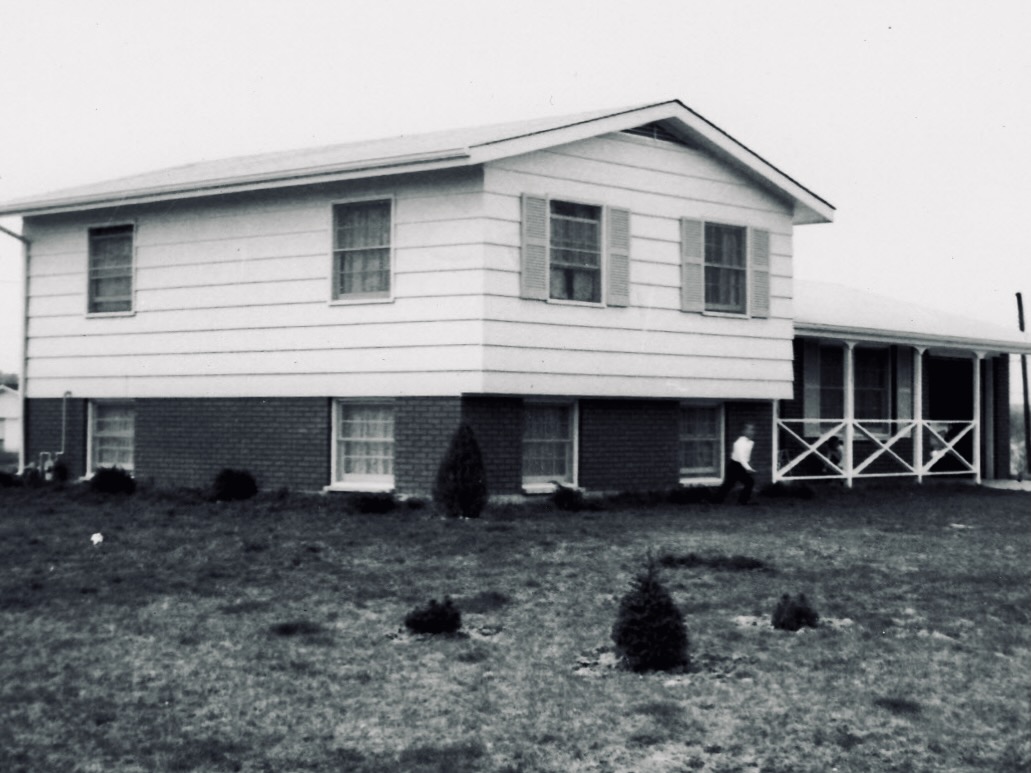

Nine Boys and a Girl
Fairview was unincorporated in the 1960s, when the Durbin family moved there from East St. Louis. There was no mayor or city hall. It was just the area on either side of a two-mile stretch of Highway 50, its eponymous name invented around 1905 by a Dr. Fairbrother, one of the first known landowners in the area.
Along those couple of miles of Highway 50 were a dozen or so houses of varying ages, side roads that went off into new subdivisions and old farms, and a handful of small businesses and whatnot. For the Durbin kids, that stretch of road—with the Fairview Beer Garden at one end and St. Albert the Great Catholic Church at the other—would be their universe for the next eleven years.
The split-level house was modern for its day. It was square and boxy and sat on the corner lot where Primrose Lane met North Point Road. The ample lot was as verdant as the lunar landscape. There was no money for grass, trees, or shrubs. Nor was there money for furnishings to fill out the larger space inside. Bill and Lorraine took care of that, in part, by pooling all the kids’ savings and using it to buy end tables and lamps. The kids were too young—or maybe just too excited about the new house—to notice their life savings had vanished.
Bill and Lorraine’s family of eight filled the new house to capacity the day they moved in. Barb got a room of her own, and Bill and Lorraine took one of the smaller bedrooms so they could pack bunk beds into the master. Three boys went in there. Dan and Steve slept on green vinyl sleeper sofas in the basement.
Later, Dan and Steve would occupy a bedroom Bill built in the basement, a cozy space that doubled as Bill’s study. The desk in there, which Bill built himself, was an ingenious thing consisting of a flat-panel door attached by its hinges horizontally to the wall, held up on either end by heavy chains.
Money was tight as ever, but life was good as this family settled into its new home in the fall of 1962. Dan, Steve, and Barb attended school at St. Albert’s Catholic School, at the intersection of Highways 50 and 159, while the three younger kids kept Lorraine busy at home.
A few years later, when the monsignor at St. Albert’s asked Bill to put more money in the collection plate, our parents realized that parochial education would have to go. They transferred their kids to Grant Elementary, the public school just a bottle-throw from the Fairview Beer Garden. Grant was located on Lincoln Trail, so named because President Abraham Lincoln once spent the night at a house across the street—or so the story went.
Bill found co-workers at ACIC to start a carpool so Lorraine could have the car a few days a week. She had dinner ready at 5:00 o’clock sharp every evening, which Bill preceded nightly with a Beefeater martini, very dry. After dinner, there were plenty of hands to clean up the kitchen in time for the fifteen-minute evening newscast on TV.
The biggest national news of 1962—maybe the biggest world news—was the Cuban Missile Crisis. From October 14, when U-2 spy plane photographs revealed the Soviets were installing nuclear-tipped missiles a short ninety miles off the coast of Florida, until October 28, when Nikita Khrushchev realized that putting atomic weapons so close to U.S. soil wasn’t such a good idea and halted the project.
Bill was even more spooked than the rest of the country, watching those newscasts in our basement. He and everyone else in the defense department were on high alert, preparing daily for the very real possibility of global nuclear war. As he came home from the office each day, those martinis tasted pretty damn good.
One evening just a few weeks after the missile crisis, shortly after Walter Cronkite ended the nightly CBS News with his famous “And that’s the way it is,” Lorraine headed upstairs to fix holes in underwear. Alone for the first time that day, opening the old fruitcake tin that held sewing supplies, she looked forward to the peace and quiet.
Those plans were soon thwarted by labor pains. She’d been through the drill and knew just what to do, and got herself calmly down the stairs to tell Bill. The kids were in front of the TV looking forward to an evening of prime-time shows—Bonanza, The Flintstones, and the brand-new Beverly Hillbillies—when Bill’s voice echoed down the stairs.
“Everyone in the car!” he yelled.
Bill put everyone in the blue Ford station wagon and soon the family of eight was off to the hospital. A few hours later, after the birth of this writer, they came home a family of nine.
In the summer of 1964, our Grandma Durbin built a house at 112 Primrose Lane, just next door to ours. It made sense she would leave East St. Louis to be closer to family. But for reasons not entirely known, Dad’s mother had not told anyone of her plans to build a house on the lot next to ours until tractors were digging the foundation. Mom and Dad scratched their heads at the news, but their kids could not have been happier that Grandma was moving next door.
We grew to a family of ten kids with the arrivals of my brothers Marty, Ken, and Dave in 1965, 1966, and 1968, respectively—Barb would be the only girl. On her doctor’s advice, Mom decided this was enough. As much as my parents’ families welcomed each new Durbin baby, they too thought ten might be enough. Mom’s dad, our Grandpa Kalish, playfully recommended the name Finneas for the final Durbin child. They stuck with Dave.
By the time of their tenth child’s arrival, a routine was well-established: On weekdays, Dad would go off to his work over in St. Louis and Mom would stay home for her work in Fairview, taking care of us kids and the house.
Saturdays were workdays. Mom would use the family car to go to the beauty parlor and then the grocery store. Dad would stay at the house and put the kids to work cleaning the house and taking care of the yard, and giving haircuts to whoever needed one.
Sundays were reserved for going to church at St. Albert’s in the morning (first for Mass, then for Sunday school, which went by the cryptic name of Confraternity of Christian Doctrine, or CCD for short), then relaxing in the afternoon and maybe having relatives over for a dinner or barbecue, complete with a big metal tub filled with beer and soda on ice.
In 1966, Dad and the older boys put a fresh coat of paint on every room in the house, and our neighbor and State Farm insurance agent Warren Baker wrote Mom and Dad a new homeowners insurance policy on the house. Just a few weeks later, I nearly burned that house down. At the age of three, I was playing with the knobs on the kitchen stove and tipped over the milk carton where Mom stored bacon grease.
Miraculously, our home was saved by a volunteer fireman who happened to be driving up North Point Road only to see a tower of black smoke pouring out our kitchen window. Mom had just put the four of us kids at home into the car in the garage when the fireman burst into the house to help Mom put it out before damage could extend past the kitchen. But the smoke damage throughout the house was extensive. Every wall had to be repainted.
The older boys got an all-expenses-paid vacation as a result of my pyromania, staying with Dad at the Trailways Motor Lodge and Restaurant on Lincoln Trail, complete with daily maid service, all-you-can-eat meals, and a different dessert every night. Mom and the rest of the kids stayed next door at Grandma Durbin’s house while our house was restored.
Ann Durbin’s house at 112 Primrose would become one of the favorite places in the world for the Durbin kids. We could always count on a homemade cookie from Grandma, or cornmeal fritter, or a spoonful of a sweet and sticky concoction she called tutti-frutti and kept in a big jar over the washing machine. A single batch would seemingly last for months—I have no idea how it didn’t go bad.
Once our bellies were full, we could sit beside Grandma on her couch in front of the TV—it was a big color TV, much nicer than the black-and-white at our house—and pretend to help her do the crossword in the daily paper, or actually help her play solitaire on a sheet of brown Masonite placed across our laps.
Another favorite destination during our time in Fairview Heights was the home of Mom’s sister, our Aunt Jackie, and her husband Richard Mahoney. Like our family, they had moved from ESL, going even farther east to the rural town of Highland, to a house on a lake—complete with horses—about an hour west of Fairview.
We would have many memorable visits to that wonderful place in Highland.


Civil Rights
When Bill and Lorraine Durbin moved their family from East St. Louis to Fairview, they were keenly aware they had joined a parade of white families fleeing Black ones.
They themselves had learned racial tolerance from the words and deeds of their own parents. As little kids, when my mom and her sister needed a babysitter while their mom went into labor to have their brother Jim, their dad invited Addie, a Black woman and family acquaintance, to stay at their house. When my dad got his first job at the New York Central Railroad, where his dad was Chief Clerk, my grandfather assigned his very best stevedore, a Black man, to be his son’s mentor.
After settling into their split-level on Primrose Lane, Mom and Dad had an idea. Maybe they could host coffees at their house, inviting their old Black neighbors from East St. Louis to sit with their new white neighbors? If families would just get to know each other, they figured, new friendships could be made to help bridge the racial divide.
After broaching the idea with a few of their neighbors, the coffee idea went cold. There was zero interest. And asking Black friends to come to Fairview could put those friends in harm’s way. The police were said to idle their cruisers at the base of the bluffs on Highway 50, watching for cars with dark-skinned occupants heading up to Fairview—cars that were promptly escorted out of town. Intimidation like this kept the number of Black visitors to Fairview at approximately zero—and, for many years, the number of Black residents at exactly zero.
As a devout Catholic and avid reader, Dad kept up with what the Pope had to say, which was quite a lot in that era of reform known as Vatican II. The 1967 papal encyclical Populorum Progressio by Pope Paul VI addressed the needs of “those who are looking for a wider share in the benefits of civilization.” Dad thought of Black people. It spoke of the Church putting herself at the service of all, and proclaiming that “solidarity in action at this turning point in human history is a matter of urgency.” To Dad it was a clarion call to get to work.
Dad had stayed in touch with Father Goldammer at St. Elizabeth’s, the East St. Louis parish he and his parents had long belonged to, and where his own kids went to school before the move to Fairview. Many priests are known for mild manners and solemnity. But this priest would turn red in the face, raging from the pulpit about the racial conflict tearing the country apart. And when my dad brought up the papal encyclical, and offered to write and give speeches to anyone who would listen, Father Goldammer was all ears. He would find my dad an audience.
So Dad gave these talks, mostly in church basements, and his speeches were well received. He put the message of Populorum Progressio into his own words that went along these lines: Violence and anger and hatred aren’t the answer. Looking past racial differences is the answer. We are all brothers and sisters of the same family, the family of God’s people. Dad felt like one of the big brothers of that family. And it felt great. He had found his cadence in the great march for civil rights.
Just as the police murder of George Floyd would ignite the flames of protest in 2020, so too did the assassination of Martin Luther King Jr. in 1968. Then, as in 2020, the battle over civil rights became an intense topic of national conversation. Which side you were on, and how vocal you were about it, could make a difference in how others—including your employer—saw you.
There was a presidential election in 1968 that turned out to be a memorable one. Although he had won by a landslide in 1964, President Lyndon Johnson, with the yoke of the Vietnam War around his neck, decided not to run for re-election. The Democratic nomination went to Vice President and former Minnesota Senator Hubert Humphrey. Our family liked this guy a lot. Nicknamed the Happy Warrior, this architect of the Peace Corps, before becoming Johnson’s VP, had been the Democratic Whip in the U.S. Senate (a position Senator Dick Durbin, Dad’s brother, would hold starting in 2005).
Johnson’s withdrawal from the race also opened the door for the reincarnation of Richard Nixon’s political life after having lost the race for president to John F. Kennedy in 1960. He won the 1968 Republican nomination. Unlike most presidential races, this one featured a viable third-party candidate in the segregationist George Wallace. He ran as an independent. Most people wrote off the Alabama governor as an avowed racist, given his attempts to block Black children from entering newly integrated schools.
In a mock election at Grant School, the Durbin kids old enough to participate all voted for Hubert Humphrey. They were promptly labeled “n-word lovers” by their classmates. And on the big sign at the front of our South Bountiful Heights subdivision, someone used Wallace bumper stickers to rename it “Wallace Heights.”
“Don’t worry,” Mom assured all her kids at home. “If George Wallace becomes president, then we’re all moving to Canada. Or maybe New Zealand.”
Some of our neighbors made a point of letting us know how they felt about our views. One morning we found our house had been egged and spray-painted. The twisting patterns were all over our fake window shutters and front porch railings. Dad decided not to let it bother him, and to let the vandals know of his defiance by keeping those shutters and porch rails just the way they were.
He responded differently to the next message that came our way. Some “yahoos,” as Dad called them, began driving their cars across our yard at night, leaving deep trenches in the grass. He drove a bunch of us down to the nearby Haydite mines, where cinder blocks were made. There, we loaded our Ford station wagon with massive, fossil-laden stones. It’s a miracle the car’s suspension didn’t snap on the drive home. Sparks flew from the bottom of our lumbering car as it scraped the asphalt of Old Lincoln Trail. We put those stones along the curb of the house, and the yahoos never came back.
Meanwhile, Dad got pretty good at giving those speeches and his words were mostly well received. When he spoke of church leaders having a responsibility in the matter of racial justice, however, word got back to his new church, St. Albert’s in Fairview. And he got a message from fellow members of the Diocesan Council of Catholic Men. They took him aside one night after a meeting.
The head priest at St. Albert’s and even the local bishop, they told him, thought Bill Durbin was being arrogant. His DCC buddies asked him to stop giving speeches. Knowing he was being heard by Church leadership only made my dad want to speak out more. He felt he was accomplishing something good, and told these guys. They weren’t going to shut him up. But something else soon would.
One night, as Dad entered the basement of St. Joseph’s Church to give a speech, he saw something he hadn’t seen at one of these events before: a film crew. And beside them, some colleagues from the Aeronautical Charts and Information Center, or ACIC, the Defense Department agency in St. Louis where Dad worked. He wondered what the hell was going on.
Dad’s speech was preceded by one from another activist priest, Father Geneseo, who was himself on thin ice with Church leadership. But the crew didn’t film him. They waited for Dad. When he approached the pulpit, they turned on their lights and raised a microphone as the film camera started to whir. When he was done, the crew packed up and left. They didn’t stay for the next speaker. They were only there to film Bill Durbin.
This made all kinds of questions go through our dad’s head: Who brought the film crew? What kind of word would go back to his supervisors? Would they make some kind of report to the government investigators who kept an eye on the personal lives of the men working on their secret projects making maps for the military? Would he have some explaining to do when he was next up for promotion? Would he even be up for promotion? He decided not to find out. The possible answers to any of these questions were too painful to bear.
Until that night at St. Joseph’s, Bill Durbin hadn’t thought anyone at ACIC would care what he spoke about, as long as he wasn’t revealing classified information, which of course he never did. He was making a steady income for the first time in his life, serving as a diligent civil servant in the midst of the Cold War. It had been years since he or Mom went to relatives to borrow a few dollars until payday. But now, with the government apparently recording his activities, he felt that meager financial security was at risk.
Dad told Father Goldammer there would be no more speeches. He also called up the head of the Diocesan Council of Catholic Men to tell him he had reconsidered their advice. They didn’t have to worry anymore, Dad told the guy, because there would be no more speeches. The guy thanked him.
Then he quit the Diocesan Council of Catholic Men and, keeping his word, stopped giving speeches. And, at last, he painted those shutters on our front windows. The march for civil rights would have to continue without Bill Durbin, at least outside the house. But the education of his children would continue. And it included one field trip some of us will never forget.
Although typically considered a northern state, the longitudinal expanse of Illinois puts it in both the North and South. For the better part of the twentieth century, while the progressive metropolis of Chicago at its northern edge was chock-full of racially tolerant whites, the little town of Cairo at the other end had scant few. Pronounced KAY-ro like the syrup (not KY-ro like its namesake city in Egypt), things happened in that Illinois town that one might think in those days only happened in places like Alabama or Mississippi.
According to newspaper accounts, in July 1967, nineteen-year-old Private Robert Hunt, a Black soldier home on leave in Cairo, was stopped by the police for a malfunctioning taillight. A few hours later he was dead. His battered body lay crumpled on the floor of a holding cell in the police station, where the cops later told the FBI the disturbed AWOL had hung himself with his T-shirt.
The FBI agreed and decided not to investigate, despite the bruises, despite no indication Private Hunt was AWOL, and despite a mesh ceiling on the holding cell that could not possibly hold the weight of a grown man. In any earlier year, things might have ended there. But this was 1967. This time the Black community rose up in anger. They smashed windows, burned buildings to the ground, and vowed to continue until things changed.
A few years later, when Bill Durbin drove a station wagon full of us kids past the cotton fields on its outskirts and into the town of Cairo, things hadn’t changed much. White residents had formed a group known as the White Hats, for the white construction helmets they wore while patrolling the city. White civil rights activists joined up with the NAACP and local Black residents to form the Cairo United Front. One of those activists was Father Bernard Bodewes, once a priest at St. Albert’s in Fairview who had relocated to Cairo to join the battle.
Dad had called Father Bodewes and asked to bring his kids down for a visit. Dad wanted us to see firsthand that some of the riots and violence we’d read about in the papers and seen on TV happened just a few hours’ drive from where we lived.
Father Bodewes pointed to the wall of his dining room. “See those holes? Who wants to look through and tell me what they see?”
We took turns peering through some of the half dozen or so holes in the wall, each big enough to slide a hot dog through. “I see a flagpole,” I said as I peered outside and felt a slight wind on my face coming through the hole.
“That’s the police station,” said Father Bodewes.
As it dawned on us these holes were from bullets fired from the direction of the police station—maybe by police themselves—Dad suggested we move away from the wall and into the living room. There, Father Bodewes shared some of what was going on in Cairo. The younger of us kids didn’t follow all of it, but we could tell Dad really thought the world of this guy. Dad might have stopped speaking out himself on behalf of civil rights, but I think he wanted us to know someone who was still speaking. At least for the time being.
Father Bodewes was booted from the Catholic Church in 1971. His excommunication was ostensibly the result of his taking the diocese to court in an attempt to restore his paycheck. The Church hadn’t paid his $700 monthly salary in nearly a year, cutting him off when he refused to break with the Cairo United Front. Apparently, these disciples of Jesus Christ were unimpressed by a priest literally putting his life on the line in the service of people in need. Bernard Bodewes died in 2013.
On the way out of Cairo, Dad drove us through parts of town that by comparison made East St. Louis look good. The streets were nearly deserted, and it looked like the trash hadn’t been picked up in years. Dad slowed down as we passed the remains of buildings that had been burned down. Some were nothing but charred woodpiles, or brick boxes with no tops and filled with blackened debris. The half dozen Durbin kids packed into the car didn’t have much to say.
The long drive home was a quiet one.
In later years, recalling these experiences, Mom summed things up. “Some people just need other people to look down on,” she said. She remembers exactly where the so-called color lines of East St. Louis were drawn—Blacks had to stay south of Louisiana Boulevard, Latinos in Washington Park—and laments that we’re still struggling with such things. She ended by quoting Eleanor Roosevelt: “The worst four-letter word we have is hate,” she said.

Off to Washington
By 1973 Bill Durbin had climbed the ladder at ACIC about as far as he expected he ever could, mastering the promotion system there, and every couple of years would rise from his initial rank of GS-4 to GS-15. In the early part of 1973, he spent several weeks on an extended trip to Washington, DC, where he helped with the continuing transition of the Aeronautical Chart and Information Center into the Defense Mapping Agency, or DMA.
Dad came home from that trip with unbelievable news: The DMA wanted him to relocate to Washington, DC. When he came home from a later house-hunting trip, he sat on the stairs describing our new house with so much detail and elaboration (“The basement has an unfinished area we can turn into anything we want!”) we pictured a mansion.
Bill Durbin would be the last of the kids of Ann Durbin, our Grandma Durbin, to move away from the East St. Louis area. Her son Bob had moved to California years before, so we didn’t see much of him during the Fairview years.
Her son Dick Durbin (he was no longer going by Joe) had moved away too. He and his wife Loretta lived a couple of hours north in Springfield, the Illinois state capital, where he worked in politics.
Dick was a lawyer for Paul Simon—the lieutenant governor with the deep voice and bow tie, not the famous singer. He knew all about Washington because he had already lived there, when he was a student at Georgetown University and worked for Senator Paul Douglas of Illinois.
On the morning of our flight in August 1973, our Aunt Jackie and Grandma Durbin drove us to Lambert Field in St. Louis. Stepping aboard the TWA jetliner just behind Mom, most of us got our first glimpse of the inside of a plane. Dad wasn’t with us because he and my brother Ed were driving the family Ford—now a sporty, powder-blue Gran Torino, the first car Mom and Dad had ever bought new, and a recent and somewhat impractical upgrade from the usual station wagon—out to Maryland.
The size of our house in Kensington, at 10003 Thornwood Road in the Parkwood subdivision, did not quite live up to expectations. Our family of twelve was moving into a house perfectly sized for a family of four. Soon there would be ten people sleeping in that house every night. When Dan and Steve came home for summer from Chicago, where each had already started college, it grew to twelve. When Grandma Durbin visited, thirteen.
Mom and Dad had simply bought their retirement house a few decades early, figuring every couple of years a kid would move out and free up space. Barb was just out of high school when we moved to Maryland, and it wasn’t long before she moved into an apartment with some friends to start her adult life. That left seven Durbin kids at home: Bob, Ed, Bill, Mike, Marty, Ken, and Dave.
Then as now, real estate was far more expensive in the Washington, DC, area than in southern Illinois, so it’s no surprise our new house was smaller. Mom and Dad could have more easily afforded a larger house in a distant suburb, but they wanted us to be in Montgomery County. It was close to all the Washington sites and had some of the best public schools in the country, so they stretched their dollars to put us there.
A house in Virginia was out. After crossing the Mississippi River to get to work all those years back in Illinois, Dad didn’t want to have to cross the Potomac to get to the U.S. Naval Observatory, where DMA was located, from a house in Virginia.
As it turned out, Dad would in fact drive across the Potomac all the time to get to work, though we didn’t know it at the time. His job regularly took him to CIA headquarters in Langley, Virginia, hidden in earlier years behind a sign on the GW Parkway for the “Fairbanks Highway Research Station.” As did the ACIC in St. Louis, the DMA did top-secret stuff in Washington, so none of us, including Mom, had a clue what he did at work.

Kensington
As this family settled into life in Kensington, church remained important to Dad. Everyone living at home attended Holy Redeemer Catholic Church, about a mile away on Saul Road. Attendance was one of the few basic conditions of living under Mom and Dad’s roof: no skateboards, no motorcycles, no dogs, and everyone goes to Mass on Sunday.
Money was tight as Mom and Dad adjusted to living in an affluent suburb of Washington, DC, on a civil servant’s wages. With no nearby family, they had to figure things out on their own. Once, when there was no money for groceries and Dad’s next paycheck was several days away, they raised a quick $40 by selling their high school graduation rings to a nearby jewelry shop. As kids we never knew our next few meals came at the cost of Mom and Dad’s high school mementos.
Fortunately, there were plenty of free things for a family to do. Dad organized countless budget-friendly excursions to explore the Washington area. An early favorite was the Billy Goat Trail along the Potomac River. He took us downtown many times to see the memorials and other sites on the Mall. In those days before the Metro subway was an option, we could take an L2, L4, or L6 bus that ran down Connecticut Avenue from Kensington to Federal Plaza in DC, a big open parking lot a few blocks from the White House where most of the buses into Washington ended their trips before turning around. The fare was forty cents: one quarter, one dime, one nickel.
Our proximity to Washington, DC, was one of the very best things about moving to Maryland. We could join the crowds at presidential inaugurations, traipse through the Capitol and congressional office buildings, and attend as many of the free Smithsonian museums as we wanted.
We were also close to significant historical events. Watergate remained the biggest news story after we moved to DC, ending with Richard Nixon resigning the presidency in August of 1974. We watched that live on the TV in our basement, alongside some members of the Sullivan family, longtime friends of Mom and Dad who were then visiting from Fairview.
At the end of the Iran hostage crisis in 1981, when the hostages were freed just after Ronald Reagan was sworn in as president, I organized a few friends to paint a huge sign on the green Metro construction fence on Wisconsin Avenue just across from the Naval Hospital where I believed they were being taken. “Welcome Home 52 Freed Americans!” it said.
One morning in the 1970s, well before dawn, Mom woke up the four youngest of us kids with the unbelievable news: we were going to the beach. A few hours later we had our first glimpse of an ocean, at a free public beach in Delaware, where we broiled on a blanket and dashed in and out of the surf.
A year or two later Dad and Uncle Dick started a tradition that would live on for decades. They rented a house on a beach in South Carolina, at Edisto Beach. It was a mostly awful place with so many biting flies and thorn bushes on the beach we spent much of the two weeks inside the dismal house. The next trip was to a nicer house on the Outer Banks of North Carolina, and we’d soon go there nearly every year, to Nags Head, Duck, or Corolla.
The Durbin kids in Kensington went mostly to three different schools in Maryland. Parkwood Elementary School, for grades K–6, was just a few blocks from our house on Thornwood Road, so my younger brothers and I could easily walk there. Parkwood was also our local polling place. Mom served as an election judge there, steadfastly representing the Democratic Party for the next two decades, never missing an election.
For grades 7–9 some of us went to Kensington Junior High. KJH was a longer walk from our house than to Parkwood, down Everett Street and across Connecticut Avenue. Ken and Dave went to different junior high schools (now called middle schools) after KJH was closed.
Each of us from Bob on down—seven Durbin kids in total—attended Walter Johnson High School. It was not in Kensington but in Bethesda, near Montgomery Mall, so it took a car or bus to get there. Walter Johnson was named for a famous pitcher from the Washington Senators baseball team. His home was (and remains) standing a couple of miles away, where Old Georgetown Road meets Cedar Lane.
All seven of us at WJ played a musical instrument in the school band under the direction of the venerable Gilbert Muir. Mom would organize the Friday night potluck suppers for the annual band exchange with other East Coast high schools. She also worked on the school’s PTSA newsletter, The Big Train (Walter Johnson’s nickname).
In 1977, Mom and Dad celebrated their twenty-fifth wedding anniversary with a trip to Europe—their first ever. We kids gave Mom an opal necklace. Dad got a brand-new Fujica SLR camera with a detachable lens. I can still recall his disbelief as he opened the box.
That camera was never lost. And it never ran out of film before it was meant to.
Over the years in Kensington, Dad would be promoted a number of times for his excellent performance at work (whatever it was he did there), and his government pay went up a little bit each time. None of the raises were substantial, but with fewer mouths to feed as Durbin kids moved out, he and Mom could eventually save for retirement and even go out once in a while for an evening meal. In the 1980s, there was one place they went out to more than any other.
Ireland’s Four Provinces was an Irish pub and restaurant on Connecticut Avenue in the Cleveland Park neighborhood of Washington, DC. Opened in the late 1970s by the Irish immigrant Kevin Finney, “the 4Ps” featured nightly music, regulation dart boards, and reasonably priced beer and pub food. It was at the end of a couple of blocks that also included the Yenching Palace, a Chinese restaurant where secret negotiations to end the 1962 Cuban Missile Crisis had been held, and the Uptown Theater, a classic movie palace built in 1936, which for decades had the largest movie screen in the city.
Family members frequented all three of those DC landmarks, none of which remains open today, but nothing brought more joy to Mom and Dad (and income for at least five of the ten Durbin kids who worked there at one time or another) than the 4Ps. Mom and Dad made countless trips there, inviting along anyone who wished to join them, where Mom especially enjoyed their Irish Coffee and Dad their corned beef and cabbage. And everyone loved the music at the 4Ps, memorizing songs like The Unicorn Song, whose lyrics remain with me to this day. There were green alligators, and long-necked geese…
Owner Kevin Finney once remarked that he should rename his pub. “It should be called the 4Ds,” he told my brother Ken. “Because there’s always four Durbins in here.”

The Last Stop
Bill Durbin retired from the Defense Mapping Agency in 1986. He then did some consulting work, dove deep into family history research, cooked meals and baked bread for family gatherings, and began taking long walks with Mom in nearby Rock Creek Park. On one of those hikes, he felt some chest pain. This led first to an angioplasty procedure to open up narrowing blood vessels, and eventually to heart bypass surgery.
Owing to a family history of heart disease, and a Depression-era diet that did not include an abundance of heart-healthy foods, we lost Dad to a heart attack in February 2001. Although his health issues had been mounting, losing him at the age of seventy-one was still a shock. It deprived many future Durbins and spouses of ever getting to meet Bill Durbin, just as his own dad’s passing at the age of fifty-three deprived so many of us from ever meeting our paternal grandfather.
After Dad’s passing, some of the ten kids remained in Maryland to make homes and start families of their own. Some had already relocated to other states. At one time or another, Bill and Lorraine’s children could be found raising families in Maryland, Illinois, Indiana, Texas, Pennsylvania, Virginia, and North Carolina.
In 2005, Mom sold the house on Thornwood Road (for more than ten times the $43,000 she and Dad paid for it in 1973) and moved into apartment 912 on the top floor of the Kensington House apartment building. Her unit was in the back, looking out over the town railroad tracks. The roar of passing trains—exceeding ninety decibels when the windows were open—alarmed visitors but did not bother Mom one bit. It just reminded her of East St. Louis, she said.
Around this time, Lorraine Durbin found a wonderful traveling companion in Bob Schaeffer, a friend from her high school graduation class. With their shared ESL roots and passion for seeing the world, they got along wonderfully. Bob died of cancer in 2010.
Mom lived in the Kensington House for fourteen years. In 2018, she moved into an apartment with her daughter Barb and Barb’s husband Max in the Avalon apartments in nearby Rockville. Two years later they moved to an apartment in Waldorf, Maryland, to be closer to Barb’s children and grandchildren, then later to a house in the nearby town of La Plata.
Like everyone else on Earth, our family spent most of 2020 in our homes due to the COVID-19 global pandemic, the deadliest since the Spanish Flu pandemic a century earlier. Offices, restaurants, movie theaters, and all other such gathering places closed. We went to grocery stores wearing masks and otherwise stayed home. The planned 2020 Thanksgiving gathering at the Outer Banks was canceled. A videoconferencing service called Zoom—previously known by few—became a household word. It wasn’t the same as gathering in person, but it was all we had.
When vaccines became available in early 2021—no vaccine had ever been developed so quickly—we got them as soon as we could. By the end of 2021 we had begun returning to offices, restaurants, and movie theaters, and our family booked a house on the Outer Banks for Thanksgiving. Few family gatherings had ever been so anticipated.
In 2023, Lorraine Durbin held her ninth great-grandchild in her arms. She had already welcomed twenty-three grandchildren into this world. Mom could by then count forty-two direct descendants, each of whom could trace their existence to one afternoon in East St. Louis in 1949, when a young sailor named Bill Durbin went to Jimmy’s Malt Shop in search of a date for the Easter Dance.
In 2024, after six years away from Kensington, Mom, at age ninety, decided she wanted to return there for “her last stop,” as she called it. The metaphor was appropriate. The Modena Reserve assisted living facility is on the town railroad tracks, barely a mile from where she had lived all those years in the Kensington House. She moved to the Modena in January 2025. When a train roars by, conversation pauses. And Mom smiles. “It makes me think of East St. Louis,” she says.
On my first visit a few weeks after Mom moved to the Modena, she surprised me not at all by sharing that she had already met more than fifty new friends. Confined to a wheelchair, on every visit to the dining room she would roll herself up to a table and introduce herself with a smile. Her new friends and staff soon gave her a nickname: Scooter.
Mom could not be happier at this place, her last stop on a journey lasting now more than nine decades. Nor, despite all she has experienced in this life, could she be more eager to learn new things about her home and neighbors.
“Mike, those are my secrets to life,” she told me. “Joy and curiosity. They get me through every day.”
When it comes to words to live by, one would be hard-pressed to find any wiser than those.

Timeline
1600s
1610s
- 1619 The ship The White Lion brings the first of enslaved Africans to Virginia
- 1619 The House of Burgesses is established in Jamestown, Virgina, introducing representative self-governance to the colonies
1660s
- ~1663 William Logsdon born in Bedfordshire, England
1680s
- ~1681 Honor O’Flynn born in Ireland
1700s
1700s
- ~1702 *** William Logsdon and Honor O’Flynn marry in Maryland
- 1703 Ann Logsdon born to William & Honor Logsdon in Westminster, Maryland
- 1705 William J Logsdon II born to William & Honor Logsdon in Baltimore, Maryland
1710s
- ~1710 Ann Davis born in Baltimore , Maryland
1720s
- 1723 *** Samuel Durbin and Ann Logsdon marry in Baltimore, Maryland
1740s
- 1741 Christopher Durbin born to Samuel & Ann Durbin in Baltimore, Maryland
- ~1742 Honor (O’Flynn) Logsdon dies in Maryland
- ~1745 William J Logsdon II dies in Baltimore, Maryland
- ~1745 Elisha Logsdon born to William J & Ann Logsdon in Westminster, Maryland
- 1748 Rebecca Howard born in Maryland
- 1749 Margaret Braun born in Fredrick, Maryland
1730s
- ~1730 *** William J Logsdon II and Ann Davis marry in Maryland
- ~1736 William Logsdon dies in Maryland
1750s
- 1754 Ann Davis dies in Maryland
1770s
- 1770 Ann (Logsdon) Durbin dies in Frederick, Maryland
- 1771 Patience Logsdon born to Elisha & Rebecca Logsdon in Kentucky or Maryland
- 1775 The American Revolutionary War commences with the Battles of Lexington and Concord
- 1776 The Declaration of Independence is signed in Philadelphia, breaking ties with Great Britain and marking the birth of the United States
1760s
- ~1763 *** Christopher Durbin marries Margaret Braun
- ~1764 *** Elisha Logsdon marries Rebecca Howard
- 1769 (or 1772) John J Durbin born to Christopher & Margaret Durbin in Maryland
1780s
- Christopher & Margaret Durbin move their family from Maryland to Kentucky, year unknown
- Elisha & Rebecca Logsdon move their family from Maryland to Kentucky, year unknown
- 1783 The American Revolutionary War concludes with the Signing of the Treaty of Paris
- 1789 The US government begins operation following ratification of the US Constitution
- 1789 George Washington inaugurated as first president of the United States
1790s
- 1793 *** John J Durbin (son of Christopher & Margaret Durbin) marries second cousin Patience Logsdon (daughter of Elisha & Rebecca Logsdon) in Madison County, Kentucky
- 1798 Rebecca (Howard) Durbin dies in Kentucky
1800s
1810s
- 1812 The War of 1812 commences with the US formal declaration of war against Great Britain
- 1812 Robert Anselm Durbin born to John J & Patience Durbin in Madison, Kentucky
- 1815 The War of 1812 concludes with the US ratification of the Treaty of Ghent following the Battle of New Orleans
- ~1815 Elisha Logsdon dies in Madison County, Kentucky
- 1817 Elizabeth Ann Hill born in Edmonson County, Kentucky
1820s
- ~1820 William Gaul Sr born in County Kilkenny, Ireland
- 1825 Christopher Durbin dies in Boonesborough, Kentucky
1830s
- c1830 Bridget Leahy born in County Kilkenny, Ireland
- 1833 *** Robert Durbin and Elizabeth Ann Hill marry in Madison County, Kentucky
1840s
- 1842 *** William Gual and Bridget Leahy marry in Ireland
- 1843 William “Billy” Gaul Jr born to William & Bridget Gaul in Ireland
- 1846 Start of the Mexican-American War
- 1847 Pius Anselm Durbin born to Robert & Elizabeth Ann Durbin in Edmonson County, Kentucky
- 1848 Patience (Logsdon) Durbin dies in Sunfish, Kentucky
- 1848 William Gaul Sr dies in Jerseyville, IL
- 1848 The Mexican-American War concludes with the signing of the Treaty of Guadalupe Hidalgo and US acquisition by force of several states including Texas, New Mexico, and California
1850s
- ~1850 Fleeing the Great Potato Famine, William Gaul Sr immigrates from Ireland to Jerseyville, IL
- ~1851 Bridget (Leahy) Gaul, William’s wife, immigrates from Ireland with son William “Billy” Gaul Jr, daughter Helen Marie Gaul, and newborn John Gaul to Jerseyville, IL
- ~1853 William Gaul Sr dies
- ~1853 William “Billy” Gaul Jr goes to live as farmhand with William Massey
- ~1855 Elizabeth Ann (Hill) Durbin dies in Lawrence County, IL
- 1858 John J Durbin dies in Sunfish, Kentucky
- 1858 Teresa Burtle born in Sangamon County, IL
1860s
- 1861 The Civil War begins after the Confederate attack on Fort Sumter
- 1861 Billy Gaul enlists in the Union Army, mustering in at the fairgrounds in Carrolton, IL
- 1861 Stefan Kalis (later Kalish) born in 1861 in Austria-Hungary (now Slovakia)
- 1862 Bill Gaul survives one of the first major battles of the Civil war in Shiloh, TN
- 1863 Bridget (Leahy) “Fanny” Gaul remarries, to Dennis Hennessy, in IL
- 1865 The Civil War concludes with the surrender of Robert E Lee at Appomatox
- 1865 Billy Gaul comes home to Jerseyville, IL, after serving the entirety of the Civil War
- 1867 Leonard Krokvica born in Austria-Hungary
- 1869 *** Billy Gual and Marry Cummings marry in Jerseyville, IL
- 1869 Katarina Jurda born in Austria-Hungary
- 1870 John Gaul born to Billy & Mary Gaul in Jerseyville, IL and dies
1870s
- 1870 Mary Nemec born in Austria-Hungary
- 1870 Delia Gaul born to Billy & Mary Gaul in Jerseyville, IL
- 1870 Pius Anselm Durbin marries Elizabeth Burtle in Sangamon County, IL
- 1872 Mary “Mame” Gaul born to Billy & Mary Gaul in Jerseyville, IL
- 1873 William Gaul Jr born to Billy & Mary Gaul in Jerseyville, IL
- 1873 Marcele Sarockaite born to Andriejus Sarocka and Leokadija Sarockiene in Lithuania
- 1873 Pius Anselm & Elizabeth Durbin relocate family from Illinois to Kansas
- 1875 Ellen “Nell” Gaul born to Billy & Mary Gaul in Jerseyville, IL
- 1876 Rokas Kutka (later Robert Kutkin) born to Egnotz Kutka and Mary (Rupkas) Kutka in Lithuania
- 1877 Patrick Henry Gaul born to Billy & Mary Gaul in Jerseyville, IL
- 1879 Peter C Gaul born to Billy & Mary Gaul in Jerseyville, IL
- 1879 Elizabeth (Burtle) Durbin dies in Kansas
1880s
- 1880 *** Pius Anselm Durbin and Teresa Burtle (sister to Elizabeth) marry in Sangamon County, IL before returning to Kansas
- 1881 William Oscar “Pa” Durbin born to Pius Anselm & Teresa Burtle in Dickinson County, KS
- 1881 John Gaul born to Billy & Mary Gaul in Jerseyville, IL
- 1881 Adam Malec born to John Malec & Sophia (Rzaczelko) Malec in the Galicia region of Austria-Hungary
- ~1882 Billy & Mary Gaul move family from Jerseyville, IL to Monmouth, IL
- 1882 Pius Anselm & Teresa Durbin relocate from Kansas to Missouri
- 1883 Margaret “Ma” Gaul born to Billy & Mary Gaul in Monmouth, IL
- 1885 Lawrence Gaul born to Billy & Mary Gaul in Monmouth, IL
- ~1886 Billy & Mary Gaul move family from Monmouth, IL to Dahlgren, IL
- 1886 *** Stefan Kalis (later Kalish) and Katarina Jurda marry in Austria-Hungary
- 1886 Annie Kalis (later Kalish) born to Stefan & Katarina Kalis in Austria-Hungary
- 1887 Kathryn Gaul born to Billy & Mary Gaul in Dahlgren, IL
- Julia Walczak born in the Galicia region of Austria-Hungary
- 1888 Ludwich Kalis (later Louis Kalish) born to Stefan & Katarina Kalis in Austria-Hungary
- 1889 Josephine “Josie” Gaul (aka Johanna) born to Billy & Mary Gaul in Dahlgren, IL
1890s
- ~1890 Pius Anselm & Teresa Durbin relocate family, including William Oscar Durbin, from Missouri to Dahlgren, IL
- 1892 *** Leonard Krokvica marries Mary Nemec in Austria-Hungary
- 1892 Robert Anselm Durbin dies in Newton, IL
- 1892 Mary Kalish born to Stefan & Katarina Kalish in Austria-Hungary
- 1894 Mike Kalish born to Stefan & Katarina Kalish in Austria-Hungary
- 1894 Anna Krokvica born to Leonard & Mary Krokvica in Austria-Hungary
- 1897 Josephine “Josie” Gaul (aka Johanna) dies in Dahlgren, IL at age 8
- 1897 (or 1901) Joe Kalish born to Stefan & Katarina Kalish in Austria-Hungary
- 1898 The Spanish-American War begins in April with the US blockade of Cuba, and ends in December with the signing of the Treaty of Paris.
- ~1899 Josephine Krokvica born to Leonard & Marie Krokvica in Austria-Hungary
1900s
1900s
- 1900 Steve Walko Sr born in Austria-Hungary
- 1901 Zeigler, IL founded by multi-millionaire Joseph Leiter where he opens a coal-mining operation
- 1902 Mildred Kalish, aka Mika and Emma, born to Stefan & Kata Kalis (later Kalish) in Austria-Hungary
- 1902 *** William Oscar “Pa” Durbin marries Margaret “Ma” Gaul in Dahlgren, IL
- 1902 Bridget (Leahy)(Gaul) “Fanny” Hennessy dies in Dahlgren, IL
- ~1903 An unnamed child born to William Oscar & Margaret Durbin in Dahlgren, IL and dies
- 1903 Annie Kalish, daughter of Stefan and Kata Kalish, arrives in ESL from Austria-Hungary
- 1904 Louis Kalish, son of Stefan and Kata Kalish, arrives in ESL from Austria-Hungary
- 1904 Helen Durbin born to William Oscar & Margaret Durbin in Dahlgren, IL
- 1905 Helen Durbin dies in Dahlgren, IL
- 1905 *** Adam Malec marries Julia Walczak in ESL
- 1905 *** Rokas Kutka (later Robert Kutkin) and Marcele Saockaite marry in 1905 in Lithuania
- 1906 John Malec born to Adam & Julia Malec in ESL
- 1906 William Durbin Sr born to William Oscar & Margaret Durbin in Dahlgren, IL
- 1906 Stefan and Kata Kalish arrive in ESL from Austria-Hungary with children Mary, Mike, Joe, and Mildred
- 1906 Annie Kalish marries Frank Stengel Sr in ESL
- 1906 Frank Stengel Jr born to Frank and Annie (Kalish) Stengel
- Fay Malec born to Adam & Julia Malec in ESL
- 1908 Charles “Charlie” Stengel born to Frank and Annie (Kalish) Stengel
- 1908 Margaret Durbin born to William Oscar & Margaret Durbin in Dahlgren, IL
- 1909 Martin Malec born to Adam & Julia Malec in ESL
- 1909 Pius Anselm Durbin dies in Dahlgren, IL
- 1909 Ona Kutkaite (later Ann Kutkin) born to Rokus Kutka (later Robert Kutkin) and Marcele (Sarockaite) Kutka in Lithuania
- 1909 Mary Krokvica born to Leonard & Marie Krokvica in ESL
1910s
- 1910 Margaret Durbin dies in Dahlgren, IL at age 2
- 1910 *** Louis Kalish marries Anna Krokvica in ESL
- 1910 Meri Kalish born to Louis and Anna Kalish in ESL and dies at birth
- 1910 Franz Kavalier marries Mary Kalish in ESL
- ~1910 Rokus Kutka (later Robert Kutkn) arrives in ESL from Lithuania
- 1911 Marcele Kutka (later Kutkin) arrives in ESL with 2yo daughter Ona Kutka (later Anna Kutkin) and her half-siblings Leo Thomas Davlanski (later Davlan) and Della Davlanski (later Davlan)
- ~1912 William Oscar & Margaret Durbin move family from Dahlgren, IL to ESL
- 1912 Frank Kavalier born in ESL to Franz Kavalier and Mary (Kalish) Kavalier
- 1912 James “Jimmy” Kalish born in Oklahoma City to Louis and Anna Kalish
- 1912 Stefan & Kata Kalish leave ESL to return to Austria-Hungary with daughter Mildred
- 1912 Louise Lenora Kutkin born to Robert & Marcele Kutkin in ESL
- 1912 Angie Malec born to Adam & Julia Malec in ESL
- 1913 Franz & Mary Kavalier travel to Austria-Hungary from ESL with infant son Frank
- ~1913 Louis & Anna Kalish return to ESL from Oklahoma
- ~1913 Mike Kalish marries Millie Roach
- 1914 Louis Kalish Jr born in ESL to Mike Kalish and Millie (Roach) Kalish
- 1914 Bernice Malec born to Adam & Julia Malec in ESL
- 1915 Louise Lorena Kutkin dies in ESL at age 3
- 1916 John Owen Durbin born to William Oscar & Margaret Durbin in ESL
- 1916 *** Steve Walko Sr marries Josephine “Josie” Krokvica
- ~1916 Joe Kalish starts taxi service between ESL and Zeigler
- 1917 US involvement in World War I begins with formal declaration of war on Germany
- 1918 World War I concludes with signing of the Armistice
- 1918 Mary Catherine Durbin born to William Oscar & Margaret Durbin in ESL
- 1918 Louis Kalish buys boardinghouse in Zeigler
- 1918 Steve Walko Jr born to Steve & Josephine Walko in ESL
- 1919 Mike Kalish Jr born to Mike and Millie (Roach) Kalish
- 1919 Joe Kalish marries Leah Brown in Benton, IL
- ~1919 Leo Davlan marries Marie _____
1920s
- 1920 Prohibition goes into effect following ratification of the 18th Amendment, banning the manufacture, sale, and transportation of alcohol in the US
- 1920 Ed Walko born to Steve & Josephine Walko in ESL
- ~1920 Steve and Josie Walko move from ESL to Zeigler
- ~1920 Leonard and Marie Krokvica move from ESL to Zeigler
- ~1920 Millie (Roach) Kalish dies
- 1920 Mike Kalish marries Rose Heisler
- 1921 James Kalish earns school award in Zeigler
- 1921 Violet Kalish born to Mike and Rose (Heisler) Kalish
- 1921 Stefan and Kata Kalish arrive in ESL from Austria-Hungary a second time with daughter Mildred
- 1921 Kata Kalish dies in ESL
- ~1921 Stefan Kalish goes back to Austria-Hungary
- ~1921 Louis and Anna Kalish move back to ESL from Zeigler with son James Kalish
- 1921 Leo Bernard Davlan born to Leo and Marie Davlan
- ~1922 Louis Kalish buys Savoy Hotel in ESL
- 1922 William Durbin Sr starts working at Pennsylvania Railroad in ESL. Later works for New York Central, rising to position of Chief Clerk
- 1922 Rudolph “Rudy Junior” Lenz born to Rudy and Della (Davlan) Lenz
- ~1923 Franz Kavalier, Mary Kavalier, and son Frank return from Europe
- 1923 Louis Kalish pays off mortgage on Zeigler property
- 1924 Dorothy Walko born to Steve & Josie Walko in Zeigler
- 1924 Mary Darlene Davlan born to Leo and Marie Davlan
- 1925 Stefan Kalish dies in Austria-Hungary
- 1926 Louis Kalish dies in ESL
- 1927 Anna Kalish dies in ESL
- ~1927 Walko family returns to ESL from Zeigler to run Savoy Hotel with Joe Kalish
- ~1927 Walko family moves into house with kids and James Kalish across from Jones Park in ESL
- ~1927 Leonard and Marie Krokvica return to ESL from Zeigler
- 1927 Joe Kalish marries Goldie Elliot
- 1927 Ralph Lenz born to Rudy & Della (Davlan) Lenz
- 1928 *** William Durbin Sr marries Anna Kutkin in ESL
- 1928 Mike Kalish goes to prison after bond client skips bail. His son Louis Kalish begins career in gambling at casino outside ESL
- 1929 Steve Walko Sr loses everything gambling. The Walko family with James Kalish moves into the Savoy Hotel
- 1929 Billy Gaul dies in Illinois
- 1929 William Durbin Jr born to William & Ann Durbin in ESL
- 1929 Fay Malec marries Joseph Przybilski
- 1929 Dorothy Jean Davlan born to Leo and Marie Davlan
- ~1929 Dolores Davlan born to Rudy & Della (Davlan) Lenz
1930s
- 1930 Marcele Kutkin dies in ESL at age 57
- 1930 Mary (Cummings) Gaul dies in Dahlgren, IL
- 1931 Robert Emmet Durbin born to William & Ann Durbin in ESL
- 1933 Prohibition is repealed upon ratification of the 21st Amendment
- 1933 Joe Broderick marries Mary Krokvica in ESL
- 1933 *** James Kalish marries Bernice Malec. First home is the Savoy Hotel.
- 1933 Lorraine Kalish born to James & Bernice Kalish
- 1935 Jacqueline “Jackie” Kalish born to James & Bernice Kalish
- 1935 James & Bernice Kalish move to 1119th N 8th Street
- 1935 Dolores “Dolly” Broderick born to Joe and Mary (Krokvica) Broderick
- 1937 Delia Gaul dies in Dahlgren, IL
- 1938 Teresa (Burtle) Durbin dies in Dahlgren, IL
1940s
- 1940 Mary Catherine Durbin marries George Petterson
- 1941 The United States formally enters World War II following the Japanese attack on Pearl Harbor
- 1941 Steve Walko Sr dies in ESL
- 1941 John Malec marries Catherine Novak
- 1943 James R Kalish Jr born to James & Bernice Kalish in ESL
- 1944 Future US Senator Richard Joseph “Dick” Durbin born to William & Ann Durbin in ESL
- 1944 Ed Walko marries Margaret Vigie in ESL
- 1944 John Owen Durbin marries Delphine Salsbury
- 1945 World War II comes to an end with the surrender of Germany in May, and the surrender of Japan in September following the US dropping of atomic bombs on Hiroshima and Nagasaki
1950s
- 1950 The Korean War begins
- 1950 William Oscar “Pa” Durbin dies in ESL
- 1950 Patrick Henry Gaul dies
- 1952 *** William Durbin Jr marries Lorraine Kalish in ESL
- 1953 The Korean War ends with the signing of the Korean Armistice Agreement
- 1954 Richard Mahoney marries Jacqueline “Jackie” Kalish in ESL
- 1954 Peter C Gaul dies in ESL
- 1954 Kathryn (Gaul) McPherson dies in ESL
- 1954 Leonard Krokvica dies in ESL
- 1955 The Viet Nam War begins for the US with a military advisory role
- 1956 Mary (Nemec) Krokvica dies in ESL
- 1957 Josephine (Krokvica) Walko dies in ESL
- 1958 Joe Kalish dies
- 1959 William Durbin Sr dies in ESL
- 1959 Adam Malec dies in ESL
1960s
- 1960 Robert Kutkin dies in Hartford, IL
- 1961 Margaret “Ma” (Gaul) Durbin dies in ESL
- 1962 Bill & Lorraine Durbin move with six children from ESL to Fairview
- 1962 Mike Kalish dies and is buried in Fairview
- 1964 Mary “Mame” Gaul dies in Belleville, IL
- 1964 John Gaul dies in ESL
- 1965 Angie Malec dies in ESL
- 1965 The Viet Nam War escalates with the arrival of US ground troops
- 1966 William Gaul Jr dies in Illiopolis, IL
- 1967 Richard Joseph “Dick” Durbin marries Loretta Schaefer
- 1968 Lawrence Gaul dies in ESL
- 1968 James R Kalish marries Ladonna Galoway in ESL
- 1969 John Malec dies in St. Louis, MO
1970s
- 1973 The Viet Nam War effectively ends for the US with the withdrawal of the last US troops
- 1973 Bill & Lorraine Durbin move with ten children from Fairview Heights, IL to Kensington, MD
1990s
- 1990 The Persian Gulf War begins with the Iraqi invasion of Kuwait
- 1991 The Persian Gulf War concludes with the declaration of a ceasefire
- 1997 Ann (Kutkin) Durbin dies in Bethesda, MD
- 1998 Steve Walko Jr dies
2000s
2000s
- 2001 William Durbin Jr dies in Kensington, MD
- 2001 The September 11 attacks on New York commence the War in Afghanistan, which continues until the final departing of US military aircraft departing Kabul in 2021
- 2003 Ed Walko dies in Sun City West, AZ
- 2009 Robert Emmet Durbin dies in Long Beach, CA
- 2009 Dorothy (Walko) Durly dies
Acknowledgments and Sources
Acknowledgments
The words here would have been impossible to write were it not for the work of others, starting with my dad, Bill Durbin, and his brother, Bob Durbin. They spent years collecting and documenting precious family history, as did Robert Ross Durbin, a fourth cousin twice removed.
My mother, Lorraine Durbin, and her sister, Jackie Mahoney, have never tired of answering my questions about Mom’s side of the family. Last but not least, my cousin Ann Mahoney’s rich compilations of the Kalish, Krokvica, and Malec family histories were as priceless to me as they will be for generations to come.
I am deeply grateful to all of these genealogical collaborators, and to those who took the time to speak or correspond with me directly. Each is listed below.
Sources
Interviews and Correspondence
- Durbin, Ann
- Durbin, Dan
- Durbin, Dick
- Durbin, Ed
- Durbin, Ken
- Durbin, Leslie James (Jim)
- Durbin, Lorraine
- Durbin, Marty
- Durbin, Robert E
- Durbin, William P Jr
- Graybill, Barb
- Kalish, Bernice
- Kalish, James L
- Kalish, Lou
- Kurowsky, John
- Mahoney, Ann
- Mahoney, Jacqueline (Jackie)
- Petterson, Catherine
- Volkmann, Beth
Books, Publications, Papers, and Letters
- Crankshaw, Edward : The Fall of the House of Habsburg (Viking Press, 1963)
- Durbin, Robert E : Durbins of East St. Louis & Related Families (2003)
- Durbin, Robert E : 29th Street (2000)
- Durbin, Robert E: The Line of William and Bridget (Fannie) [Leahy] Gaul (2007)
- Durbin, Robert Ross : A Durbin Heritage (2000)
- Durbin, William P Jr : Letters home during US Navy tour of duty (1948-1952)
- Durbin, William P Jr : Random Notes on the Kalish Background (1996)
- Durbin, William P Jr : The Durbin Family (A Narrative) (1997)
- Durbin, William P Jr : World War II: Billy Durbin’s Recollections (2000)
- Kalish, James L : Handwritten note with parent and grandparent birth dates and places (c1990)
- Kalish, Louis F : The Life of Louis M and Victoria Kalish (2001)
- Mahoney, Ann : Where we started, the stops along the way, and where we’re headed : For the descendants of Stefan and Kata Kalis (2012)
- Mahoney, Jacqueline : Letter to nephew Michael Durbin (1976)
- Mahoney, Ann : Krokvica Family History in America (2013)
- Mahoney, Ann : The Malec Family: You bet your dupa we’re Polish (2014)
- Prebezac, Earl: Interview of Frank Kavalier (1996)
- Time-Life Books : What life was like at empire’s end: Austro-Hungarian Empire, AD 1848-1918. (2000)
- Walko, Ed : Memoir (2001)
More
- Death records for Durbin, Kalish, Krokvica, Malec, and Walko family members
- East St. Louis City Directories, 1924 and 1926
- Genealogical notes, artifacts, correspondence, and family memorabilia from William P Durbin Jr, Lorraine Durbin, and Robert Emmet Durbin
- Immigration records for Stefan and Kata Kalis, Leonard Krokvica, Josephine Krokvica, Anna Krokvica, Maria Krokvica, Marie Krokvica
- Marriage records for Kalish, Krokvica, and Malec family members
- Personal observations and recollections of this writer
- US Census rolls for 1910 and 1930
- US Social Security Applications and Claims Index
- US Army draft registration records for Adam Malec, Mike Kalish, Robert Kutkin
- Wikipedia: Franz Joseph, Slavs, Yugoslavia
- Wikitree (https://www.wikitree.com)
Unlike commercial Internet ancestry services, Wikitree has two great things going for it. One, it is entirely free to use. Two, it aims to complete a single, unified family tree with countless contributors and editors, checking each other’s work. To date it has millions of entries and is growing all the time. It is a priceless, forward-looking resource for the historian in any family.