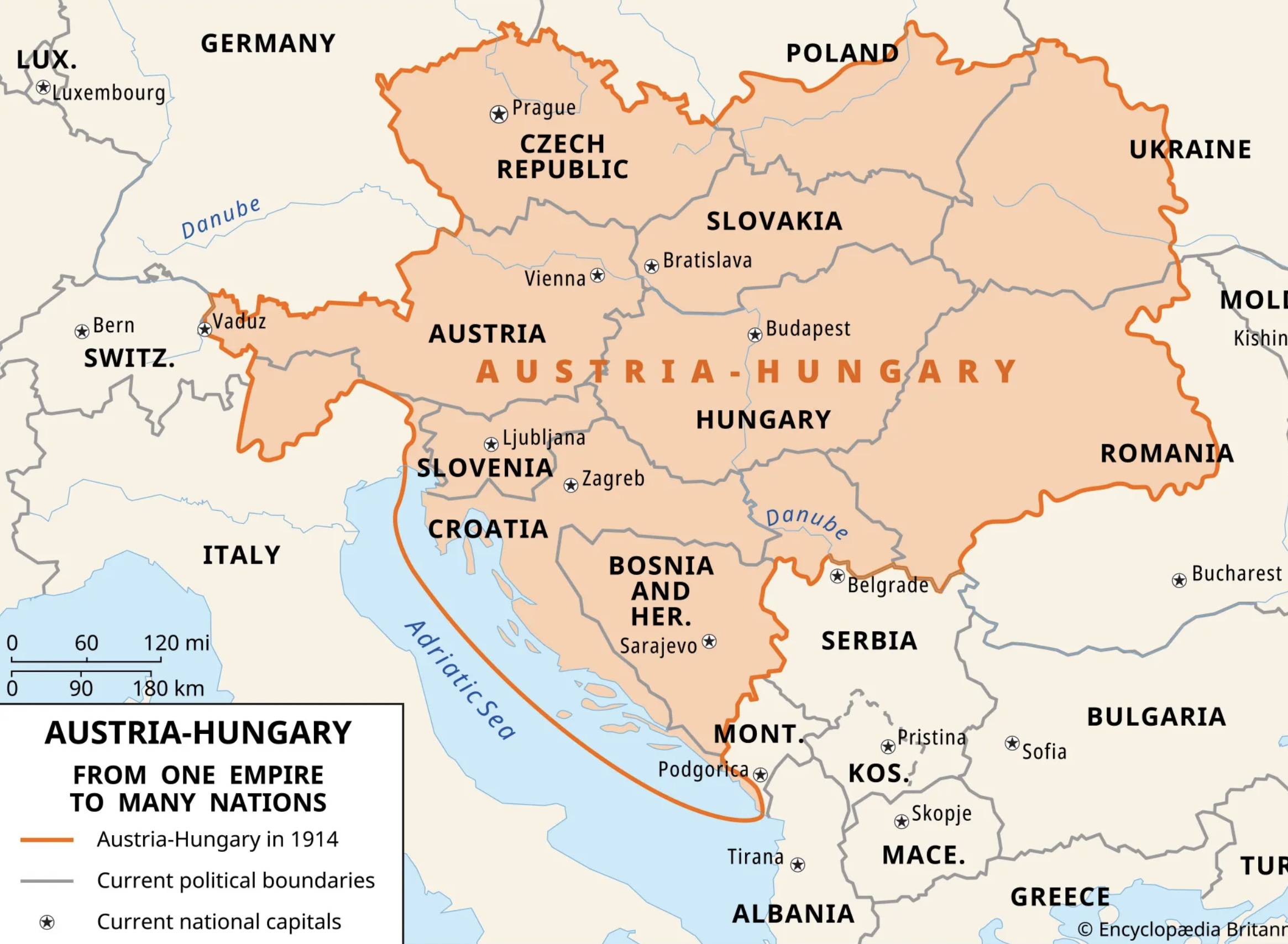
One doesn’t hear much nowadays about Austria-Hungary, the last dominion of the Habsburg Monarchy, which ruled over much of Central Europe for more than six centuries. Also known as the Austro-Hungarian Empire, or simply the Austrian Empire, the multiethnic monarchy was massive. It included what is today Austria, Hungary, Slovakia, the Czech Republic (parts of which were also known as Bohemia at the time), Slovenia, Croatia, Bosnia and Herzegovina, parts of Romania and Ukraine, and the southern part of Poland—an area then known as Austrian Galicia, or just Galicia.
The Habsburg monarch in the late 1800s, when our ancestors began emigrating from there, was a man named Franz Joseph. Beginning in 1867, he was hailed as both the Emperor of Austria and the King of Hungary. Today he is all but forgotten. The emperor-king’s heir apparent was Archduke Franz Ferdinand—and that name just might ring a bell. His assassination in 1914, during a visit to Sarajevo, sparked World War I. One of the outcomes of that global conflict was the collapse of the Habsburg Monarchy and its empire in 1918.
There was no shortage of Habsburg family drama in the lead-up to the Great War, as it was then known. The emperor’s original heir apparent, his son Rudolph, died by suicide in 1889. His wife, Elisabeth, was assassinated in 1898. The slaying in Serbia of Franz Joseph’s nephew and his nephew’s wife may have been one family tragedy too many. Nobody knows. But Austria-Hungary retaliated by declaring war on Serbia, whose ally Russia then declared war on Austria-Hungary—and soon the world was on fire.
Well before the start of World War I, in the waning decades of the dynasty, Austria-Hungary was the birthplace of each of the four grandparents of our mother, Lorraine Kalish.
Her maternal grandparents, Adam Malec and Julia Walczak, were born in 1881 and 1887, respectively, in Austrian Galicia, the Polish region of the empire. They and their descendants were intensely proud to be Poles, in part because for more than a century before World War I, there simply was no Poland. Its land had been parceled out among the Habsburgs, the Kingdom of Prussia, and the Russian Empire.
Lorraine’s paternal grandfather, Louis Kalish, was born in 1888 in a small village in Austria-Hungary. His parents, Stefan Kalis and Kata Kalish, were born in what is now Slovakia, before migrating to what is now Croatia. Mom’s paternal grandmother, Anna Krokvica, was born in 1894, also in Austria-Hungary. Her parents, Leonard and Marie Krokvica, were also born in what is today Slovakia before migrating to what is now Croatia.
As did many who moved around the Austro-Hungarian Empire in search of work, our Kalish and Krokvica ancestors took their Slovak ethnicity—and the Slovak language—wherever they went. “We are Slovaks,” James Kalish would remind his daughter Lorraine whenever the topic came up.
More broadly, Lorraine’s grandparents and great-grandparents were all Slavic, or Slavs. Each spoke one of several Slavic languages, Slovak and Polish among them. Zooming in a little further, their countries of origin were West Slavic. The East Slavic countries included Russia and Ukraine. The South Slavic countries included Croatia and Serbia, which would later be joined as Yugoslavia, or “Land of the South Slavs,” after World War I.
We don’t think any of Lorraine’s Slavic ancestors knew each other back in Austria-Hungary. It appears they met only after emigrating to the United States and finding their separate ways to East St. Louis, Illinois, for jobs in the meatpacking industry.
Those departures to America, from our ancestral cradle of Austria-Hungary, began at the very dawn of the twentieth century.
Next: 11. Adam & Julia Malec 1881-1959
Previous: 9. William & Ann Durbin 1928-1997
 Michael Durbin