A few years ago, researching a book about farmworkers in rural North Carolina, I visited a labor camp and got an unexpected answer when I asked what crop the men were growing. What follows is an audio essay about the surprisingly thin line between hemp and marijuana, the H2A guest worker program that brings hundreds of thousands of Mexican men to American farms each year, and what happens when a curious writer and his wife ignore the instructions that came with their THC edibles.
When I moved to North Carolina from Chicago in 2005, I had no idea that so much of our nation’s food was still harvested by hand. Now, twenty years later, that hasn’t really changed. Much of the produce in any grocery store–the peppers and melons and berries and whatnot–is still picked by human hands.
What has changed is the number of so-called guestworkers those hands belong to. These are the citizens of other countries who leave their families for the better part of every year to work in US crop fields, authorized by an H-2A temporary seasonal visa. In the early 2000s, the number of H-2A workers across the US hovered around 50 or 60 thousand. Now it’s almost half a million. Most are from Mexico. Most are dads.
To the Mexican farmworker, the appeal of going north each year is obvious. Here, they can earn in one hour what might take two days back home. But they must live apart from their families for the better part of each year–typically 6-9 months, often longer–and live in a labor camp that may or may not comply with even the barest of housing standards.
For many years, no state brought in more H-2A workers than North Carolina. The nation’s very largest H-2A employer is here, as is one of the nation’s only farmworker unions. It’s an ideal place to peer into what works well in the H-2A program and what does not. In North Carolina one can also get a glimpse of true family farming operations, struggling to make ends meet, who depend on H-2A labor. There are scores of those. For the past few years I’ve been diving deep into this little known world, trying to understand it. I’ve done my best to convey what I learned in my bookFinding America’s Farmworkers: Reaching Out in North Carolina.
With the second Trump administration now getting underway, nobody knows what’s in store for the army of guestworkers who depend on the H-2A program to feed their families–nor for the growers who depend on it to feed theirs. There were no day one executive orders aimed directly at the H-2A. Changes are expected, especially for US farmworkers outside the H-2A program, struggling moms and dads lacking work authorization, now at risk of being swept up in mass deportations.
In recent years, the population of agricultural guestworkers in the US has exploded. It’s not inconceivable that growth has just begun. If we are to continue growing food in this country, somebody must harvest all those peppers, melons, and berries. We may also see expansion of the guestworker program in other industries.
Before that happens, I hope we will consider what things are like today for all the homesick dads who work in our fields.
An H-2A farmworker looks out from his labor camp barracks in Sampson County, North Carolina, 2019. Photo by Michael Durbin
It’s a sad truth that tens of millions of people in the United States depend on free food to keep their families from going hungry. Many of these moms and dads plant and harvest fruits and vegetables or raise and package chicken and other meats, all for the lowest possible wage. As a result, the rest of us can spend less of our income on food than just about any other country on earth. Another result? Many farmworkers are too poor to feed themselves.
Fortunately for some, a little-known place in Sampson County has been helping to feed farmworkers and their families for more than forty years. The Episcopal Farmworker Ministry is located in the heart of this state’s farm country on a street named Easy—a misnomer if ever there was one. Just ask the people responsible nowadays for events like this one: Patti Navarro, Linda Reyes, and Anna Reyes are on the ministry staff. Fred Clarkson is the parish priest at La Sagrada Familia, an Episcopal church that shares the Easy Street campus with the ministry. Together, this team of four does work here that is anything but easy.
Patti Navarro first came here as a seven-year-old child of farmworkers, playing on the ministry playground while her mom picked up food for the family. Or some donated clothing. That was twenty years ago. Now she works here, collecting food items and helping to supervise the same food distributions that once kept her from going to bed hungry. She brings more than a firsthand appreciation for what it’s like to grow up in a farmworker family, and more than bilingual fluency. Patti possesses the ability to stay cool when things go wrong. And things always go wrong.
Patti Navarro
Pulling off a food distribution entails not one job but four. The first is advertising, to let families know when and where they can collect food. This job belongs to Linda Reyes. She relies chiefly on a Spanish-language Facebook page (they also have one in English) to get word out to their clients. It’s a well-known source of information for this community, and Linda posts here all the time.
Like Patti, Linda can relate personally to the community served here. Until a few years ago, she worked in a nearby pork processing plant until a ten-pound meat hook fell on her shoulder and sent her home, not gravely injured but frightened at what might happen next. She had been attending and volunteering at La Sagrada Familia (The Sacred Family) when offered this job. She jumped at the chance.
For this distribution, the last before Thanksgiving, Linda posts something new on Facebook: a signup form where families can register to get a free turkey, a ham, or a pair of chickens. It’s a heartfelt gesture but introduces a challenge: Where will they get all this meat?
The second job is the collection of food. For this event, that part culimates the day before the event on a cool and blustery Friday. For years, the Food Bank of Central and Eastern North Carolina has been the chief provider of food to ministry distributions. Today, long-time food bank driver Manny navigates a giant box truck onto the ministry campus and unloads eleven pallets stacked high with seven types of vegetables, watermelons, bread, and soft drinks—six tons of food. Patti and ministry volunteer Ruperto Martinez also pick up a couple hundred loaves of donated bread from the Bread of Life Food Pantry in Raleigh, and ten giant bags of rice and beans from Sam’s Club in Goldsboro. Patti has only $500 to spend at Sam’s Club, so each family will be limited to just one bag of rice or one bag of beans. It saddens Patti to not offer both halves of the staple rice and beans dish, but there is only so much money and she is trusted to spend it wisely.
“It’s kinda my job,” she tells me.
One reason Patti can only give rice or beans is that she had already spent $4,000 on 40 hams, 60 turkeys, and 204 chickens from the food service distributor US Foods. Those arrived first thing Friday morning. Patti had them loaded into the ministry’s aging walk-in cooler, careful to place them away from the constant drip of water from the ceiling. Will these three hundred pieces of meat be enough? Patti is doubtful. She calls the food bank to see if they might provide additional meat—she and Ruperto are willing to drive there to pick it up. Yes, she is told by the food bank rep who picks up the phone. Partner organizations can go to the Raleigh distribution center to pick up donated meat. Patti is ecstatic, but only until the rep asks for the ministry’s partner ID number. Patti doesn’t have it. She’s never needed it during the eight months she’s been at the ministry. So much for that source. The boxes of meat in the drippy cooler will have to do.
On the Friday before the distribution, while Patti oversees the collection of food, Linda guides a small team of volunteers in retrieving clothing from a double-wide trailer so they can distribute that on Saturday as well. Among her other responsibilities, Linda manages this oldest ministry program. In 1978, a group of parishioners launched what was then called the Clothing Closet Ministry, distributing donated clothing from a trailer just up the street from the ministry’s current home.
Job number three is the enlistment of volunteers for distribution day. It’s a difficult one. Being an hour’s drive from Raleigh, and three hours from Charlotte, the ministry’s remote location has always made this a challenge. As a joint operation of two of the state’s three Episcopal dioceses, the ministry can and does attract volunteers from a number of member churches. Indeed, parishioners of both St. Paul’s Episcopal Church in Cary, and Trinity Episcopal Church in Fuqua-Varina, sign up to work at this distribution. But most of the 39 volunteers who show up are members of the very community the ministry serves—seasonal crop workers and meat production workers—many of whom are members of La Sagrada Familia, whose brand-new church building, just off the ministry parking lot, is now framed and clad in plywood. Linda is responsible for enlisting volunteers, but she gets some help.
Fred Clarkson, a native of Colombia, has been the parish priest at La Sagrada Familia since 2017. Earlier this year, he took on responsibility for overseeing all ministry programs, effectively forming a joint operation between the ministry and the church. Previously, the ministry had operated like an independent non-profit, sharing space with the church but having its own program and much larger staff. The consolidation has greatly reduced the ministry staff to just Patti, Linda, and Anna—in recent years the staff was more than double that size. But Fred doesn’t mind.
“The healthiest churches have the smallest staffs,” he told me.
With his own small staff, to make these food distributions succeed, Fred knows he has to do more than just help recruit volunteers from his congregation. A few months ago, Fred developed an all-new system, complete with an iPad face-recognition app, for registering food distribution clients and volunteers. It also prints out adhesive name tags for volunteers, to help distinguish them from clients. On the morning of a distribution, it’s Anna’s job to use this app, greeting each volunteer, asking them to look into the camera, then giving them a name tag. Once clients start arriving, Fred and Anna both handle registration.
Father Fred Clarkson helping Anna Reyes with client registration
Once you’ve advertised an event like this, and gathered the food and enlisted the volunteers, you are still left with the fourth job: orchestration. On distribution day, how exactly does all that food get into all those cars? What exactly should everyone do? And when? On the Saturday morning of the food distribution, as the team arrives, they can picture how all of this should work:
From 8:30 to 10:00, after checking in with Anna and donning a name tag, volunteers will unwrap eleven pallets of donated food, load bulk items like apples and onions into smaller bags, and then place it all out on tables—one for each type of food. There are also two-way radios to clip on belts (Anna takes care of this), take-home boxes to assemble, and shopping carts to roll out. Normally, clients roll these from table to table and gather what items they want. But the team will today introduce a small refinement to help speed things up: they will ask volunteers to pre-load boxes with several items and place those into the carts. While all this is going on, clients arriving in cars will be greeted at the entrance of the parking lot, handed a laminated card with a number on it (indicating their place in line once the distribution begins) and then directed to the soccer field behind the main ministry building. There, a volunteer will organize them into neat lines of ten cars each.
From 10:00 to 1:00, as the plan goes, Patti or Anna will use their radio to call out to the soccer field for batches of cars, ten each, to be sent forward. Clients will then move their cars to the ministry’s south parking lot, which has been cleared of all ministry and volunteer vehicles, then walk to the registration table. While waiting to register, clients can look through bins of donated clothing and bed sheets for whatever they might need. Once registered, clients take one of the pre-loaded carts of food and roll it to the meat distribution table. There, Patti will ask the client’s name, look it up on her laptop, then hand out whatever type of meat they registered for: a turkey, a ham, or two chickens. If someone has not registered, they still get chicken. But only one. Their shopping carts full, clients roll them to their car and unload them. When about half the cars have departed, the call goes out by radio to the soccer field for another batch of cars. Cleanup begins once the last car departs, after which everyone goes home.
That’s the plan. And things do, in fact, go generally according to plan. But not entirely.
Linda Reyes, Anna Reyes
It’s 49 degrees and drizzling when the team arrives a little after 8am. The high today is only forecast to be in the fifties, but thankfully the rain is supposed to end in about an hour. By 8:45, almost 20 volunteers are busy putting out loaves of bread, watermelons, and cabbages. Others are putting bulk items like carrots and apples into smaller bags. Fortunately, most of these volunteers have been here before and need only be assigned a station. Once everyone has a task, Patti rolls out a large speaker, turns on some music, and cranks up the volume. The opening lyrics of Luis Fonsi’s Despacito are just filling the open-aired workspace when Patti realizes some of the volunteers brought children with them. She quickly changes the music to De Música Ligera by Soda Stereo. Someone asks Patti why she didn’t like the first song. “Not PG-13!” she answers.
Patti is in constant motion. She checks to see if everything has been taken out of the cooler, from the van with donated bread, and the warehouse everyone calls la bodega. She answers non-stop questions. And at each station she does some math, determining how many of each item will go into a shopping cart. Watermelons are easy: one per family. For things like onions and cucumbers, she must estimate how many there are and divide by 300—the most families she expects. She need not estimate at the massive carton of soft drinks, whose content count is written on a label.
“783 divided by 300,” she says outloud, tapping into her iPhone’s calculator. “Three apiece. Wait. We need these for the Christmas party,” she concludes, before asking a volunteer who knows how to operate a pallet jack to move the sodas to la bodega.
Her main job now is to direct people and solve problems, like one at the meat station. At last month’s distribution, each chicken came packed in its own bag. Here, there are six chickens per bag. Volunteer Barbara Lawrence asks Patti if there are latex gloves and smaller bags. “Yes!” she answers, returning in no time with both. She isn’t sure the ziploc bags are big enough, so puts on a pair of gloves and bags the first chicken herself. The bags are just big enough. Patti takes off the gloves and dashes off to where she’s needed next.
Whoever designed this multipurpose space might’ve had events like this in mind. The 200 or so square foot area features a smooth concrete floor, a soaring cathedral ceiling, and no walls—just pillars. This allows for the constant and easy entrance and exit of people at nearly any point, as when Patti exits between two pillars, into the persistent drizzle of rain, to be sure arriving cars are properly greeted and instructed. She’s especially concerned that each client family gets only one of the pre-numbered cards, which will act as their entrance ticket at the registration table. Her mind is soon at ease.
Longtime volunteer Ruperto greets each family at the entrance of the parking lot, hands them one card, and directs them to the soccer field where raincoated volunteer Shirley Lamont forms lines of ten cars each. By 9:15, the first line is full. Shirley attends Trinity Episcopal Church and has been volunteering at these events for eight years, often accompanied by her husband Alex, who at this moment is loading shopping carts with cardboard boxes. Ruperto has been volunteering at ministry events for even longer. He works the night shift at a nearby turkey farm, so typically arrives to work these events having been awake all night. “Trabajaste anoche?” someone asks him this morning. Did you work last night? No, he answers. It was Friday, his night off. When he came here yesterday, to help gather food, he had been up all night working.
At 10:00, when the distribution is scheduled to begin, the drizzling rain shows no sign of letting up. With winds picking up, the effective temperature is dropping. There are 95 cars lined up in the soccer field, their occupants hoping to turn on their engines at any moment. But over in the distribution area, things are nowhere close to being ready. There’s just too much food—more than 20 thousand items—to be bagged and set out in the 90 minutes alotted, despite arms flying nonstop and everyone working at top speed. And some volunteers arrived just minutes before the scheduled start of the distribution. Half an hour later, the team decides things are ready enough. She turns off the music and speaks through a microphone to finalize station instructions, pointing to each table and confirming who will be sure its table remains loaded with food.
“Maria en la zanahoria, Enrique en la repollo, Alex en la sandia,” she calls out before switching to English. “Who can give out hand sanitizer? Who can retrieve empty carts?” English-speaking volunteers raise their hands.
Satisfied that all bases are covered, Patti tells volunteers they can go through the line now to collect a despensa for their own family. It’s the Spanish word for pantry, which in Anglo cultures generally refers to a room or cupboard, but in Latin American cultures refers simply to a load or collection of groceries. Most of the volunteers here need a despensa as much as those waiting in cars do. By showing up early and helping to prepare them, they can be sure to get one before food runs out, as it does more often than not.
At 10:45, everything is finally in place and the team is ready to receive clients waiting in the soccer field. Patti uses her two-way radio to ask Shirley to send out the first batch of cars. There is no answer. She presses the talk button and asks again. Still no answer. Patti disappears into the rain, running out to the soccer field to tell Shirley in person. Ten minutes later, clients are wheeling shopping carts full of groceries out to their cars. Ten minutes after that, Anna uses her radio to call out. “Shirley! Send another ten!” This time Shirley responds. The great transferance of food to families is finally underway.
Farmworker and volunteer Ruperto Martinez greets a client at the food distribution
Many of the recipients of today’s food are cropworkers. I wonder what they think as they eye the very type of produce they plant, cultivate, and harvest in their jobs. One crop they will never see here is state’s number one crop. North Carolina produces more tobacco than anything else—as has been true for four hundreds of years—and far more than another other state. The second leading crop is sweet potato, which is often a feature of ministry food distributions but not this one—perhaps because growers sell so much of it for Thanksgiving there isn’t much to give away right now. But on these tables today the crop workers do see watermelons, cabbages, onions, cucumbers, and zucchini. And those are all grown in abundance around here. The meat production workers here are certainly familiar with the meat items going into these carts. Each year, North Carolina raises, slaughters, and packages these in staggering numbers: 8 million hogs, 28 million turkeys, and nearly one billion chickens—more than 2 million a day.
The explosive growth of this state’s meat production in recent years has altered the very meaning of the term farmworker. It once referred to crop workers but is now practically understood to include meat production workers as well. Like virtually all crop workers, the men and women who actually raise, slaughter, and package all those animals are nearly all Latino, all generally paid the lowest wages that federal law will allow. Meat production workers tend to live here year-round. Some crop workers do as well—they are known as seasonal workers. But a large number of crop workers migrate here each year from Mexico by way of the H-2A visa program, living for the better part of every year in one North Carolina’s two thousand or so labor camps. A smaller number of workers migrate domestically, typically harvesting citrus in Florida during winter months and other crops in North Carolina and other more northern states during warmer months.
Of course, one need not be a farmworker of any kind to receive food at a ministry food distribution. You need only be willing to give your name and county you live in, get your photo taken, and wait in line. There’s a family who lives right across the street from the ministry, at a house where I’ve seen a Confederate flag atop a pole in their yard. I’m told they’ve been here for food.
Volunteer Alex Lamont prepares shopping carts
By 11:30, only 20 cars have left the soccer field. There are more than 100 still there. The holdup is at the meat pickup station. There, Patti must ask each family for their name and look them up on her laptop, to see what meat they pre-ordered. That process stops entirely when she is called away to fix new problems, such as when they run out of ziploc bags for the chickens. Fortunately she finds a new box of bags, far larger than necessary but adequate for the job.
There are issues at the registration table, such as when a family shows up without a numbered card. They did not know they needed one. Father Fred explains the process then sends them back to their car, pointing toward the soccer field where they can join the end of the line to wait their turn for a despensa. The energetic son of a volunteer, too young to work but paying keen attention, notices Fred sending the disappointed family away. Fred notices the boy staring up at him. “We have to be fair,” he explains.
At 12:30, a family with card #98 signs in. Patti has sped things up at the meat station, such that 80 families have been served in just one hour. Things are picking up. So too is the wind. People are shivering now so Fred asks a volunteer to retrieve three propane-powered space heater from la bodega, the kind restaurants use for outdoor seating areas. In the open-air space, they provide heat in only three tiny areas. But at least it’s a place people can go to for a break of warmth.
Out in the soccer field, Shirley tries to keep moving to stave off the chill of standing so long in the drizzly cold. At one point she has an opportunity to run into the covered workspace, to find her husband Alex. A car won’t start. Apparently, its battery is dead. Alex uses jumper cables to get it going. An hour later, another car’s battery is working but the engine won’t turn over. Shirley thinks the engine is flooded and advises the driver to sit and wait. Later, someone’s car alarm goes off at the end of the line. Too tired to investigate, she lets it wail.
At 1:30, a half hour after the scheduled end of the event, nearly 30 cars remain in the soccer field. Inside the distribution area, fatigue is setting in. Staff and volunteers say little. The music blasting from the loudspeaker does not help. The Girl from Iponema, with its smoky bassa nova beat and minor key melody, only adds to the downbeat vibe. But not everyone is sullen. Outside, the rain has finally stopped, and half a dozen kids, from toddlers to pre-teens, are all over the slides and swings in the playground area, dashing about in glee as kids on playgrounds do.
By 2:30 the rain is back. The playground is again empty. But minutes later, Patti picks up the microphone to announce the last of the cars have left the soccer field. Fifteen minutes later, those familes have driven off with their groceries and cleanup begins.
Two hours later, the team goes home after an intense eight-hour day at work. They think of what to fix next time. First, the pre-loaded carts will go. Families, unsure how much they could take, ended up helping themselves to more food items from the tables. Next time, they’ll put out instructions on each table with the number of items alotted to each family. Linda will also think of how to better advertise the event to more families not on Facebook. And of course Patti will use the ministry’s partner ID number to secure meat products from the Food Bank, saving some of the ministry’s precious cash.
The team is especially relieved that the meat they bought was enough. Not only did every family get a turkey, ham, or chicken, but nearly 30 pieces of meat remain in the cooler, along with several bags of carrots and onions. Everything else is gone. But at least they will have food to hand out for the next few weeks. Farmworker families arrive nearly every day of the week at the ministry, to ask for help of one kind or another. When the help they need includes feeding their families, Patti or Linda or Anna can walk them to the cooler for a despensa to take home.
Food distribution at the Episcopal Farmworker Ministry, November 2023
This little-known ministry on Easy Street has been serving this little-known community of agricultural workers since the 1978 launch of the Clothing Closet Ministry. A few years later, after expanding their programs to include food distribution and other services, the name changed to the Episcopal Migrant Ministry. It took its current name in 1986. Since then, the structure and leadership of the Episcopal Farmworker Ministry has changed many times. Running a place like this entails any number of challenges and periodic reinvention is inevitable.
The people here—the members of the board, the leadership, the staff—they all come and go. Sometimes those transitions are difficult. But the essence of this place, its spirit if you prefer, never seems to change. Nor does the simple reason why people show up here to work or volunteer: They are here to address the poignant and stubborn truth that among the hungriest in this country are those who feed the rest of us.
We know he was 30 years old, a citizen of Mexico, working at a North Carolina tobacco and sweet potato farm. It was just the second week of his first year working there, authorized by an H-2A temporary seasonal work visa. We know area temperatures neared 100 on the fifth day of September. It was a Tuesday. We know someone at Barnes Farming Corporation, one of the state’s largest employers of H-2A guestworkers, whose president Johnny Barnes is the husband of State Senator Lisa Barnes, called 911. We know the responders arrived too late. They could not save the life of José Arturo Gónzalez Mendoza.
We do not yet know the details of how he died. According to Barnes, their new fieldworker went to rest on the field transportation bus after reporting to his supervisor he was not feeling well. Later, checking in on him, they called for medical assistance. His family told television news station WRAL he died of dehydration and heat stress. His brother told the labor advocacy group El Futuro Es Nuestro (It’s Our Future) the Barnes supervisor never gave José any medical attention.
Did Mr Gónzalez Mendoza show signs of heat sress? If so, did the field supervisor recognize them? One former employee of the North Carolina DOL Agricultural Safety & Health Bureau told me that the lack of sweat can indicate a body preparing to shut down from overheating. So heat stress might not be the first thing that comes to mind when you see someone on the verge of dying from it.
According to the North Carolina Department Labor, the state investigates, on average, two agricultural work-related fatalities per year. I don’t know why this one got the attention of CNN and nearly a dozen other media outlets. Most farmworker deaths go relatively unnoticed. I hope these journalists keep a lookout for the state’s report into this one, so we can better understand what happened to help keep it from happening again. Two farmworker deaths each year, in just one state, is clearly too many.
While waiting for the report, we can consider what we do know about farmworkers like Mr. Gónzalez Mendoza and employers like Barnes. There’s a lot to know.
According to H-2A job orders for the 2022 growing season, filed with the US Department of Labor, just over 900 North Carolina agricultural employers sought certification of H-2A visas for nearly 27 thousand temporary workers. A few of these employers were farm labor contractors who act as intermediaries between growers and workers, but most are farming operations, or growers, who hire workers directly. Barnes is the very largest among these, requesting certification of 645 workers. The median number of requested workers per employer is ten.
Roughly a third of this state’s H-2A farmworkers come by way of the North Carolina Growers Association, a trade association that handles H-2A paperwork, transportation, and other logistics for member growers like Barnes. The NCGA is officially a co-employer of workers. It’s located in the tiny town of Vass, where they operate an orientation center for an annual stream of nine thousand or so incoming workers.
Most H-2A farmworkers live in Mexico. They leave their families for the better part of every year; the median 2022 contract length at Barnes was 8 months, with some there for as long as 10. Their journey from all parts of Mexico begins with a bus ride to the city of Monterrey. There, they are interviewed at the US Consulate and complete their visa application. Then they board another bus to take them across the border and bring them to a US farm. A worker might sit on a bus for two or three days to get here, and then do so again, at the end of the season, to spend time with family before doing it all again. H-2A employers are required to reimburse workers for these transportation expenses, and to provide them housing at no cost.
To many H-2A temporary visa holders, this is anything but a temporary job. Many do it for the entirety of their working lives. According to a post on the Barnes Facebook page, 2022 was the 25th year their H-2A worker Pablo had been making his annual trek.
It’s little surprise why they come. H-2A workers earn far more here than they can at home. This year, H-2A workers in North Carolina are paid the government-mandated wage (the Adverse Effect Wage Rate, or “A were” as the acronym is pronounced) of $14.91 per hour. That’s more than they might earn from two full days of farm labor in Mexico.
Living and working conditions for many H-2A workers are not so great. The labor camps they live in, while meeting minimal state health and safety standards, can be disgusting. While at work in the field, supervisors may or may not provide them sufficient water and rest breaks, and some may not know to give new workers extra break time to acclimate to North Carolina’s brutal summer heat. Many workers are also reportedly, and regularly, exposed to pesticides.
The ability to earn a relatively high wage is an obvious reason H-2A workers tolerate living and working conditions that most US workers would not. But it’s not the only reason.
H-2A contracts are limited to one growing season, meaning that each worker must be re-hired each year. Employers are free to ask someone back or not. Workers know this. This extraordinary power imbalance is widely believed to contribute to this seemingly endless state of affairs, where guestworkers tolerate living and working conditions in which they risk their lives, not to mention their dignity, in order to feed their families.
Growers must feed their familes too. And while the scale of the Barnes Farming Corporation is an exception, from what I can tell, most H-2A employers in North Carolina are family farms of modest size. And what they do, trying to make a living growing food for the rest of us, is not easy. They are at the mercy of the weather, of course, especially as climate change only increases the frequency of destructive hurricanes and droughts. Most have no say over the prices they can charge for the vegetables and fruits they take to market—especially as foreign competitors can sell produce at ever lower prices. And then there’s inflation. As with most businesses, the cost of everything it takes to produce a crop goes up every year. Near the top of that list is the cost of labor. It’s little wonder that, to most growers, AEWR is a four-letter word.
Having to bear an ever-increasing cost of labor is no excuse, but nor is it any wonder that growers seek to minimize housing costs and maximize worker productivity however they can. I believe most growers want to strike a reasonable balance between what their H-2A workers need and what they can afford to provide them. But I also see and hear credible accounts, some directly from farmworkers, of growers and contractors who clearly cross a disturbing line.
For two years I’ve been talking with farmworkers, growers, legal and health care advocates, and others inside the little-known world of today’s migrant farmworker. Typically I see workers at their labor camps, of which there are more than two thousand in North Carolina, most located in the eastern counties. I don’t know what every camp is like, but I’ve been to dozens. Almost none is a place I would want to spend a night. Just last week, I helped workers carry donated food into their kitchen, a dark and hot and humid place with a cloying odor—from decades of meal preparation in a poorly ventilated space—that had me dashing for the door as fast as I could. I cannot imagine cooking or eating a meal in there.
I’ve had glimpses too of farmworker hardships that go beyond the endurance of poor living conditions. Last year, a worker showed me a photo of a nasty sore on his hand, the result, he believed, of not being allowed to wear gloves when snapping flowers off the top of tobacco plants. A few weeks earlier, another worker acknowledged that he and his coworkers come here by choice, but wondered, plaintively, why they couldn’t have more break time when it gets hot, and why they are forced to run from furrow to truck when harvesting camote. It’s a word you hear all the time when speaking with North Carolina farmworkers. It’s Spanish for sweet potato.
For years, North Carolina was the nation’s top employer of H-2A farmworkers. Today, the majority can be found at farms across California, Florida, Georgia, North Carolina, and Washington. The recent growth of the program across the United States has been nothing less than explosive, with annual H-2A farmworker certifications climbing over the past ten years from roughly 100 thousand to nearly 400 thousand. Soon, we can expect more than half a million Mexicans will leave their wives, children, and parents for the better part of each year to do some of the hard work that needs to be done here.
Businesses outside of agriculture apparently like what they see in our fields. The US Chamber of Commerce, for example, is calling for the expansion of guestworker visa quotas in other industries. There are also calls for making guestworker visas year-round. Before going there, we as a nation should stop and think: Do we want to separate even more parents from families just so they can feed them? And before we turn this path of hungry migrants into a superhighway, can we at least build in safeguards to protect them from abuse by unscrupulous employers?
In the recent, tragic case of José Arturo Gónzalez Mendoza, there is one other thing we can already be certain of. He left a wife and two kids at home in Mexico. One is said to be 10, the other 17. Not four weeks ago they and the rest of his family got the worst news anyone can ever get: a loved one had died, far from home and way before his time. The shock must have hit them hard. It no doubt still courses through their bodies, in waves, they way grief like that does. It will be some weeks before papa can come back home. He’ll travel this time in a casket. There will no doubt be a funeral. The family may have a few more facts by then, but it won’t much matter. Facts do little to ease a pain like theirs.
Tobacco growing at a typical farm in South Carolina
In 1981, the travel writer Tom Miller made a spot-on prediction. President Reagan was then planning an experimental program to allow US growers to hire 50 thousand Mexican farmworkers each season on temporary contracts, a program that would be enacted into law in 1986 as the H-2A visa program. Writing in The New York Times, Mr. Miller feared this newest bracero program—bracero is the name used for contract farmworkers in two earlier guestworker programs—would fail to protect against the abuse of workers, just as its predecessors had.
Tom Miller knew our southern border well. He had traveled all 2,000 miles of it and had written extensively on US relations with Latin America in popular books and magazine articles. He died in 2022, living long enough to see his prediction come true. The H-2A program today provides the cheap farm labor the US agricultural economy depends on, but stories of worker abuse appear all the time. Tom did not live long enough to witness a sobering milestone just around the corner. Soon, if trends continue, the US will bring more than half a million H-2A workers to our fields each year, ten times the fifty thousand originally planned.
Given the explosive growth of the current bracero program, and urgent calls on both ends of the political spectrum to modernize it, we’d do well to remember what went wrong with the last one. Let’s take a look back at some history.
The United States entered World War I in April 1917. One month later, growers in California and other western states were allowed to hire “otherwise inadmissable aliens” from Mexico on six-month contracts, ostensibly to compensate for US workers diverted to war jobs. The Mexican civil war was then just ending, and peasants displaced by the fighting were desperate for jobs. So both countries saw benefits. However, when this first bracero program ended in 1921, Mexicans continued to cross into the US for work, now without authorization.
Fast forward to the 1930s. With record numbers of US citizens unemployed and many flocking to California to seek farm work, the US repatriated hundreds of thousands of Mexicans in an attempt to free up jobs for US workers.
In 1941, the US entered World War II. With thousands of its citizens either enlisting or taking manufacturing jobs to aid in the war effort, growers in western states pleaded for help. Starting in 1942, they were again allowed to hire farmworkers from Mexico on temporary contracts, presumably only for the duration of the war. However, despite Japan’s 1945 surrender bringing the war to a close, the bracero program went on. And with the 1951 passage of Public Law 78, this second bracero program effectively became permanent, with annual admissions growing to levels unseen during the war, peaking at 445,000 in 1956.
US growers loved the program and its seemingly endless supply of non-union workers, desperate for jobs and willing to do “stoop work” at low wages. On paper, bracero workers were entitled to wage protections and other safeguards against exploitation and abuse. With few enforcement mechanisms in place, however, the reality was something different.
In 1955, the labor activist and writer Ernesto Galarza toured bracero labor camps to see what things were like, visiting 156 such camps. The next year, his 80-page report “Strangers in our Fields” shone a light on numerous cases of wage theft, racism, and other indignities that braceros suffered as a matter of course. The federal government was quick to refute many of Galarza’s findings, issuing its own report to try to highlight the supposedly bad facts and misleading statements in Galarza’s report. But public opinion had begun to turn toward Galarza’s view. Also, many lawmakers believed there were enough US citizens to fill these jobs if only workers were paid higher wages to attract them. The government ended the program in 1964. By then, an estimated 1.5 to 2 million Mexicans had worked as braceros over the 22 years this “temporary” program was in place.
Among the biggest fans of the demise of the second bracero program were the labor leaders Cesar Chavez and Dolores Huerta. With that program out of the way, it’s no coincidence their United Farm Workers union soon won a 40-percent increase in wages for grape workers, in 1966. And the grape and lettuce boycotts of the late 60s and early 70s would help facilitate passage of the landmark California Agricultural Labor Relations Act of 1975, establishing for the first time ever the rights of US farmworkers to unionize. However, those rapid gains of organized farm labor would not last for long.
After the second bracero program ended, former contract workers kept on crossing the border from Mexico seeking work—now without authorization—and US growers kept on hiring them. The growing problem of illegal border crossings, and the never-ending need for cheap farm labor, prompted the Reagan plan that so worried Tom Miller and led to his 1981 prediction. He saw what was coming, dubbing the plan “Bracero Program No. 3.”
In 1986, the United States enacted the sweeping Immigration Reform and Control Act, or IRCA. One of its key provisions was to make it against the law for employers to hire undocumented workers. But to ensure a steady supply of farmworkers, IRCA also dusted off and modified a decades-old temporary labor program known as H-2. The US had established this temporary and seasonal visa program in 1952, primarily for Florida sugar cane cutters from Jamaica. Under IRCA, the US would issue not one but two types of guestworker visa: the H-2A for agricultural work and the H-2B for non-agricultural jobs. The H-2A remains essentially the same today as when it was enacted 37 years ago, spelling out numerous conditions for hiring foreign agricultural labor, some of them identical to the old bracero rules.
In its first full year in 1987, the US certified just 44 H-2A visas, but it did not take long for the program to surpass the adoption rate of either of the bracero programs. In 2012, the US certified more than 75,000 H-2A visas. By 2018, that number had grown to almost a quarter of a million. Now in 2023, the number of certifications is approaching 400,000.
H-2A farmworkers are better off than the earlier bracero workers in some important ways. First, they are not subject to dehumanizing procedures, such as delousing with DDT upon arrival, nor long registration and induction periods that might deprive them of food for days on end. More broadly, H-2A farmworkers are entitled to numerous provisions of the 1983 Migrant & Seasonal Agricultural Worker Protection Act, including the right to disclosure of and compliance with terms of employment, housing that meets federal and local standards, and transportation in vehicles that meet federal safety standards.
They are also better paid. Each year, the US Department of Labor sets a minimum wage for H-2A farmworkers known as the Adverse Effect Wage Rate (AEWR), which is generally well above the federal minimum wage, and often more than ten times what a Mexican farmworker could earn at home in Mexico. Growers hate the AEWR. But it is an undeniable benefit to the worker.
So do we treat H-2A farmworkers better than we treated earlier braceros? Thankfully, in some ways, yes. But is their treatment on par with that of other low-wage workers in the US? No, it’s not even close.
First let’s consider the housing. One observer, after visiting numerous farmworker labor camps, noted how it “ranges from good through indifferent to downright bad.” That was Ernesto Galarza writing in 1956. But anyone today who visits any number of migrant labor camps, certainly in North Carolina where I live, could use those very same words. Growers have few incentives to maintain and repair farmworker housing beyond what is necessary to pass annual inspection. Providing free housing to workers is a cost of business that few employers must bear.
I believe most H-2A employers do their best to treat workers fairly. As in any line of work, some do not. But how many workers in this country are prohibited from seeking a new job when their employer cheats them out of wages, works them to exhaustion, or otherwise mistreats them? H-2A contracts prohibit workers from changing employees during their contract period, institutionalizing a power imbalance unheard of in other settings. Of course, unionization and collective bargaining have been used to halt unchecked worker mistreatment for decades. But as agricultural workers, H-2A farmworkers have no federally protected right to those options. Nor are they entitled to overtime pay, no matter how many times they work for more than 40 hours in a week.
And then there’s the human trafficking. By allowing farm labor contractors to participate in the H-2A program we all but invite the notorious contratista to exploit foreign workers. They can lie to them, indenture them, steal from them, and treat these human beings as something less. Earlier this year, a story from Prism Reports detailed the results of an 18-month investigation into this little-known but widespread accommodation of human traffickers. Sadly, the Department of Labor’s enforcement of program rules, which would discourage such behavior, is on the decline—and the contractors know it.
There’s something else baked into the H-2A program, something that will never make a headline but deserves recognition nonetheless: How many workers in this country are separated from their families for up to ten or eleven months each year just to earn, if they’re lucky, maybe $15 thousand in a year? Last year I met two H-2a farmworkers in North Carolina who each had been away from home for the better part of the past 30 years. And both have sons now doing the same thing. If there is a more poignant display of family values in this country, of enduring harsh living and working conditions to provide for one’s family, year after year with no end in sight, I’ve not seen it.
US lawmakers on both side of the aisle are under increasing pressure to do something about the H-2A program. Here’s what they should do:
First, the farm labor contractor must go. Employers should be directly accountable for the welfare of their H-2A farmworkers, banned by law from hiding behind an intermediary who might do anything to increase their profit margin. Unfair to smaller farms? They could join a collective to spread both the cost and burden of program compliance. Today’s North Carolina Growers Association is a model for this approach, acting as a joint employer, facilitating farmworker mobility across growers, and willing to stick their necks out to ensure workers are treated fairly.
Second, we must help growers, especially smaller ones, shoulder the cost of housing farmworkers. They have families to support too. In an ever-competitive global market, they cannot simply pass along this unusual cost. Our growers are entitled to meaningful tax breaks or other means of subsidizing the cost of housing farmworkers, in return for reasonable and verifiable evidence of doing well by their workers.
Third, it is high time to give all US agricultural workers—guestworker or not—the right to overtime pay and other basic labor rights. In 1938, farmworkers were excluded from the Fair Labor Standards Act because they were Black and had no voice in Congress. Academics refer to this as agricultural exceptionalism. Surely, 85 years is long enough to recognize and refute such a racist stain remaining on our book of law. Most farmworkers today are Latino, still lacking a voice in Congress, and still doing some of the most strenuous and low-paying work anywhere. If anyone is entitled to overtime pay, I say it’s them.
It appears this latest incarnation of the bracero program is here to stay.
“There is nothing more permanent than temporary workers,” writes Philip Martin of the Wilson Center, drawing on an old adage to describe our nation’s insatiable need for cheap farm labor. He may be right. Our H-2A farmworkers are both perennial and essential. The least we can do is treat them with more dignity and respect.
Photo credits: Top half: Michael Durbin. Bottom half: Extension Bulletin Illustrations Photograph Collection, Oregon State University Special Collections and Archives Research Center, Corvallis, Oregon.
We live in an era of deeply polarized politics. But anyone who gives it much thought is likely agree on this: Our nation’s agricultural economy would grind to a halt without farmworkers, nearly 400 thousand of whom leave their families in Mexico for the better part of each year to plant, cultivate, and harvest crops in the United States. The number of so-called guestworkers, here on a temporary work visa known as the H-2A, is growing rapidly. It’s likely to top half a million any year now. Many more farmworkers live year-round in the US, some with work authorization and some without. Because practically no US citizen is willing to do this work, nearly every one of America’s farmworkers is Latino.
And that’s about where the agreement ends.
There is deep disagreement on important matters such as how much farmworkers should be paid, how to protect them from human traffickers and sub-standard living and working conditions, and whether or not they are entitled to a path to citizenship.
Earlier this month, those questions were all on the table in Washinton, DC at a hearing of the Judiciary Committee of the United States Senate. Congressional hearings don’t get media coverage like they used to, but I listened closely as five deeply knowledgeable witnesses gave testimony to Chairman Dick Durbin (a Democrat from Illinois, and also my uncle), Ranking Member Lindsey Graham (a Republican from South Carolina), and other members of the committee.
Three witnesses—two farm owners and an attorney—spoke on behalf of the growers who hire farmworkers. Two witnesses spoke on behalf of farmworkers. At the end of this post is a link to their written testimony and video coverage of the entire hearing.
Much of the debate centered on the nonimmigrant temporary work visa program known as the H-2A, written into law in 1986 as part of the landmark Immigration Reform and Control Act, or IRCA. Subject to a number of requirements, the H-2A program allows US growers to hire as many temporary seasonal workers as they need. The 35-year-old program is showing its age. Both growers and farmworker advocates have serious issues with it, issues they highlighted at the hearing.
Advocates called attention to the illegal recruitment fees many workers must pay, oftentimes putting them in debt to the farm labor contractor—an intermediary between grower and farmworker—who recruited them. By tying an H-2A contract to a single employer, the program generally denies workers job mobility. It also makes them reluctant to speak up about poor working or living conditions for fear of losing their jobs, conditions that are often extremely bad yet go overlooked due to ever-shrinking enforcement of labor laws. Advocates also pointed to the denial of basic federal labor rights such as overtime pay to farmworkers, and to the lack of a path to citizenship no matter how long and how hard they work. Witness Diana Tellefson Torres, CEO of the UFW Foundation, summarizes it this way:
“The H-2A visa program has become the worst source of human trafficking among U.S. visa programs, deprives farm workers of basic freedoms, and subjects US and foreign workers to widespread violations of their rights”
Growers are equally impassioned about what is wrong with the H-2A program. Their chief complaint is the minimum wage they are required to pay to an H-2A worker, known wonkily as the Adverse Effect Wage Rate, or AEWR. The Department of Labor announces the AEWR late each year. Growers don’t like how this gives them little time to budget for the next growing season. They also don’t like the methodology used to set the AEWR. What they dislike most is how it goes up so much each year. For witness Chalmers Carr of South Carolina, who runs the second largest peach farm in the country, it went up 14% last year.
“This is a prime example,” Mr. Carr observed, “of how the AEWR is directly driving up food costs.” He spoke for all growers when he added “this is a crisis that will only grow out of control.”
As they must compete with foreign growers in lower-cost countries, US farmers are generally unable to set the prices at which they sell their crops, often giving them no choice but to absorb rising labor costs or go out of business. Growers are also unhappy with some of the restrictions placed on H-2A workers, such as their inability to perform non-agricultural labor during their time here. Nor do they like the bureaucratic requirements of the Department of Labor.
In a nutshell, growers would like to see reasonable limits placed on what they must pay farmworkers, and advocates want to see those farmworkers better protected against abuse. To me, the asymmetry here could spell opportunity. Each side wants something different. Farmworker advocates don’t seem up in arms about keeping the AEWR unchanged—other things are more important—so they might go along with some measures to cap its growth. It goes without saying that growers are not clamoring for the right to abuse their workers, so I expect they would support increased enforcement of existing labor laws, and even new ones to keep farm labor contractors from crossing the line into human trafficking.
And both sides might like some loosening H-2A restrictions, such as by increasing job mobility. Why not let any H-2A farmworker move to a different farm if work dries up at the farm that brought them from Mexico, as they can if they work for the North Carolina Growers Association? And if a grower has a camp full of workers but no farm work, due to weather or what not, why not let those workers do some other kind of work? Naturally there would need to be measures to minimize the abuse of such mobility (starting with overtime pay) but I doubt there’s an H-2A farmworker out there who would not jump at the chance to do some landscaping or painting rather than sit idle and unpaid at a camp.
There are any number of pathways to making things better for America’s growers and farmworkers both, even in divided times like these. I just hope we can pick one. And soon.
Here’s a link to a page where you can read the testimony of each of the five witnesses (listed below) and watch a video replay of the hearing.
Chalmers R. Carr, III, Owner & CEO, Titan Farms, Ridge Spring, SC Leon Sequeira, Prospect, KY Daniel Costa, Director of Immigration Law and Policy Research, Economic Policy Institute, Washington, DC Adam Lytch, Operations Manager, L&M Farms, East Palatka, FL Diana Tellefson Torres, Chief Executive Officer, UFW Foundation, Bakersfield, CA
An innovative college program opens privileged young eyes to the million undocumented laborers who toil away in an invisible America. Story and photos by Michael Durbin…
It’s early June at Camp Chestnut Ridge in Efland, North Carolina. Towering pines outside the dining hall are still dripping after a night of hard rain. I take a seat at a breakfast table where most of the college students are quiet, still shaking off sleep. But one of them is bright-eyed.
“What brings you here?” Eric Britton asks me.
I explain I’m researching a story about Student Action with Farmworkers, the non-profit that assembled these thirty students from schools across the country.
Loosely affiliated with Duke University, SAF has sent more than 700 college students — they call themselves Safistas — into migrant farmworker camps as interns with various educational, legal and healthcare agencies.
The interns are here for a week of orientation about the estimated one million, mostly undocumented migrant farmworkers in the U.S. and the issues they face: workplace hazards, inadequate housing, low wages.
Not all of what they learn comes from SAF instructors, and not all of it is about farmworking.
Eric turns to another Safista at the table. “Are there any good bars in Columbia?”
“There’s Delaney’s, in Five Points,” answers Christine Burke. She grew up in Columbia, South Carolina, where Eric will be based. “They have pint nights on Wednesday.”
“Delaney’s. Got it.”
At twenty-one, Eric is among the oldest here. He is deep-voiced, slim and fit — an avid soccer player since age four — and wears glasses on a face rarely devoid of a smile. When I ask what brought him here he doesn’t hesitate:
“For me it’s all about the language.”
Eric’s Spanish is already quite good for a non-native. He started learning it in kindergarten, when his parents enrolled him in a Spanish immersion elementary school. But Eric is considering a career in the foreign service and needs all the practice he can get.
Around half of the Safistas are already fluent in Spanish. It’s their native language. Unlike Eric, these Safistas come from farmworking families. Working with SAF broadens their view of farmworker issues beyond their personal experience. Their participation also allows Safistas from more privileged backgrounds to learn about the farmworker experience not only from workers the meet in the fields, but from their peers as well.
Eric Britton was born in June 1992 — the very month SAF first sent students into the fields. Every summer since, while Safistas worked in some of the poorest counties in America where farmworkers live, Eric was growing up in one of the wealthiest.
Montgomery County, Maryland, lies just outside of Washington, D.C. Its tonier parts are home to country clubs, houses with seven-digit price tags and private schools where tuition can top $30,000. Eric and his two sisters went to public school in Rockville, one of the county’s more middle-class areas. Their upbringing on a tree-canopied street was typical of the area: nice brick house, weekend movies at the Regal cinema and summer vacations to places like the Florida Keys. He took up skydiving when he turned eighteen, something he enjoys now whenever he can.
Eric Britton spent his summer working as a Safista – an intern for Student Action with Farmworkers (SAF).
After five rainy days in Efland, the 2013 Safistas pack their cars and disperse across a multi-state triangle spanning both Carolinas and some of Virginia, an area of more than 70,000 square miles. SAF estimates there are roughly 150,000 farmworkers in North Carolina, the majority of them undocumented, and two to three million nationally (other estimates put the number closer to one million).
Eric calls his parents and says he’ll be working for the Migrant Education Program (MEP) in Columbia, a two-hour drive from the College of Charleston, where he’ll be a senior this fall.
Authorized by Congress in 1965 as part of President Johnson’s Great Society program, the MEP provides educational services — from supplemental classes to private tutoring — to migrant children who struggle to keep up as they move from one school to another.
“I think I’ll be translating documents and helping teachers,” Eric tells his parents.
He’s right about the Columbia part. The rest is just a guess, and not a very good one.
Eric is assigned to the Lowcountry District of the South Carolina MEP. His training in a sleek office tower in Columbia is brief and loaded with jargon: His job is to ID and R (identify and register) OSYs (out of school youth) on COEs (Certificates of Enrollment) then return to camps to teach ESL (English as a Second Language). That’s about the extent of formal training.
Zach Taylor is Eric’s supervisor at the Migrant Education Program (MEP), which used SAF interns for this first time this year.
Most of what he learns comes during ride-alongs with his supervisor, Zach Taylor. In contrast to Eric’s slim frame, Zach Taylor has the upper body of a weightlifter. With his Anglo skin and crew-cut hair, farmworkers used to mistake him for a cop. He fixed that by buying a baseball cap with Viva Mexico! on the bill. He never goes to a camp without it.
Zach is only a few years older than Eric. When he was fifteen, his father, an English teacher, moved the family from a small town in Maryland to Costa Rica, where Zach developed a fluency for Spanish and Latin American culture.
This is the first year the MEP is using SAF interns, and when Zach heard about it he had some doubts. Could they handle the long hours? The minimal supervision? Were they only here to grind a political axe or make a statement about social justice?
Zach knows as well as anyone how bad farmworkers have it, but he can’t stand so-called “toxic charity” where wealthy people give stuff away or drop in for a vacation service project. He thinks what farmworkers need most is empowerment. And that, he learned from his dad, begins with education.
Eric peers at a Google Earth map that Zach uses to record locations of farmworker camps across the state.
Fiddling with the controls, Eric thinks how easy this job will be with a map like this. “Which ones do we hit first?” he asks.
“Dude. These have already been ID and R’d,” says Zach. “That’s how they got on the map. You gotta find new camps.”
The term “camp” is misleading. It just refers to any place a farmworker might live. Finding a camp is all about profiling, Zach explains. You look for clues at rundown houses and trailers on the side of the road: clotheslines, cars with out-of-state plates and windows covered with sheets.
“I remember the first house we stopped at,” recalls Eric. “The house was right on the highway. Very run down, and a sewer line just coming right out the side of the house. There was sewage spreading onto the yard.”
A migrant farmer’s home in North Carolina.
Inside was a Latino family with four young kids. Eric filled out COE forms as Zach explained the education program to the family and handed out extras he always keeps in the car: hygiene kits containing things like diapers, wipes, toothpaste. The mom was delighted and Eric was impressed.
“She called her two sisters and some neighbors over. We signed up three or four families, right on that one stop.”
Later they approached a house with all the right signs: clotheslines, windows blocked by droopy bed sheets and a car with Florida plates.
“Whaddya want!?”
The first thing they noticed was the stocky man’s pale skin and sleeveless white t-shirt, followed by the face of a woman, equally irritated, yanking the door wider to see who it was.
“Sorry,” they explained in retreat. “Wrong address.”
One evening Eric is looking out of Zach’s slow-moving Hyundai at some trailer homes. Only nobody calls them trailer homes. Just trailers. Which is fitting: Farmworkers are not so much housed in these aging metal boxes as stored overnight.
Eric wonders why he and Zach are here. It’s already late and the workers are inside, probably watching soccer and drinking Bud Light — the blue metal empties are everywhere. But Zach insisted they visit before calling it a night.
Just beyond the trailers is an old building made of wood, its shape vaguely familiar to Eric. They approach it on foot.
“Was this a stable?” asks Eric.
Zach bangs the door. “It still is.”
Like most stables, the central passageway is lined on either side by stalls. But most stables keep horses in their stalls.
These contain men.
It’s the kind of camp Zach calls “under the radar.” Unlike camps for workers on temporary H2A visas, which are supposed to meet minimal housing standards (though enforcement is often lacking), these out-of-sight hovels are for undocumented workers who know better than to complain about accommodations.
At under-the-radars, roofs might leak, refrigerators may not keep food cold enough to ward off gut-wrenching bacteria, and the drinking water is often unfit for human consumption.
Eric notices an air conditioner, refrigerator and microwave all connected by a single extension cord. Were all three running at once it’s a safe bet this dry wooden structure would go up in flames. The only water comes from a spigot outside, at the end of a pipe in the ground, and there’s neither a bathroom nor outhouse in sight.
Eric knows they could report this place to state inspectors. He also knows they won’t. He’s heard of outreach workers forced to contend with a cruel compromise: If you report every housing violation, the grower might not let you back.
Zach introduces Eric to a farmworker with a smiling but weather-beaten face a man of sixty might sport. Eric guesses he’s probably more like forty.
On Zach’s last visit the man implored him to sign up his teenage daughter for English classes. She is very interested, he insisted, but wasn’t at the camp that day.
“¿Cómo se llama su hija?” Eric asks the cheerful man. What is your daughter’s name?
“Linda,” he answers. “Se llama Linda.” (All farmworker names have been changed for this story.)
“¿Y dónde está Linda?” asks Eric. And where is Linda?
The smile falls off the father’s face. Again the girl isn’t here and it’s not clear where she is or even if her dad knows. His daughter appears to be missing.
Where Eric grew up, a missing child would set off alarms throughout the community. Police would be called and radio stations would broadcast Amber Alerts.
Eric is pretty sure those things won’t happen here.
After Zach departs for the other end of Lowcountry, where he lives, Eric, now on his own, finds ID & R more challenging. He might register one or two workers on a good day. And not every day is a good day.
Zach helps by calling and texting with places Eric might try, including known camps that haven’t been visited for a while. One is a cluster of trailers alongside a wooded highway.
Gabriela came from Mexico as a young girl so she speaks English reasonably well — a relief to Eric. Even with his strong Spanish it’s less work to speak in English.
Her four young boys swarm to Eric like puppies. He gives them books, asks about school and takes them on a nature walk at the edge of the trailer cluster. It reminds him of his own childhood escapes to the woods at the end of his street in Rockville.
Escorting the boys back to the trailer, Eric sees elements of normalcy in this family. The kids and their parents look healthy, and Gabriela seems to have things under control. She even drives the kids around in a minivan just like his own mom did. In another setting, he realizes, Gabriela might be just another soccer mom.
Standing at the door of her trailer, Eric asks Gabriela about the kids’ school when she interrupts with a question of her own.
“Do you have any food?”
This is no soccer mom. Gabriela’s refrigerator is broken and the crew leader hasn’t paid her yet. Some employers cheat undocumented immigrants and withhold pay, she explains, or pay less than minimum wage. It’s happened to her.
Gabriela and her kids have only ramen noodles and cereal — without milk — for dinner. Eric fetches a USDA emergency food box, donated by the Lowcountry Food Bank, from the trunk of his car.
Carrying the heavy box of dry goods, Eric navigates all manner of debris, spills and damp clothes hanging from a clothesline strung inside the trailer. Gabriela apologizes for the mess. Eric assures her it’s fine.
Eric had thought seventy songs on his iPod would get him through the summer. But with hours each day behind the wheel, by week three he’s hitting the skip button on the opening chords of even his favorites, from Fleetwood Mac to the Cave Singers.
He turns to audio books (free of charge, courtesy of Pirate Bay) starting with Hard Times by Charles Dickens. After that, Great Expectations.
Listening to tales of economic cruelty and social injustice in nineteenth-century England, Eric cruises the Carolina blacktop like a detective, viewing every rundown trailer as a potential opportunity to register some workers, teach some English or just hand out some food.
One evening Eric pulled off the highway at the sight of several Latino men kicking a soccer ball in the orange light of sunset. He asked the guys what team they followed in Mexico (Eric knows them all) and complimented them on their technique.
They asked if he played fútbol and he responded by gesturing for the ball. Seeing the heavy boots on his feet, they expected him to catch it with his hands. He caught it on the tip of a boot, tapped it to the other boot, and dribbled it perfectly before sending it back their way.
This impressed the guys even more than his excellent Spanish. He signed up every last one.
A group of workers at class led by Eric and others.
Eric’s soccer experience came in handy more than once. His comfort talking with strangers also helped. He stopped people at roadside fruit stands and gas stations, and hung out at stores where many Latino people shopped.
Following a lead one day from a tienda owner, Eric found a large trailer park he didn’t recognize. The camp wasn’t on Zach’s Google Earth map and may have never been scouted. He put some extra COEs on his clipboard.
“Mija es una estudiante excelente,” the man at the door of his trailer beams with pride, introducing Eric to his teenage daughter. She makes very good grades but, Eric learns, they have no money for college. After high school she’ll work in los campos. The fields.
Where Eric went to high school, going to work after graduating was practically unheard of. You went to college. And for the handful of kids who did go straight to work from Richard Montgomery High, it sure wasn’t to pick vegetables.
Eric produces his clipboard and asks for their names. But the man just smiles and shakes his head. Zach told him to expect this. Someone in the family is probably undocumented, and Eric’s assurance that the information will be used only by the school system does no good.
On his way out, Eric apologizes for not being able to register the family for MEP services, but does ask the girl if she has access to a computer.
“Yes,” she answers. “At the library.”
“Google CAMP,” he tells her. “It’s the College Assistance Migrant Program.” Eric learned about the program from farmworking families, some of whom used it to get into college.
Farmworking parents Jorge and Luisa invite Eric into a front room packed with piles of clothing, secondhand toys and furniture that looks reclaimed from a dump. The arms of an overstuffed loveseat are worn down to exposed wood.
Their daughter, Rosita, is an energetic first-grader who seems as typical as any other, except for one thing: Luisa has to wave a hand in her daughter’s face to get her attention. Rosita is deaf.
Eric asks if she knows sign language but her parents don’t seem to know what he’s asking. He makes a mental note: Sign language tutor!
Eric gets to work. There is something fulfilling, bordering on selfishness, about helping someone who needs exactly what you have to give. Eric feels that buzz as he prepares a fresh COE.
Jorge and Luisa go silent. Peering at Eric’s clipboard, they too, don’t want to give their names. Moments pass. He promises the information will be used only by the schools. More moments pass and, again, Eric senses opportunity vanishing.
He wonders if everyone at this camp will refuse to give their names. This camp is a waste of time, he thinks.
Then they agree. “Está bien. Te damos los nombres.” We’ll give you our names.
He races to complete the form before they change their minds. He just needs to confirm they meet the three MEP requirements. Working in agriculture? Check. Children ages three to twenty-two? Check. Moved in the last thirty-six months?
“¿Cuánto tiempo han vivido aquí?” he asks. How long have you lived here?
“Cinco años,” says Jorge. Five years.
If this is true then they’ve lived here too long and don’t qualify.
Are you sure? Yes. You have lived here, in this same place, for five years? Yes. But didn’t you go to another place to work, even for a short time, like even for one night? Not even one, single, night? Eric feels his frustration turning to disbelief.
Driving away, Eric wonders if he should have just fudged the form. No. Zach says everyone suffers if the state does one of its routine checks. He was right not to take a chance.
He did the ID but couldn’t do the R.
One day Eric signed up an entire family — by invitation. A crew leader had called the MEP and asked to have his children registered, and the office dispatched Eric his house.
Also known as patrones or contractistas, crew leaders play a key role in the farmworking community. They are like the vassals of Medieval Europe, paying homage to their lord the grower who owns the land but wants nothing to do with supervising his peon farmworkers.
Crew leaders also allow a grower to shed virtually all responsibility for anything having to do with a farmworker. Wage complaints? Talk to the crew leader. Housing complaints? Documentation issues? Medical needs? Talk to the crew leader.
Listening to the muscular patron introduce his family, Eric sees things here he doesn’t see in other farmworker housing, things like carpeting, air-conditioning and a flat-screen TV.
Eric also notices a bedroom door ajar — with someone peeking out. It’s a girl with a low-cut shirt who looks to be in her late teens. When the girl spots Eric eyeing her, she quickly closes the door.
After Eric signs up the kids he asks if there are any other youth in the house. No, answers the crew leader, nobody else. Eric waits for the crew leader to mention the girl in the bedroom. But he doesn’t.
A few days later Eric is delivering another box of food to Gabriela. Her sister Elena is there, telling about a bossy crew leader acting strangely to her friend, a nineteen-year old girl. According to Elena, the much older crew leader is controlling her friend too much and even telling her what to wear. Eric hears Elena refer to a low-cut shirt.
Eric asks the girl’s name. “Linda,” says Elena. “Se llama Linda.”
Linda?
Eric recalls the girl peeking out the bedroom at crew leader’s house, and the missing teenage daughter of the farmworker living in the stable. And now Gabriela and her sister are talking about a nineteen-year old girl and an overbearing crew leader.
Might these girls all be the same Linda? He asks the women.
“Sí por supuesto,” they answer. “Of course it’s her.” According to the women, Linda used to live in the stables but now lives at the crew leader’s house.
Workers in the tobacco fields.
Eric also learns this crew leader is a coyote, smuggling undocumented workers into the U.S. for huge fees. Coyotes have been known to entice impoverished clients with the promise of a good job, convincing them they will have money to pay the coyote in no time.
Then, when the workers arrive and learn the jobs are not so good, they have to pay off their debt another way.
Eric relays all this to Zach and together they formulate a disturbing theory: Linda’s father can’t pay for the family’s crossing — the summer of 2013 is one of the rainiest anyone can remember, and farmworkers often don’t get paid when rain keeps them off the fields — so his daughter is paying off the debt in sexual servitude to the coyote.
It’s only a theory, but a plausible one.
At the beginning of summer Eric promised his girlfriend Sara he’d come back to Charleston on weekends. He enjoys the first few trips back, hanging out with Sara and enjoying burritos and tequila shots at Juanita Greenberg’s Nacho Royale, a popular hangout near campus.
But it doesn’t take long for Eric to notice a surreal disconnect between affluent Charleston and the much larger part of Lowcountry where farmworkers live.
“It’s only twenty miles from the center of Charleston to a tomato pickers’ camp on Jones Island,” says Eric. “And it’s like nobody in Charleston knows. Or cares.”
Walking past a King Street shop selling honey for $100 a jar, Eric thinks about the emergency food boxes. Seeing shoes at another store going for $700, Eric recalls opening the trunk of his car filled with donated clothes at a camp and watching women rush to pick through it.
“It was an emotional rollercoaster, seeing people with not a care in the world,” says Eric. “Even to my friends at school it was like, ‘Oh where am I going to go drinking tonight?’ And I was just talking to a family and their main concern is how to pay for food.”
Zach kept his promise to Linda’s father, on a visit back to the area, to help his daughter with English.
He called the crew leader and got the okay to meet with Linda and give her an MP3 player with self-guided English lessons. It also gave him an opportunity to learn more of her story, a story he shares with Eric.
Linda traveled to the U.S. from Honduras with her dad, partly by foot but mostly on the top of a train. She called it el tren de la muerte. The death train.
When they arrived in South Carolina they took shelter in a horse stall at the stable. There, she was the only woman among fourteen men. Her father offered her as a prostitute.
Eric struggled with what to do with this new information. He recognized his limitations. Linda was nineteen, no longer a child. And maybe, he wondered, she wasn’t being kept by the crew leader so much as protected from a demon of a father. He didn’t know the full story.
He never learned full stories.
One farmworker claimed to have miscarried in the fields when a crew leader wouldn’t give her a break. Was it true? Another woman had a face covered in what appeared to be bruises but she claimed it was a birthmark. Really?
More than once he was forbidden entry to camps with flimsy excuses from growers when workers were expecting him for lessons after hours, even after showing his MEP credentials. It made him think of slavery.
As summer drew to a close Eric knew he could only do so much. He was determined to help as many people as he could, starting with someone who seemed to need it the most. But he’d have to bend some rules.
Rosita sat on the floor in her silent world, playing with her baby sister. Her parents hadn’t expected to see Eric again. But here he was handing out books and food and hygiene kits and treating them much like any qualifying family.
“Puedo buscar una escuela especial para su hija. ¿Quieren que lo haga?” “I can look for a special school for your daughter. Do you want that?”
Of course they said yes.
The Kudu coffeehouse on Vanderhorst Street, where Eric goes for free wifi on his weekends in Charleston, is across from St. Matthews Church. Eric is so used to the bells he hardly notices them booming every fifteen minutes as he Googles for schools for the deaf.
And maybe the clanging from the house of worship brings good fortune into the coffee shop, because Eric can hardly believe his luck when he finds the South Carolina School for the Deaf and Blind and gives them a call.
The principal describes a program especially for children like Rosita — free of charge — that extends through high school. It will change her life, Eric thinks. It will change her entire family’s life, all for free. They even provide transportation.
Luisa and Jorge listen as Eric describes the school. Thankful and intrigued, they interrupt him with gracias over and over.
The school is far away, Eric explains, but the school will pick up Rosita on Sundays and return her on Thursdays. Eric reminds them everything is free of charge — lodging, meals, and a private education tailored to her needs. But the parents have stopped listening.
“No,” they interrupt. “Ella no puede asistir a esa escuela.” She cannot go to this school.
Eric repeats his pitch, emphasizing how the school is just for children like Rosita. He says they need to visit — they have to visit. He’ll drive them there and back. “¿Cuándo podemos ir?” When can we go?
They tell him again: Rosita cannot go to this school. Eric wants to tell them they are making a big mistake. But he doesn’t. He can tell the parents won’t budge.
Walking to his car, Eric realizes what he hadn’t considered: Rosita can neither hear nor read — in any language. Nobody could explain why she was being taken away from her mom, dad and baby sister. The first time she was put on that bus, Eric realized, would be not just baffling but terrifying.
Walking to his car he hears someone yelling his name. It’s the girl he told about CAMP.
“Hey, I looked up the program like you said,” she tells him. “I never heard about it but I got the application.”
Eric wishes her luck and thanks her for telling him.
“Sure, it’s cliché to say I grew a lot this summer,” Eric tells me. “But I did.”
We’re at the Kudu, talking about the summer between bell chimes from St. Matthews.
“A lot of things I used to find really fun and fulfilling, like going out and getting hammered on the weekends, I find trivial now. It’s like, why do that when there’s actually real stuff to do?”
After his last days with SAF, and a celebration on the lawn of Duke University where Safistas gathered to swap stories, eat and dance late into the night, Eric joined his family at the beach to unwind. And to jump from a plane.
Plummeting toward the earth at terminal velocity, Eric feels the skin on his face ripple. The rush of air is like sticking your head from a speeding car — only way more intense. And the view from high above the Outer Banks of North Carolina is stunning: Endless blue ocean on one side and vast, flat land — farmland — on the other.
There are thousands of farms down there. The last time Eric fell to earth he didn’t think about those farms and certainly not the farmworkers. Now he can’t help it.
Eric Britton on the dance floor at the SAF end-of-summer celebration.
I’m a Wall Street technology manager. Two years ago I set out, citizen journalist style, to learn and write about people whose lives are very different from mine: migrant farmworkers. These are the men, women and children who harvest most of the fresh produce you see at America’s grocery stores.
I’ll share what I learned with the caveat I am but one observer who learned much of this secondhand, from farmworker advocates, social workers and others. My Spanish isn’t good enough to converse at length with farmworkers, though I did speak with a few and visited forty or so labor camps. I’ve not spoken with a single farm owner, or grower, who hires these workers. And though I’ve read nearly all the articles and books I can get my hands on I’ve certainly not read everything. So with that out of the way, here’s what I believe to be true.
There are around a million farmworkers in the United States, give or take a hundred thousand. Most are from Mexico or Nicaragua. Desperate for work, most risked their lives crossing into the United States. Many still refer to such immigrants as “illegal” but I’m with those who prefer “undocumented.” How can a human life be against the law?
Most farmworkers are truly migrant, moving from one corner of the country to another, following the work and living in temporary labor camps. Some workers stay put year-round. These are known as seasonal farmworkers and they tend to find non-agricultural work in the winter.
Most camps I’ve been to are sad places: filthy and ill-maintained, some with outhouses and water unsafe to drink. Don’t expect to see one yourself. Most are well out of the view of any highway, hidden beyond trees or down long dirt roads.
Farmworkers are paid very little, sometimes less than minimum wage, because someone desperate for work and ever fearful of deportation is easily exploited in this way. Some are hired directly by a grower but many are hired by contratistas or nickeleros who shield growers from direct responsibility for their workers. Some of these middlemen, if stories I’ve heard are true, are unspeakably cruel.
The paltry pay, by and large, is not due to unkind growers or contractors. It’s a system thing. U.S. growers must accept crop prices dictated by massive grocery chains and fast food buyers. These oligopolists will of course point the finger of blame at you and me: consumers who will almost always prefer the tomato or hamburger with the lowest price. And they are right.
Farmworkers on H2A temporary work visas, sometimes called guest workers, earn an hourly wage set by law, ranging from $10.00 to $13.59 depending on the state. They tend to live in nicer quarters as well. Still the program has plenty of critics. Growers think it’s overly bureaucratic. And labor advocates don’t like how guest workers are forced to remain with one employer, incenting abuse.
Naturally, most farmworkers stay mum about their job conditions no matter how bad. One exception is the man I heard last summer as he stood in front of two visiting Members of British Parliament and a U.S. Congresswoman. He told of standing atop a mobile tobacco harvester, dizzy from nearby pesticide spray. Miscalculating his reach, his hand went under the belt and into the gear mechanism. It chopped off his fingertip like a cigar cutter. It was hours before he made it to the hospital—the grower refused to take him—where he racked up a bill he couldn’t pay. Because he was fired.
Migrant farmwork is not slavery and farmworkers are not slaves. Still, as I consider all this, I can’t help but hear echoes of slavery, especially in the South where the economic reliance on ultra-cheap labor was ingrained back when slaves really did all this work. Consider the agricultural exemptions to federal labor laws.
Did you know farmworkers are not entitled to overtime pay? That there are different child labor laws for farmworkers? Kids as young as 12, in some cases 10, can work legally in the fields, subject to heat stroke, pesticide exposure and a long list of other health and safety risks. And when school is out children can work around the clock without breaking any laws.
The exemptions have been around since 1938. That’s when Franklin Delano Roosevelt had to include them in the Fair Labor Standards Act to appease the South. Slavery had been abolished decades earlier but practices like debt peonage and share-cropping kept farmworker wages ultralow. The South liked it that way. It still does.
My lesson in migrant farmwork makes me think of Martin Luther King’s observation about the long arc of the moral universe bending toward justice. The occupational discrimination against farmworkers in America is clearly unjust.
I know better than to expect sweeping changes any time soon. Republicans now control most state governments in the South, and both houses of Congress in Washington, and it’s usually the other party who makes things right for the working class in this country. Raising the federal minimum wage remains a pipe dream, as does immigration reform.
What to do with this knowledge? I don’t know. I keep thinking of that arc of history. I truly believe it does bend toward justice. But it is, indeed, long.
Last summer I accompanied some college students doing educational and health care outreach at migrant farmworker camps. They were generally dismal places, ill-maintained and no place I’d ever want to spend the night.
Except for one.
It was mid July. Hot. I’d been traveling all day with Julie King and Danny Guzman-Ramos, interns with Student Action with Farmworkers, trying to register young workers for ESL classes. After several hours of hopscotching the South Carolina blacktop they had managed to register a grand total of one, living in a trailer with failing siding and a yard littered with garbage. This was a familiar site.
The front porch of another camp was strewn with beer cans, dirty laundry, and filth. At another place, a courteous but uninterested farmworking mom spoke to Danny through a screen door with holes big enough for birds to get through. On other days I had seen much worse.
Fatigued and growing miserable in the heat, Danny and Julie decided to ditch the rest of their leads. They would go instead to a peach grower’s camp where they had already registered the workers for classes, this time to conduct an interview for a documentary project.
The decision changed everything. For the first time that day they seemed genuinely excited and I soon found out why.
We rolled to a stop at the end of a long gravel road, the last few pebbles crunching under our wheels. The expanse of grass surrounding the squat white building was the first I’d seen that qualified as an actual lawn. It wasn’t fancy but had clearly been mowed. And there wasn’t a spec of litter in sight.
Danny and Julie were met by a pair of men with smiles that wrapped their weather-worn faces. I couldn’t follow the rapid Spanish but the body language was clear: These people were happy to see one another.
While Danny went inside to recruit someone to interview, Julie headed to the volleyball net. Volleyball? Soon she was punching the ball to a guy on the other side, who lost sight of it in the glare of a setting sun now falling toward peach trees surrounding the camp. He laughed.
I saw things here I hadn’t seen at other camps: A pair of clean washing machines on a covered porch—they looked new. Rows of clothes lines, draped with shirts and pants, were rocked in unison by a warm breeze coming off the orchard. One worker sat on a tractor, watching the orange sun now kissing the tops of the peach trees, enjoying the simple passage of time in a gorgeous setting.
The interview went off without a hitch and was followed by friendly banter inside a screened-in porch where I took in the surroundings: Clean tables. A swept floor. A bright clean kitchen with a professional stove—a Viking, the kind you see in restaurant kitchens.
Why was this camp for migrant farmworkers so nice when so many are such filthy hovels?
This was a camp for workers on H-2A guest worker visas. The government requires housing at these camps to meet certain standards. I’m told these standards are not always enforced, but here I imagine the grower was well in compliance and maybe then some (I doubt the program requires Viking stoves and volleyball nets).
The H-2A program is not without controversy. Detractors say it doesn’t address the much bigger problem of poor living and working conditions for undocumented workers (only 10% or so of migrant workers are here on H-2As) and even its proponents decry the H-2A bureaucratic complexities. I’m still learning about the program and don’t have a strong opinion.
I just wish every migrant farmworker in America could come off the fields at the end of a day to a place like this.
A version of this essay appeared on the Farmworker Advocacy Network blog on July 12, 2014
Each year, a little-known contest by a little-known agency in Washington, DC lets children of migrant farmworkers portray their lives in essays and drawings.
The annual contest by the Association of Farmworker Opportunity Programs invites these children to submit essays and artwork for judging by a panel, with winners announced on the AFOP website and honored at the association’s annual conference. This year it was in San Diego. AFOP spokesperson Norma Flores described the experience:
“I could see the spark in their eyes as they received their awards at the conference.” As a former farmworker herself, she can relate to the importance of such recognition.
“It really does leave an impression, for them to know someone believes in them, which makes such a difference in their lives.”
It’s too bad the contest doesn’t reach more kids. Apparently only a few hundred or so of the 400 to 500 thousand migrant farmworking children even know about it.
Here’s hoping that changes.
Working in the fields is all we know, it’s all we think we’re good at, it’s what we do to survive… Falling behind in my studies is the main problem that I face every time I move from state to state… during my freshmen year I attended four high schools.
I feel as if I am going to faint but I know I can’t stop working… Sometimes I want to scream at the top of my lungs because the next day will be just the same. I hate the fact that no one thinks we can be anything but migrant workers


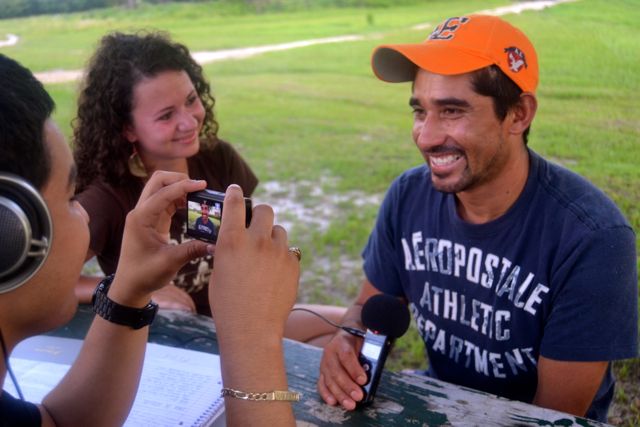


 From my 2014 blog The Considerate Omnivore…

