In the 1840s, the microorganism Phytophthora infestans began killing potato plants across Europe. The blight devastated crops for years, and nowhere was harder hit than Ireland. The resulting Irish Potato Famine, also known as the Great Hunger, changed history in a big way. Nearly half of Ireland’s eight million residents either died of starvation or fled to the United States.
Among the refugees were William and Bridget Gaul. They had married in Ireland, right around the start of the famine, and started a family there. William emigrated first, perhaps in 1850, settling in Jerseyville, Illinois. In 1851, Bridget, known also as Fanny, emigrated with their son William, born 1843, who would go by Billy his entire life. Bridget was apparently quite pregnant at the time, as Billy’s brother John was born en route from Ireland. William and Bridget’s eldest child was Helen Marie, born in 1842, who would go by Nellie or Ellen. We don’t know when exactly she emigrated.
The entire Gaul family was together in Jerseyville, but sadly not for long. Billy’s father William died around 1853. Bridget may have had no choice but to break up the family, as Billy was then taken in by the family of William Massey, a prominent landowner, who put him to work as a farmhand. The widowed Bridget married Dennis Hennessey in 1863. She lived until 1902 and is buried in Dahlgren, Illinois, as Fanny Hennessey.
In November 1861, eighteen-year-old Billy answered President Abraham Lincoln’s call for volunteers to suppress the southern rebellion. Many early enlistees in what was then known as the War of the Rebellion saw service as a chance to elevate their status from immigrant American to simply American. Billy’s reasons may have been less patriotic. According to what he later told his grandson William Durbin, he was paid—perhaps as much as $400 (over $15,000 today)—to enlist in someone else’s place.
After mustering in at the fairgrounds of Carrollton, Illinois, Billy and the rest of Company C, 61st Illinois Infantry Regiment, survived one of the war’s first major engagements at Shiloh, Tennessee, in April 1862. Although Billy left no written record, another member of the regiment, Leander Stillwell, published a full memoir, giving us a good sense of where Billy was and when.
Billy nearly died later that year—not in combat, but while passing a halted wagon train during a long march between battlefields. A mule kicked him in the head. The injury, according to surgeon affidavits from his pension file, was severe and bone-shattering. Yet he not only finished his three-year enlistment, he re-enlisted in 1864.
His sense of duty had limits. In August 1865, four months after Lee’s surrender, when his superiors refused to send his regiment home, Billy deserted. His departure was duly recorded, along with a notation that he owed the U.S. government sixty-nine cents—for the waist belt, plate, and cartridge box he took with him. In 1884, Congress passed a law removing desertion charges from soldiers who had left service after the war had ended. Billy’s status was changed from dishonorable to honorable. We don’t know if he ever paid back the sixty-nine cents.
In 1866, Billy took advantage of the Homestead Act, acquiring 160 acres in Kansas for a $10 fee and a promise to live on it for five years. One year later, he sold the land for $2,200—a 10,000% return and a complete violation of his homestead pledge. By numerous accounts, honorability would never be one of Billy Gaul’s long suits.
Sometime after the war, he married Mary Cummings. They would have twelve children, one of whom was Margaret Gaul, born in 1883 in Monmouth, Illinois—the future wife of Oscar Durbin.
Many of the Gaul children, like the Durbins, would eventually settle in East St. Louis. In addition to Margaret and her husband Oscar, these included Delia Gaul, Mary “Mame” Gaul (who married John “Jack” McGlynn), Ellen “Nell” Gaul (who married Pat Hargrove), Patrick Henry Gaul, Peter Gaul, John Gaul, Lawrence Gaul, and Kathryn “Kate” Gaul (who married Ira McPherson).
Billy himself was rarely around. When interviewed in the 1980s, his granddaughter Margaret Petterson referred to him as a rounder.
“What’s a rounder?” she was asked.
“It’s a drunkard who leaves his family and only comes around to pick up his pension check,” she answered through pursed lips. And that’s the last she wanted to say about Billy Gaul.
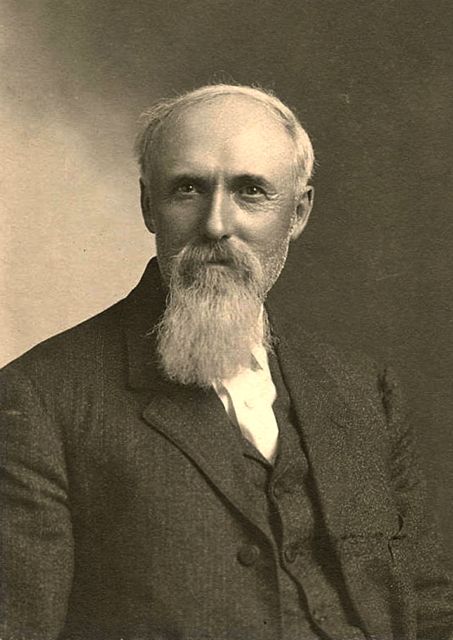
William “Billy” Gaul died in 1929 at age eighty-six. Mary Gaul died the following year in Dahlgren.

Next: 7. William Oscar & Margaret Durbin 1902-1961
Previous: 5. Pius Anselm & Teresa Durbin 1880-1938
 Michael Durbin