There are three families in our history whose stories were so intertwined, whose connections were so essential to understanding this history, that it’s impossible to tell the immigration story of any one of them without telling the others.
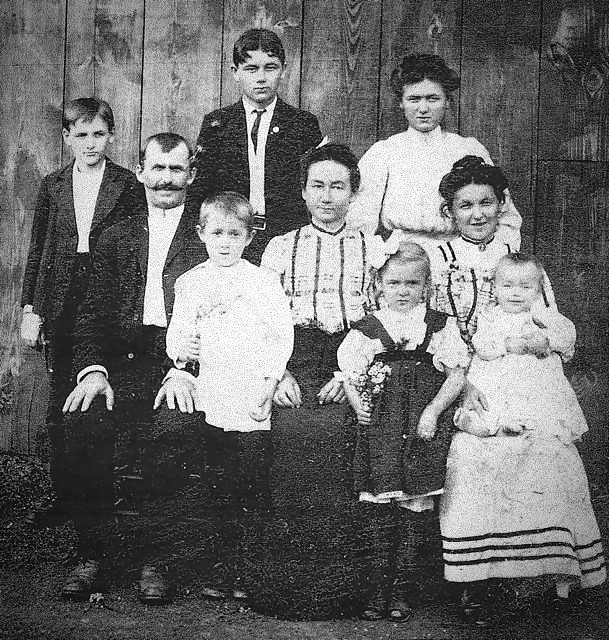
In 1867, Leonard Krokvica was born in what is today Slovakia. We don’t know who his parents were nor anything else about Leonard’s youth, but we do know that in 1892 he married Marie Nemec. She was born in 1870, also in what is today Slovakia. Her father’s name may have been Martin Neme. Their first child, Anna Krokvica, was born in 1894 in the village of Subocka, which we believe is today the Croatian village of Nova Subocka. Their second child, Josephine Krokvica, was born around 1899.
Leonard was drafted into the army, presumably not long after Josephine was born. Unhappy with this fate, he immediately looked for any chance to get out. He found one in 1903. That’s when he fled for America, his pockets bulging with family money, promising to find work and send money home to his wife and two children. He then broke both of those promises.
Years went by with no word from Leonard, and Marie could only wonder what had happened. Did he make it to America? Was he still alive? Around 1907 she got word from a relative that yes, he was alive, living in East St. Louis, doing quite a lot of drinking and not much else.
Demonstrating a sense of responsibility and resourcefulness for which she would be known her entire life, Marie at age thirty-seven raised money for passage on her own, in part by selling every family possession they had. She and daughters Anna and Josephine got on a boat and arrived at Ellis Island on February 21, 1908, before continuing to ESL.
Interestingly, Marie also brought a third young woman through Ellis Island: sixteen-year-old Maria Krokvica. But only Marie and her two girls, eleven-year-old Anna and nine-year-old Josephine, continued to ESL. Maria’s identity (whose daughter was she?) and fate (did she go from Ellis Island to some other destination? did she survive?) remain a mystery.
Marie did indeed find her husband in East St. Louis, living in a flophouse, his pockets empty. Leonard had squandered the family money with nothing to show for it. The Krokvica family was back together—but broke.
Marie and both preteen daughters went to work at the meatpacking houses of ESL. School for the girls was out of the question. They and their mother worked for five to ten cents an hour, ten hours a day, six days a week. For extra money, Marie also raised chickens to make pillows. It’s not clear if Leonard went to work or not, but he lived with his family for at least a short while. Leonard and Marie’s third daughter, Mary Krokvica, was born in ESL in 1909.
Stefan Kalis was born in 1861 in the Austro-Hungarian village of Rokoluby Okres Beckov in the state of Trenčianska, today part of Slovakia. Katarina Jurda, who went by Kata, was born in June 1869 in the Austro-Hungarian village of Caskorce Okres in the state of Nitranska. They married in 1886, presumably in Rokoluby.
The Slovak region where the Kalis and Jurda families lived was comparable to twentieth-century West Virginia: mountainous, isolated, and with relatively few job opportunities. At some point, Stefan and Kata migrated about four hundred miles southwest into what is now Croatia.
Stefan had better luck finding work in this more populated region of Austria-Hungary, ultimately becoming the town notary in the village of Banova Jaruga. It was a powerful position for someone with his presumably limited education.
Stefan and Kata had six children: Annie Kalis in 1886, Louis (originally Ludwich) Kalis in 1888, and Mary (originally Marija) Kalis in 1892. We believe Annie, Louis, and Mary were all born in Rokoluby. Mike (originally Mijo) Kalis was born in 1894 in the village of Krivaja, now part of Serbia. Joseph (originally Josif) Kalis was born in 1901, and Mildred (originally Amalija or Milka) Kalis—who also went by Emma—in 1902. We think Joseph and Mildred were born in the village of Lipovljani, now part of Croatia.
In 1903, Annie at age seventeen fled the family, reportedly to escape her abusive father. After saving up money for passage, she got on a boat to New York. She worked there as a housemaid before moving on to East St. Louis. There, she earned enough money to send for her brother Louis, who arrived in ESL in 1904 at the age of fifteen. He soon found work at the Swift meatpacking house.
Back in Austria-Hungary, Stefan may have suspected his eldest daughter was trying to break up the family. And Kata was no doubt grieving. She had been pregnant eleven times, miscarrying five times. Two of her six surviving children were now gone.
In 1906, Stefan and Kata emigrated with their remaining four children to join the others in East St. Louis. After many days at sea, they arrived at Ellis Island only to encounter a problem. The immigration official would not allow five-year-old Joe to enter the United States due to his physical condition. He had weak legs, apparently due to polio. After some special procedures—or maybe just pleading by his distraught mother—they finally let him through.
The officials at Ellis Island may also have been responsible for something else. After immigration, everyone in the Kalis family thereafter went by Kalish, adding an “h” to their surname. This may have been at the suggestion—or misunderstanding—of an immigration official.
Stefan Kalish had no trouble finding work in the meatpacking houses of ESL, but the manual labor was a step down from his position of respect as a notary public back in Banova Jaruga. He swallowed his pride and did his work.
In 1906, soon after her family’s arrival, eldest daughter Annie Kalish married Frank Stengel, a butcher. Their first son, Frank Stengel Jr., was born that same year. Their second son, Charles Stengel, was born in 1908. The elder Frank Stengel died when the children were very young. Annie then married Mike Bukovich, and they had a son, Mike Bukovich Jr.
In 1910, Stefan and Kata saw the marriage of daughter Mary to Franz Kavalir. He too had immigrated from Austria-Hungary. 1910 may indeed have been one of the happiest years in Kata’s life. The entire Kalish family, except for Annie and Frank Stengel—but including Mary and Franz Kavalir—lived under the same roof at 320 Winstanley Ave.
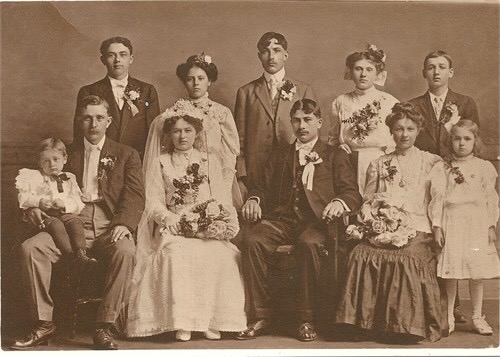
Also in 1910, on September 3rd, Louis Kalish and Anna Krokvica were married in East St. Louis, joining the two families together. They presumably met at the Swift meatpacking house. As they had both immigrated from Austria-Hungary, each with Slovak parents, a common language may have helped them find each other.
The ceremony was officiated by a justice of the peace, as they had no money for a traditional wedding—and because time was of the essence. On September 29th, Anna Kalish gave birth to a baby girl, Meri Kalish. She lived only a short time, but for how long exactly we don’t know.
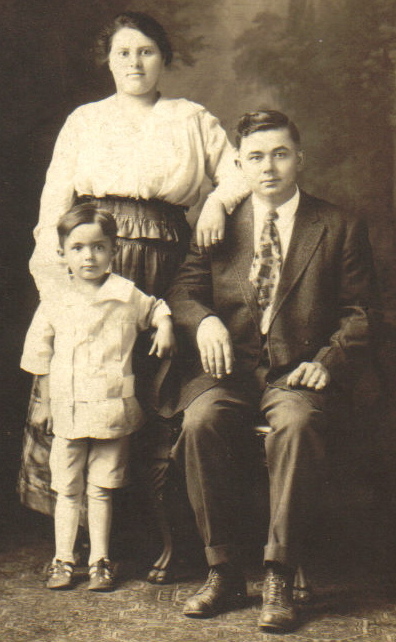
By this time, Louis had been working at Swift for six years. He worked seven days a week, ten hours a day, for ten cents an hour. In 1912 he was offered a fifty percent raise, to fifteen cents an hour, if he would relocate to a plant in Oklahoma for a job as a supervisor. He and Anna, who was expecting a child at the time, seized the opportunity and boarded a train to Oklahoma City. Their son, James Kalish, was born there in August 1912.
It didn’t take long for Louis to learn something in Oklahoma that he hadn’t been told before leaving East St. Louis: The man who held his job before him, when he was fired, had vowed to kill anyone who tried to take his place. Apparently, the disgruntled ex-supervisor meant to make good on the promise.
The death threat, and the distance from family and others in their ethnic circle, was enough to convince Louis and Anna that Oklahoma was not working out. They left after less than six months with baby James.
In 1916, a third family joined the picture when Leonard and Marie Krokvica’s second daughter, Josephine (she went by Josie), married Steve Walko. Like the Krokvica and Kalish families, Steve J. Walko had also immigrated from what is today Croatia, at the age of sixteen, around 1911. Unlike the others, he had been born in Croatia, in the town of Staro Petrovo Selo, in October 1895.
Steve’s passage was apparently financed by brothers John and Pete, whose emigration preceded his. He also had a sister who remained in Europe and was a twin of one of his siblings—we don’t know which one. Soon after arriving, Steve found a job at an ESL meatpacking house where he presumably met Josie.
The 1910 marriage of Louis Kalish and Anna Krokvica, and the 1916 marriage of Steve Walko Sr. and Josie Krokvica, brought the Kalish, Krokvica, and Walko families together in a way that would define the next era of this history. What happened to these newlywed immigrants is a true multi-family story.
It began when everyone grew weary of working in the meatpacking houses. They found a way out due to the ingenuity of the youngest of the Kalish boys, Joe—the one almost turned away at Ellis Island—who discovered that skinning calves and boiling bones was not the only way to make money in East St. Louis.

Next: 13. The Zeigler Era 1912-1922
Previous: 11. Adam & Julia Malec 1881-1959
 Michael Durbin