Adam Malec was born in 1881 in the village of Lisia Gora, in what is now Poland, to John Malec and his wife, Sophia. We think her maiden name was Rzaczelko. Adam’s mother died when he was young, and his father soon remarried. We don’t know his second wife’s name. But we do know she was not nice to Adam.
At age thirteen, Adam fled the family farm to get away from his unkind stepmother. So desperate was he to escape that he walked more than six hundred miles to Hamburg, Germany. One of his first stops there was a cobbler shop—presumably to fix up those shoes. The repair may have involved some barter, as Adam stayed in that shop for the remainder of his teenage years, working as a cobbler’s apprentice while saving money for passage to America.
He was twenty years old when he crossed the Atlantic in 1901, departing Hamburg and arriving in New York. His accommodations were zwischendeck, or steerage. Unfortunately, something didn’t go right with the immigration officers at Ellis Island. He was denied entry to the United States. Somehow, he made it to Chicago, presumably by way of Canada.
Adam wanted to join his older brother Stanley, who had also emigrated from what is now Poland and found work in the meatpacking plants in Chicago. Stanley worked in a treacherous place where workers were valued little more than the hogs and cattle they butchered, a place made infamous by Upton Sinclair’s classic novel The Jungle.
Adam, in fact, arrived in Chicago around the time Upton Sinclair was there researching his book. They may have passed each other on Halsted Street or in a tavern in the Back of the Yards neighborhood. But Adam didn’t stay long. Stanley directed his brother three hundred miles downstate to East St. Louis, where there were also meatpacking houses and where jobs were said to be more plentiful.
Adam took the advice, went south, and soon got a job at the huge Swift and Company operation. For lodging, he found an inexpensive boardinghouse on 3rd Street, where there were four beds for men in the living room. In the dining room were four beds for women.
Julia Walczak was born in 1886 in Lukowa, in what is now Poland. Around 1902, she convinced her skeptical parents to let her leave for America. A cousin in the navy had told glorious stories about the exciting country where it seemed everyone in Central Europe was headed. He also gave her the name of a supposed distant relative living a prosperous life in East St. Louis.
Julia wrote to this woman, who sent back a letter urging her to come, going on to say how there was plenty of room in her big house for a member of the family and assuring her parents the teenager would be well cared for. Julia arrived at Ellis Island with $12, a cruciform candlestick to remind her of home, and a ticket to East St. Louis.
When Julia arrived at the house on 3rd Street, she soon learned the “big house” was an overcrowded boardinghouse for packinghouse workers. She had been scammed. Julia—victim of what today would be considered human trafficking—soon learned she was expected to pay rent. The $12 did not last long.
To pay for one of those four beds in the dining room, Julia took a job in the sausage department at the giant Armour meatpacking plant, rival to the giant Swift plant where Adam worked. Adam and Julia may have worked at different packinghouses, but they came home to the same overcrowded boardinghouse. It did not take long for them to meet and begin socializing.
“It’s okay to go out with a man,” Julia would later tell her granddaughters. “But don’t let him give you any beer!”
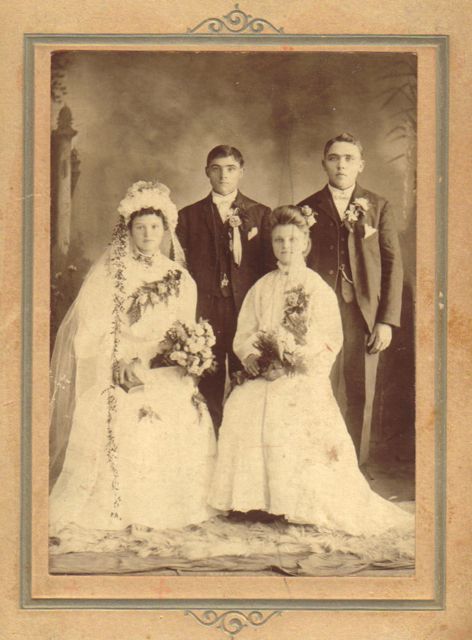
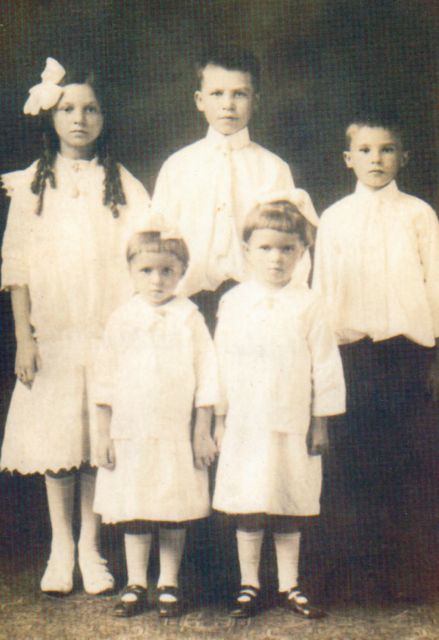
Owing to a fateful beer, the proximate sleeping quarters, or both, Adam and Julia were married on August 28, 1905, at St. Henry’s Church on Illinois Avenue. Their eldest son, John Malec, was born in 1906. Over the next eight years, they had four more children: Felecia (Fay) Malec in 1907, Martin Malec in 1909, Aniela (Angie) Malec in 1912, and Bronislava (Bernice) Malec in 1914.
Adam and Julia’s first home was at 5th and Illinois, then 2nd and Exchange, then at 1117 8th Street, where they built a house in 1914. They also owned one of the lots next door, so they soon built a house at 1119 8th Street, which they rented out for supplemental income. The house on the other side was where the Kruta family lived and operated a bakery.
Adam was naturalized in 1916. He went to free night school at a local high school to learn English. Julia never learned to read or write English, but she could converse in it just fine. Adam read the newspaper to her every day.
The kids all went to eight years of education at the Polish Catholic school affiliated with St. Adalbert’s. Adam read to them too, and also helped with math, though he himself had only four years of schooling back in Poland.
Adam was a dependable provider, thrifty saver, and caring husband and father. He kept a set of shoe lasts brought from Europe, drawing from time to time on what he had learned in the cobbler shop in Germany to keep family shoes in good repair.
Adam did whatever was needed to be there for his family, but one thing he could not do was discipline his children. The emotional scars from his youth, at the hands of an abusive mother, left Julia to be the family disciplinarian. When their son John or daughter Fay arrived home after curfew, for example, Julia would send them out to the chicken shack in the backyard for handfuls of corn in which they were made to kneel.
Julia was forever resourceful and smart, and she too would do whatever was necessary to care for her family. When Adam was badly scalded by a tipping vat of boiling bones, unable to work for nearly a year while healing from wounds that nearly cost him his life, Julia hung up her apron and went back to making sausage at Armour’s. Later, once a full-time homemaker again, Julia continued to bring in money, this time without leaving the house.
Julia had only to open a rear window to hand over a few coins to a bookie running numbers up and down the alleys of East St. Louis, hiding the strips of paper indicating her bet in a turkey pot in the oven. She didn’t make a lot of money gambling but did have enough spare cash during Depression years to lend money to Kruta’s Bakery next door when they needed a short-term loan to buy sugar or flour.
The connection with Kruta’s Bakery and our family would continue for decades, with their signature cheese and apple strudel a fixture of Sunday dinners well into the 1970s.
Adam and Julia’s work ethic rubbed off on all their children. As an adult, daughter Fay worked at the Switzer Licorice factory in St. Louis. In 1929 she married Joseph Przybylski, with whom she would live in St. Louis for the rest of her life. She died in 2002 at the age of ninety-five.
John Malec married Catherine Novak in 1941, and they too settled on the St. Louis side of the Mississippi River. He started his career as an office worker until his parents gave him money to open a restaurant in St. Louis, where he and his sister Angie worked until it folded. John was then an office worker again for the rest of his life, living until 1969, when he died of cancer at the age of sixty-three.
Angie Malec did not marry. But she did brighten the lives of nieces Lorraine and Jackie Kalish, and Dolores Przybylski, at every opportunity—letting them play with the costume jewelry she kept in a big metal tin, teaching them to play Chinese Checkers, and buying them a Ouija board when they were teenagers. After her parents died, she shared the house with her brother Martin—and a large number of cats—and worked at the Hunter’s packinghouse. In 1965 she was diagnosed with breast cancer and died two years later at the age of fifty-five.
Martin Malec also worked at the Hunter’s packinghouse, eventually managing the arrival and departure of shipping trucks. He was an accomplished bowler, loved playing golf, and enjoyed many years as an unmarried bon vivant who delighted his grandchildren by giving each of them a quarter on every visit. At the age of sixty-four, deciding it was time to settle down, he married Hattie Budryk in 1973. Martin lived until 2001, when he died at the age of ninety-two.
Youngest daughter Bernice Malec went only to the 8th grade, then went to work at the Bemis Bag Company in St. Louis, a manufacturer of machine-sewn cotton bags for milled food and grain products. Bernice worked until she met an exceptionally fit and educated young man named James Kalish when he was in East St. Louis on a visit home from college. They married in 1933 and went on to have three children: our mother Lorraine, Jacqueline (Jackie), and James (Jim). We’ll come back to the story of James and Bernice Kalish later on.
Adam and Julia Malec, once a pair of immigrants with little more than a candlestick and a set of shoe lasts, had figured things out. They made life work. And as their own children grew into adults, they remained model parents and grandparents, demonstrating their love of family on every occasion—a love that sprang from the love Adam felt for Julia and the love she felt for him. They depended on each other. Deeply.
One day in 1958, at the age of seventy-two, Julia went to the kitchen for a drink of water. As she held the glass to her mouth, a brain hemorrhage struck and sent her to the floor. Adam was still grieving when, a few months later, he was diagnosed with prostate cancer. His doctors explained his options. Adam just shook his head and refused all treatment.
“I don’t want to live,” he told his doctor and family. “Not without my Julia.”
He died in 1959 at the age of seventy-eight.

Next: 12. The Kalish, Krokvica, and Walko Families 1867-1916
Previous: 10. Austria-Hungary
 Michael Durbin