Fairview was unincorporated in the 1960s, when the Durbin family moved there from East St. Louis. There was no mayor or city hall. It was just the area on either side of a two-mile stretch of Highway 50, its eponymous name invented around 1905 by a Dr. Fairbrother, one of the first known landowners in the area.
Along those couple of miles of Highway 50 were a dozen or so houses of varying ages, side roads that went off into new subdivisions and old farms, and a handful of small businesses and whatnot. For the Durbin kids, that stretch of road—with the Fairview Beer Garden at one end and St. Albert the Great Catholic Church at the other—would be their universe for the next eleven years.
The split-level house was modern for its day. It was square and boxy and sat on the corner lot where Primrose Lane met North Point Road. The ample lot was as verdant as the lunar landscape. There was no money for grass, trees, or shrubs. Nor was there money for furnishings to fill out the larger space inside. Bill and Lorraine took care of that, in part, by pooling all the kids’ savings and using it to buy end tables and lamps. The kids were too young—or maybe just too excited about the new house—to notice their life savings had vanished.
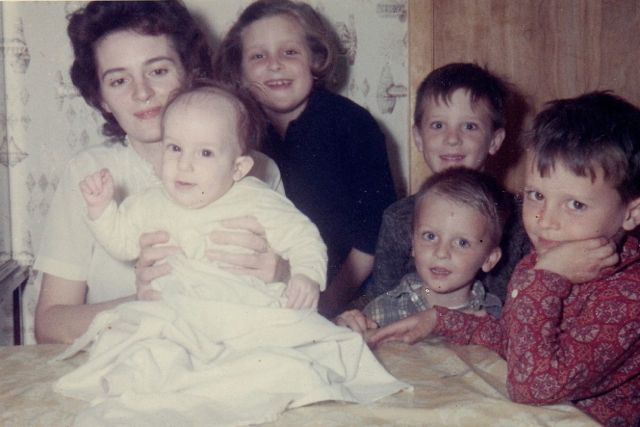
Bill and Lorraine’s family of eight filled the new house to capacity the day they moved in. Barb got a room of her own, and Bill and Lorraine took one of the smaller bedrooms so they could pack bunk beds into the master. Three boys went in there. Dan and Steve slept on green vinyl sleeper sofas in the basement.
Later, Dan and Steve would occupy a bedroom Bill built in the basement, a cozy space that doubled as Bill’s study. The desk in there, which Bill built himself, was an ingenious thing consisting of a flat-panel door attached by its hinges horizontally to the wall, held up on either end by heavy chains.
Money was tight as ever, but life was good as this family settled into its new home in the fall of 1962. Dan, Steve, and Barb attended school at St. Albert’s Catholic School, at the intersection of Highways 50 and 159, while the three younger kids kept Lorraine busy at home.
A few years later, when the monsignor at St. Albert’s asked Bill to put more money in the collection plate, our parents realized that parochial education would have to go. They transferred their kids to Grant Elementary, the public school just a bottle-throw from the Fairview Beer Garden. Grant was located on Lincoln Trail, so named because President Abraham Lincoln once spent the night at a house across the street—or so the story went.
Bill found co-workers at ACIC to start a carpool so Lorraine could have the car a few days a week. She had dinner ready at 5:00 o’clock sharp every evening, which Bill preceded nightly with a Beefeater martini, very dry. After dinner, there were plenty of hands to clean up the kitchen in time for the fifteen-minute evening newscast on TV.
The biggest national news of 1962—maybe the biggest world news—was the Cuban Missile Crisis. From October 14, when news came out that the Soviets were installing nuclear-tipped missiles a short ninety miles off the coast of Florida, until October 28 when Nikita Khrushchev realized that putting atomic weapons so close to U.S. soil wasn’t such a good idea and halted the project.
Bill was even more spooked than the rest of the country, watching those newscasts in our basement. He and everyone else in the defense department were on high alert, preparing daily for the very real possibility of global nuclear war. As he came home from the office each day, those martinis tasted pretty damn good.
One evening just a few weeks after the missile crisis, shortly after Walter Cronkite ended the nightly CBS News with his famous “And that’s the way it is,” Lorraine headed upstairs to fix holes in underwear. Alone for the first time that day, opening the old fruitcake tin that held sewing supplies, she looked forward to the peace and quiet.
Those plans were soon thwarted by labor pains. She’d been through the drill and knew just what to do, and got herself calmly down the stairs to tell Bill. The kids were in front of the TV looking forward to an evening of prime-time shows—Bonanza, The Flintstones, and the brand-new Beverly Hillbillies—when Bill’s voice echoed down the stairs.
“Everyone in the car!” he yelled.
Bill put everyone in the blue Ford station wagon and soon the family of eight was off to the hospital. A few hours later, after the birth of this writer, they came home a family of nine.
In the summer of 1964, our Grandma Durbin built a house at 112 Primrose Lane, just next door to ours. It made sense she would leave East St. Louis to be closer to family. But for reasons not entirely known, Dad’s mother had not told anyone of her plans to build a house on the lot next to ours until tractors were digging the foundation. Mom and Dad scratched their heads at the news, but their kids could not have been happier that Grandma was moving next door.
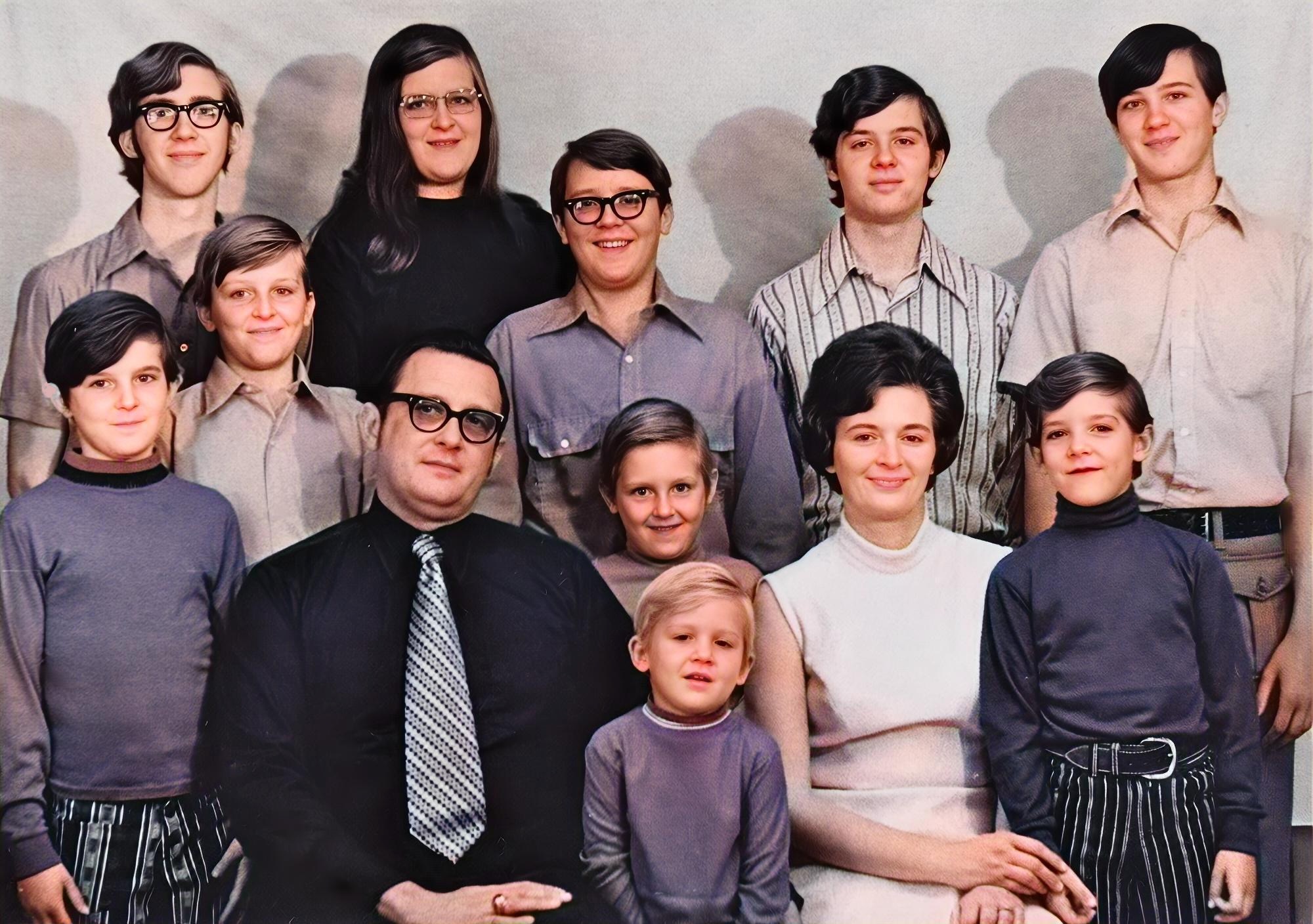
We grew to a family of ten kids with the arrivals of my brothers Marty, Ken, and Dave in 1965, 1966, and 1968, respectively—Barb would be the only girl. On her doctor’s advice, Mom decided this was enough. As much as my parents’ families welcomed each new Durbin baby, they too thought ten might be enough. Mom’s dad, our Grandpa Kalish, playfully recommended the name Finneas for the final Durbin child. They stuck with Dave.
By the time of their tenth child’s arrival, a routine was well-established: On weekdays, Dad would go off to his work over in St. Louis and Mom would stay home for her work in Fairview, taking care of us kids and the house.
Saturdays were workdays. Mom would use the family car to go to the beauty parlor and then the grocery store. Dad would stay at the house and put the kids to work cleaning the house and taking care of the yard, and giving haircuts to whoever needed one.
Sundays were reserved for going to church at St. Albert’s in the morning (first for Mass, then for Sunday school, which went by the cryptic name of Confraternity of Christian Doctrine, or CCD for short), then relaxing in the afternoon and maybe having relatives over for a dinner or barbecue, complete with a big metal tub filled with beer and soda on ice.
In 1966, Dad and the older boys put a fresh coat of paint on every room in the house, and our neighbor and State Farm insurance agent Warren Baker wrote Mom and Dad a new homeowners insurance policy on the house. Just a few weeks later, I nearly burned that house down. At the age of three, I was playing with the knobs on the kitchen stove and tipped over the milk carton where Mom stored bacon grease.
Miraculously, our home was saved by a volunteer fireman who happened to be driving up North Point Road only to see a tower of black smoke pouring out our kitchen window. Mom had just put the four of us kids at home into the car in the garage when the fireman burst into the house to help Mom put it out before damage could extend past the kitchen. But the smoke damage throughout the house was extensive. Every wall had to be repainted.
The older boys got an all-expenses-paid vacation as a result of my pyromania, staying with Dad at the Trailways Motor Lodge and Restaurant on Lincoln Trail, complete with daily maid service, all-you-can-eat meals, and a different dessert every night. Mom and the rest of the kids stayed next door at Grandma Durbin’s house while our house was restored.
Ann Durbin’s house at 112 Primrose would become one of the favorite places in the world for the Durbin kids. We could always count on a homemade cookie from Grandma, or cornmeal fritter, or a spoonful of a sweet and sticky concoction she called tutti-frutti and kept in a big jar over the washing machine. A single batch would seemingly last for months—I have no idea how it didn’t go bad.
Once our bellies were full, we could sit beside Grandma on her couch in front of the TV—it was a big color TV, much nicer than the black-and-white at our house—and pretend to help her do the crossword in the daily paper, or actually help her play solitaire on a sheet of brown Masonite placed across our laps.
Another favorite destination during our time in Fairview Heights was the home of Mom’s sister, our Aunt Jackie, and her husband Richard Mahoney. Like our family, they had moved from ESL, going even farther east to the rural town of Highland, to a house on a lake—complete with horses—about an hour west of Fairview. We would have many memorable visits to that wonderful place.
Next: 23. Civil Rights
Previous: 21. Fairview Heights
 Michael Durbin