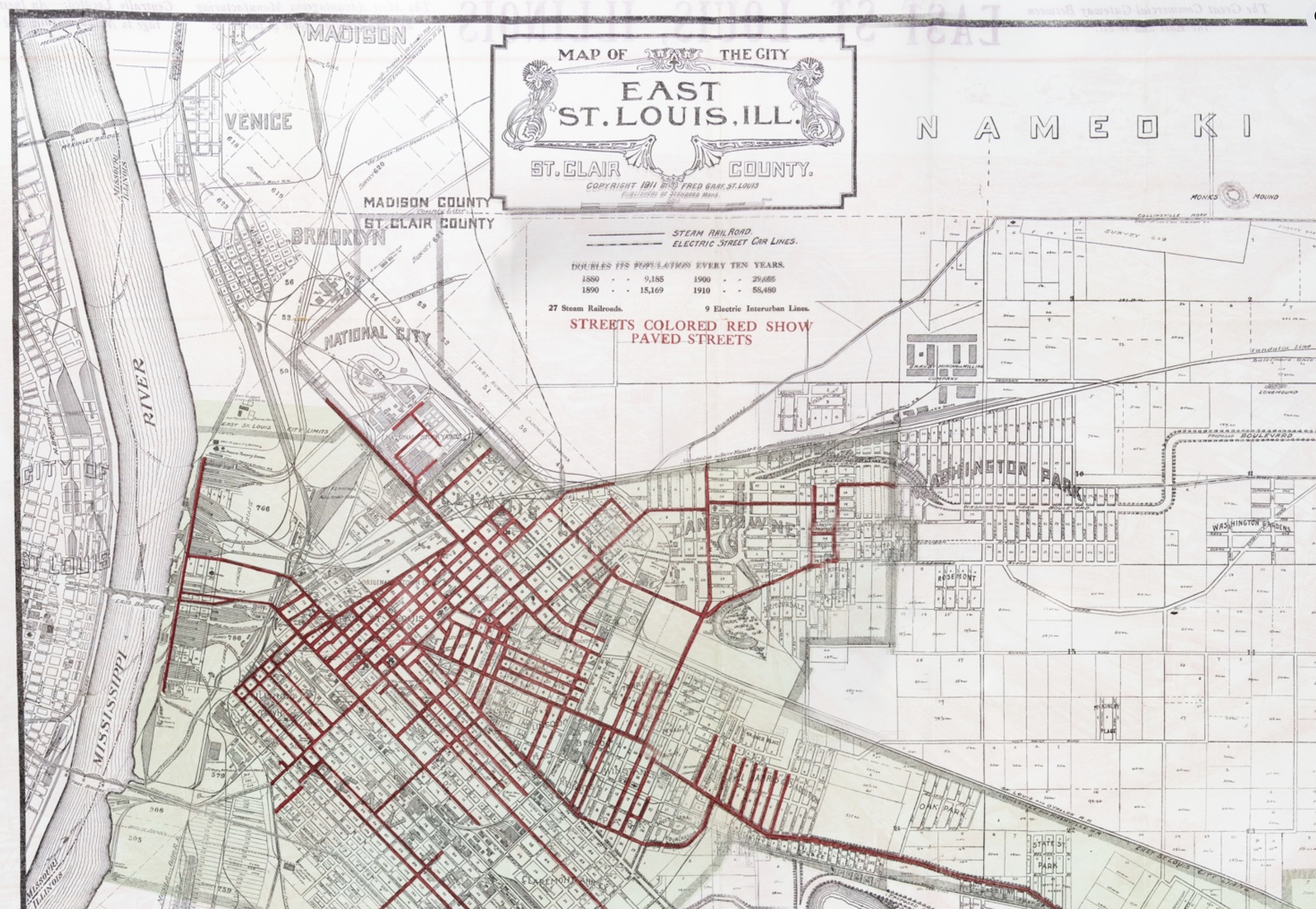
No place is more central to this story than East St. Louis, Illinois, a once-booming industrial town across the Mississippi River from the more affluent St. Louis, Missouri. Bill Durbin and Lorraine Kalish not only met and married there, but so did their parents and each of Lorraine’s grandparents. ESL is our ancestral nexus—the trunk of the family tree where all roots and branches converge.
Our parents, grandparents, and maternal great-grandparents all met there because in the early 1900s, East St. Louis was where a great many people came looking for work. Few of our arriving ancestors spoke English, but ESL had jobs for all of them. And that was fortunate. Had any one of them gone elsewhere, this family would not exist.
In 1905, Polish immigrants Adam Malec and Julia Walczak met at an East St. Louis boardinghouse for meatpacking workers. A few years earlier, Adam had fled an abusive stepmother in the Polish region of Galicia, then part of the Austro-Hungarian Empire. He walked more than six hundred miles to the port city of Hamburg, Germany, where he worked as a cobbler’s apprentice until he could afford passage to America, eventually finding his way to ESL.
Teenaged Julia was a victim of human trafficking. Deceived into believing she would be taken in by supposed “cousins” in East St. Louis, she left Galicia with her parents’ reluctant consent. When she arrived to find no cousins waiting, she had no choice but to work long hours at a packinghouse to pay for room and board.
Adam and Julia married soon after meeting. Their youngest daughter was Bronislava Malec, who went by Bernice.
In 1906, Slovaks Stefan and Kata Kalis left the Austro-Hungarian Empire with their three youngest children for East St. Louis, where their eldest daughter, Annie, had fled a few years earlier. Their eldest son had also already made his way to ESL in search of work. His name was Ludwich Kalis—Louis Kalish in America.
In 1908, another Slovak, Marie Krokvica, departed the empire with her two daughters in search of her missing husband, Leonard. She found him in East St. Louis. Their eldest daughter was Anna.
In 1910, Louis Kalish married Anna Krokvica. For several years they worked low-wage jobs in the packinghouses—until fortune struck in 1920 with the start of Prohibition. Teaming up with siblings and in-laws, they made a small fortune peddling bootleg liquor and prostitutes, only to lose it all after a series of misfortunes.
Louis and Anna had one son, James Kalish. In 1933, James married Bernice Malec, daughter of Adam and Julia. Their eldest child was our mother, Lorraine Kalish.
In 1911, one-year-old Ona Kutkaite arrived in East St. Louis from Lithuania. She traveled with her mother, Marcele, and two step-siblings to join her father, Rokus Kutka, who was already living there under the name Robert Kutin, working at a steel foundry. Ona’s childhood was marked by poverty, alcoholism, and neglect. Yet as the adult Ann Kutkin, she applied determination and intellect to forge her own path in life.
In 1912, six-year-old William Pius Durbin arrived in East St. Louis with his parents, William Oscar and Margaret Durbin. They had abandoned a failed farm in downstate Dahlgren, Illinois, where the family was nearing starvation. In ESL, William Oscar found far better fortune, first as a streetcar operator, then as a bus driver. His son, William Pius, went on to build a career in the railroads.
In 1928, after meeting on a blind date, William Pius Durbin married Ann Kutkin. Their first son was also named William Pius Durbin—whom I will refer to as Bill Durbin. His 1952 marriage to Lorraine Kalish marked the beginning of our immediate family. William and Ann’s second son was Robert Emmet Durbin, our Uncle Bob. Their third was Richard Joseph Durbin—known in the family first as Uncle Joe, then as Uncle Dick, and to the rest of the world as U.S. Senator Dick Durbin.
Most of our East St. Louis ancestors arrived as first-generation immigrants. One exception was William Oscar Durbin, already a sixth-generation American. His father, Pius Anselm Durbin, had been born in Kentucky to Robert Anselm Durbin, who was also born in Kentucky—to John Durbin.
John Durbin was born in Maryland before his father, Christopher, moved the family to Kentucky. Christopher’s father was Samuel Durbin, our earliest confirmed Durbin ancestor. We believe he immigrated from England or Wales (though some Durbin historians dispute this). Samuel worked as a toll road operator in the town of Owings Mill, just outside Baltimore. In 1723, he married Ann Logsdon, launching our branch of the Durbin line.
When our ancestors arrived, East St. Louis was a rough place. Unless you were desperate for a job and willing to live anywhere to get one—as they all were—it was not a desirable destination. “Only those who must,” it was said, “live in East St. Louis.” In 1913, John Chamberlain was elected mayor after campaigning on a promise “to make East St. Louis a little more like home and a little less like hell.”
By the late 1940s, when Bill Durbin and Lorraine Kalish were teenagers, conditions had improved dramatically. Meatpacking was a major and thriving industry, as was rail transportation. At one time, twenty-seven rail lines converged here, meeting at the foot of the marvelous Eads Bridge—the first to span the Mississippi River when it opened in 1874.
Mid-century was a good time for many children and grandchildren of Eastern European immigrants like ours, who had arrived decades earlier at this flood-prone bend of the Mississippi.
Life was not so good for the African Americans of East St. Louis. In 1917, race riots ravaged the city when mobs of angry—and tragically misled—white residents feared that Southern Black migrants were taking their jobs. For many of those born with dark skin, ESL would remain a kind of hell.
The 1950s brought another change of fortune to East St. Louis. Industries began shifting operations south in search of cheaper labor, and ESL—like many industrial cities—fell into steep and lasting decline. To offer just one stark metric: today the median home price in the United States is about $450,000. In East St. Louis, it is only $40,000.
In 1962, Bill and Lorraine Durbin moved their growing family out of East St. Louis, past Cahokia—where pre-Columbian Native America once thrived—and up the ancient Mississippi bluffs to a rural area known as Fairview.
In 1973, our parents moved the family from Illinois to Maryland, unknowingly completing a genealogical round trip. The town of Kensington, where we settled, was only a short drive from Owings Mill—where Samuel and Ann Durbin had started a family exactly 250 years earlier.
Next: The Essential Family Tree
Previous: Introduction
 Michael Durbin