Pius Anselm Durbin, born in Kentucky in 1847, was the seventh child of Robert Anselm and Elizabeth Durbin. For reasons unknown, he left his home state as a young man and moved one state north to Illinois. There, in 1870, at the age of twenty-three, he married Elizabeth Ellen Burtle of Sangamon County. She was twenty-two.
Their first child, Charlotte, was born in 1870. In 1872, Elizabeth was eight months pregnant with their second child when little Charlotte, not yet two, died. Three weeks later the grieving mother gave birth to a son. They named him Charles in honor of the big sister he would never know.
In 1873, Pius and Elizabeth took little Charles and headed west, crossing the Mississippi River the only way one could at the time, by ferry, to settle in Kansas and start a farm.
By then, the slave-free state of Kansas had dispossessed most of its Native American inhabitants and was actively enticing settlers of European descent onto its wide-open plains. Its state motto, per aspera ad astra—Latin for “through hardship to the stars”—was both a promise and a warning.
In Kansas, Elizabeth bore four more children, one of whom died at birth. In 1879, she succumbed to an unknown illness and died at just thirty-one years old.
Pius traveled back to Illinois to break the news and console his sister-in-law Teresa Burtle—then asked for her hand in marriage. They wed in 1880, and he returned to Kansas with his new wife—the sister of his late wife. In 1881, they welcomed a son: William Oscar Durbin.
Life on the Kansas frontier proved too harsh for Pius and Teresa, as it did for many. A brutal Midwest drought brought dust storms, grasshopper plagues, and despair—giving rise to a wry motto of the times: “In God We Trusted, In Kansas We Busted.”
Pius and Teresa cut their losses and moved to Missouri around 1882, where they had four more children. But farming life there was not much easier. After experiencing earthquakes along the New Madrid fault line, they grew fearful and decided to return to Illinois. With nine children in tow, they made the journey the only way they could afford: on foot.
This time, when they crossed the Mississippi, there was a bridge.
Completed in 1874, the Eads Bridge—designed by engineer James Buchanan Eads—was a technological marvel: the longest arch bridge in the world and the first to employ steel on such a scale. It was so daunting that many refused to cross it—until a circus elephant was marched across to prove its strength.
Around 1890, nine-year-old Oscar Durbin crossed that bridge into East St. Louis for the first time. Barefoot, he would later recall how the metal grillwork hurt his feet, and how he could see the brown water of the Mississippi—“the Big Muddy”—eighty-eight feet below.
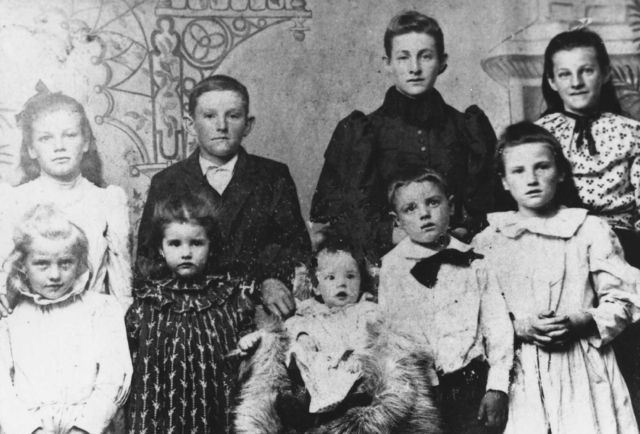
After crossing, the weary Durbin family passed through East St. Louis and continued south to Dahlgren, Illinois, about a hundred miles away. There, they once again took to farming. They had two more children in Dahlgren, bringing their total number of surviving children to eleven.
Another family in Dahlgren at the time were the Gauls, who had also failed to make a go of it in Kansas. Whether the two families had known each other out west is unknown, but their paths converged definitively in 1902, when twenty-one-year-old Oscar Durbin married Margaret Gaul, a second-generation immigrant from Monmouth, Illinois, whose father and paternal grandparents were born in Ireland.
In later years, Pius Anselm Durbin went simply by “P.A.” He died in Dahlgren in 1909 at the age of sixty-two. Teresa lived until 1938, dying at the age of eighty.

Next: 6. Billy & Mary Gaul 1845-1930
Previous: 4. Robert & Elizabeth Durbin 1833-1892
 Michael Durbin