After his discharge from the Navy, Bill Durbin resumed work at the New York Central Railroad. One of the employee perks was a pair of free tickets—once a year—to anywhere the NYC line went. The destination farthest from East St. Louis was Buffalo, New York, a short distance from Niagara Falls. So that’s where they went for their honeymoon.
The newlyweds planned to take photos with a camera Bill had picked up for a great price in Tokyo. Sailors meandering the streets there could get just about anything cheap in those years just after World War II, killing time on leave while Japan was still emerging from ruinous defeat.
Unfortunately, Bill Durbin’s beautiful new bride left his beautiful new camera on a seat when they changed trains in Cleveland. Their only photographic memento would be a postcard from the Lafayette Hotel in Buffalo, where they stayed. Lorraine felt terrible about losing the camera, but Bill, from his perch on cloud nine, forgave her without hesitation.
Their first home was an apartment at 456 23rd Street, above the home of an elderly couple, Mr. and Mrs. Weir. Mom kept her job at the Swift meatpacking company as a Comptometer operator, using mechanical desktop machines to calculate employee bonus payments. Married women were allowed to keep their jobs—but not if they were expecting a child. Once Lorraine was six months pregnant, she had to quit.
Many employers in those days banned married women with children from their payrolls—men could, of course, have children or not—but the blatantly sexist policy, made illegal in later years, didn’t matter in this case. Lorraine Kalish was ready to spend the rest of her life as a full-time wife and mother.
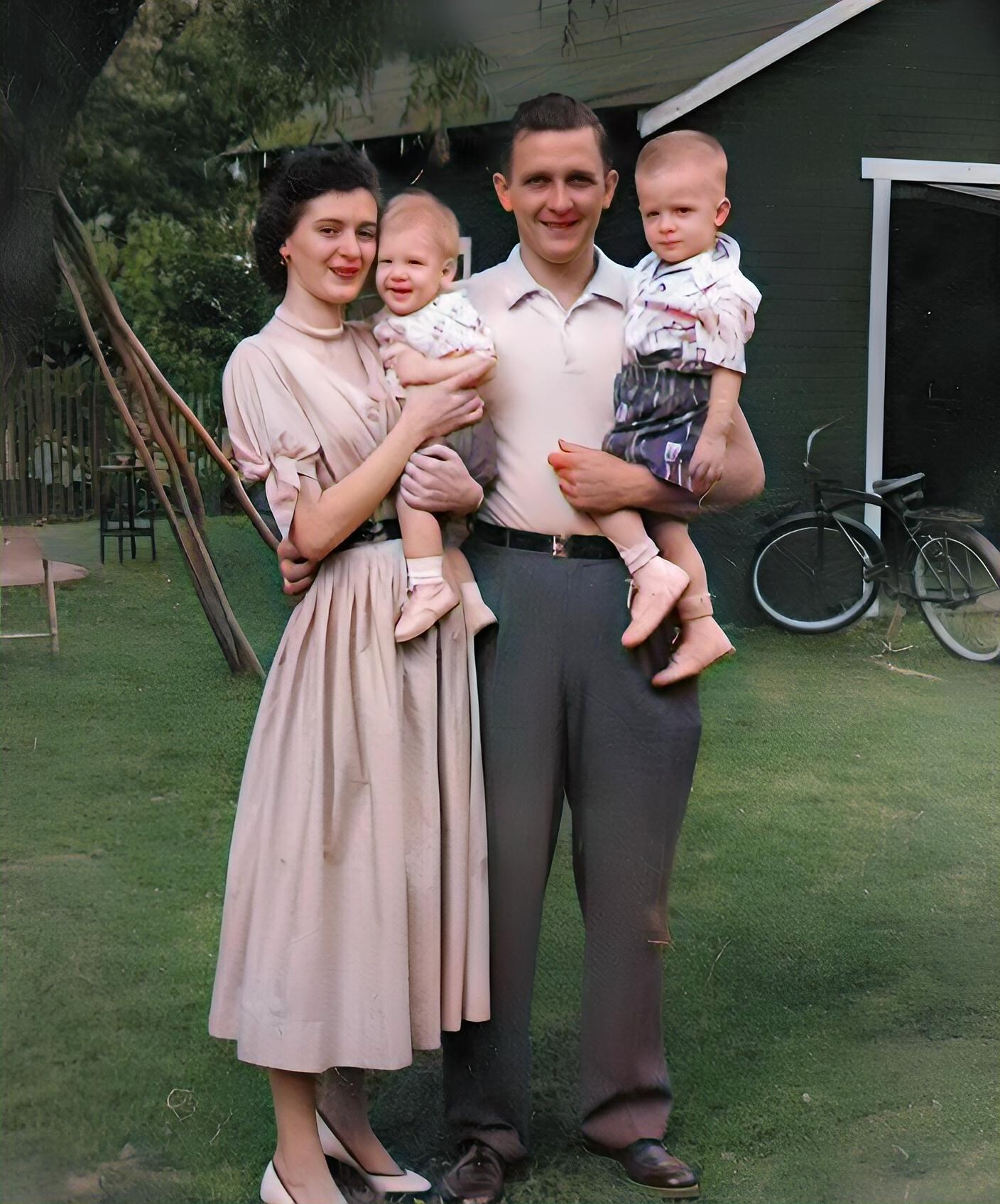
Their first child, Dan, was born in 1953. With the arrival of a child and visions of a few more to come—Mom imagined five kids would be nice—thoughts turned to Bill’s career. In the fall of 1953, he enrolled in night classes at St. Louis University. He already had a few credits from Belleville Junior College, from before he enlisted in the Navy, and the GI Bill—an act of Congress ensuring veterans wouldn’t have to pay for a college education—would cover the cost of completing his degree.
Bill’s parents were perplexed by the college decision. They thought the son of a Chief Clerk for the venerable New York Central was crazy to even consider wasting time at college when his future on the railroad was so bright. He didn’t like the idea of bucking the will of his parents and knew he’d have to keep a full-time job while he went to school, but he and Lorraine knew this was the right thing to do.
When they learned a second child was on the way, Bill and Lorraine started thinking about a house of their own. Bill’s paternal grandfather, William Oscar Durbin, had died in 1950 while Bill was away in the Navy. He left a small nest egg for his widow, Margaret. She offered some of it to Bill and Lorraine to help with a down payment.
The bigger problem with finding their first house was redlining—a widespread practice whereby banks would not lend money to buy houses in areas that “had turned,” that is, where Black families lived. By the waning months of 1953, the “color line” had already crossed into most of the neighborhoods of East St. Louis where Bill and Lorraine could afford a house, but there was a block of Ridge Avenue where every house was still owned by a white family. State Savings & Loan was still writing mortgages for those houses. In February 1954, Bill and Lorraine bought a two-bedroom house at 2719 Ridge Avenue for $9,450.
The location was perfect. It was a short walk north to State Street, an arterial road where you could walk or catch a bus to just about any place you’d want to go. Bill’s grandmother Ma lived around the corner at 484 29th Street, and his parents and younger brother Joe still lived next door at 486.
Their second child, Steve, was born in 1954, and third child, Barb, in 1955. Bill’s daily work-and-school grind soon became a daunting challenge—and not just for him. With only twenty-four hours in a day and having to work nights and attend classes during the day, the only time he could sleep was in the afternoon and early evening. Lorraine had to somehow keep a house of young children quiet during these hours and thanked God for the coal bin in the basement. She could have the kids play in there while Bill slept.
In 1957, their fourth child, Bob, was born. Later that year, trying to do math homework on a mind starved for rest, Bill reached a breaking point. He threw his books into the wastepaper basket, marched to the kitchen, and announced to Lorraine he was giving up school. She promptly towed him back to the bedroom, retrieved those books from the trash, and ordered him to plant his butt back in the chair.
“If I can go through this, then so can you!” said the mother of four, her own mind addled by sleep deprivation and exhaustion. Bill got back to his homework and never did that again.
When the kids weren’t playing in the basement coal bin they could, of course, play outside, which they did as often as possible, with playmates both Black and white. Ridge Avenue “turned” in the mid-1950s and before long there were Black families living on either side of the Durbin family.
Bill and Lorraine liked this just fine. They thought it was the best way possible to learn racial tolerance and were glad the kids got to see firsthand that judging people by the color of their skin was just stupid. They did things any friendly neighbor might do—inviting their neighbors’ kids along on weekend fishing trips with their own, having them over for coffee or a beer, and accepting their invitations to backyard barbecues that featured whole pigs roasting over a pit dug into the ground. The Durbin kids didn’t have to be told that skin color didn’t matter. They saw it for themselves.
In February 1958, Bill received his undergraduate degree from St. Louis University, with a major in geology and a minor in math. Wanting to capture the event in photos—he was the first known Durbin ever to attend college—he loaded his camera with film and gave it to his brother Joe. The thirteen-year-old knew precisely how to use the camera, taking practice photos before the ceremony of the floor, the ceiling, and some more of the floor. By the time his big brother walked across the stage, the camera was out of film.
Between losing a camera on his honeymoon and getting no college graduation photos, Bill was not having much luck with cameras.
The 1958 birth of their fifth child, Ed, made it clear Bill would need a better-paying job. He was elated to soon get an offer from none other than Standard Oil, as a field geologist helping to locate oil reserves. The offer came with just one catch: the job was in Libya. Bill and Lorraine soon found themselves telling slack-jawed family they were moving to North Africa, quite literally about as far from East St. Louis as one could get.
As it turned out, Standard pulled the job offer just weeks after extending it, citing vague economic reasons. The reversal sent Bill Durbin into the dumps. No other job offers came in, and he began to wonder if his years in college were a complete waste. Luck turned at a summer party as Bill sipped a beer while bellied up to the basement bar of close friend Al Janacek.
“I’ve got a geology degree and a rock hammer,” complained Bill. “But no place to swing it.”
Bill was crying in his beer to just the right guy. Al Janacek worked for the Aeronautical Charts and Information Center, or ACIC, a branch of the U.S. Air Force located in St. Louis. Bill learned they were hiring something called earth scientists—and that sounded a lot like a geologist to him. He soon had a job offer, but it came with a catch: a pay cut.
Bill was earning $4,000 a year as a clerk at the New York Central, and the ACIC would pay only $3,000. He and Lorraine took the long view, predicting that a career as a government scientist would eventually pay more than one on the railroad. They took out a second mortgage to cover their cash flow shortage, and when they needed a short-term loan to make it to payday—or a few pounds of meat to cook up for dinner—they weren’t too proud to reach out to family and ask.
Just as Bill Durbin came on board, ACIC was sending new recruits to a year-long program at Ohio University to learn a radical new scientific technique known as geodesy. Bill threw his hat in the ring and went to Columbus for the first half of the program. Geodesy deals with the precise measurement of the surface of the Earth from space and the effects of gravity. Bill ate it up.
When he did well in preliminary coursework and was allowed to stay for the remaining six months, Lorraine and the kids found a renter for the Ridge Avenue house and went to Columbus to be with Bill. The apartment there was hotter than hell and way too small for a family of seven. It grew to eight when their sixth child, Bill Durbin, was born in 1959—the only one of their kids to be born outside Illinois. When the little Buckeye was eleven days old, the family returned to East St. Louis and the house on Ridge Avenue.
Next: 20. The Cold Warrier
Previous: 18. The Navy Years
 Michael Durbin