You grow what?

Cannabis plant

listen or read

A few years ago, researching a book about farmworkers in rural North Carolina, I visited a labor camp and got an unexpected answer when I asked what crop the men were growing. What follows is an audio essay about the surprisingly thin line between hemp and marijuana, the H2A guest worker program that brings hundreds of thousands of Mexican men to American farms each year, and what happens when a curious writer and his wife ignore the instructions that came with their THC edibles. 

Listen here:

read here

Finding America’s Farmworkers

Finding America’s Farmworkers: Reaching Out in North Carolina

When I moved to North Carolina from Chicago in 2005, I had no idea that so much of our nation’s food was still harvested by hand. Now, twenty years later, that hasn’t really changed. Much of the produce in any grocery store–the peppers and melons and berries and whatnot–is still picked by human hands.

What has changed is the number of so-called guestworkers those hands belong to. These are the citizens of other countries who leave their families for the better part of every year to work in US crop fields, authorized by an H-2A temporary seasonal visa. In the early 2000s, the number of H-2A workers across the US hovered around 50 or 60 thousand. Now it’s almost half a million. Most are from Mexico. Most are dads.

To the Mexican farmworker, the appeal of going north each year is obvious. Here, they can earn in one hour what might take two days back home. But they must live apart from their families for the better part of each year–typically 6-9 months, often longer–and live in a labor camp that may or may not comply with even the barest of housing standards.

For many years, no state brought in more H-2A workers than North Carolina. The nation’s very largest H-2A employer is here, as is one of the nation’s only farmworker unions. It’s an ideal place to peer into what works well in the H-2A program and what does not. In North Carolina one can also get a glimpse of true family farming operations, struggling to make ends meet, who depend on H-2A labor. There are scores of those. For the past few years I’ve been diving deep into this little known world, trying to understand it. I’ve done my best to convey what I learned in my book Finding America’s Farmworkers: Reaching Out in North Carolina.

With the second Trump administration now getting underway, nobody knows what’s in store for the army of guestworkers who depend on the H-2A program to feed their families–nor for the growers who depend on it to feed theirs. There were no day one executive orders aimed directly at the H-2A. Changes are expected, especially for US farmworkers outside the H-2A program, struggling moms and dads lacking work authorization, now at risk of being swept up in mass deportations.

In recent years, the population of agricultural guestworkers in the US has exploded. It’s not inconceivable that growth has just begun. If we are to continue growing food in this country, somebody must harvest all those peppers, melons, and berries. We may also see expansion of the guestworker program in other industries.

Before that happens, I hope we will consider what things are like today for all the homesick dads who work in our fields.

An H-2A farmworker looks out from his labor camp barracks in Sampson County, North Carolina, 2019. Photo by Michael Durbin

The Death of a Farmworker

We know he was 30 years old, a citizen of Mexico, working at a North Carolina tobacco and sweet potato farm. It was just the second week of his first year working there, authorized by an H-2A temporary seasonal work visa. We know area temperatures neared 100 on the fifth day of September. It was a Tuesday. We know someone at Barnes Farming Corporation, one of the state’s largest employers of H-2A guestworkers, whose president Johnny Barnes is the husband of State Senator Lisa Barnes, called 911. We know the responders arrived too late. They could not save the life of José Arturo Gónzalez Mendoza.

We do not yet know the details of how he died. According to Barnes, their new fieldworker went to rest on the field transportation bus after reporting to his supervisor he was not feeling well. Later, checking in on him, they called for medical assistance. His family told television news station WRAL he died of dehydration and heat stress. His brother told the labor advocacy group El Futuro Es Nuestro (It’s Our Future) the Barnes supervisor never gave José any medical attention.

Did Mr Gónzalez Mendoza show signs of heat sress? If so, did the field supervisor recognize them? One former employee of the North Carolina DOL Agricultural Safety & Health Bureau told me that the lack of sweat can indicate a body preparing to shut down from overheating. So heat stress might not be the first thing that comes to mind when you see someone on the verge of dying from it.

According to the North Carolina Department Labor, the state investigates, on average, two agricultural work-related fatalities per year. I don’t know why this one got the attention of CNN and nearly a dozen other media outlets. Most farmworker deaths go relatively unnoticed. I hope these journalists keep a lookout for the state’s report into this one, so we can better understand what happened to help keep it from happening again. Two farmworker deaths each year, in just one state, is clearly too many.

While waiting for the report, we can consider what we do know about farmworkers like Mr. Gónzalez Mendoza and employers like Barnes. There’s a lot to know.

According to H-2A job orders for the 2022 growing season, filed with the US Department of Labor, just over 900 North Carolina agricultural employers sought certification of H-2A visas for nearly 27 thousand temporary workers. A few of these employers were farm labor contractors who act as intermediaries between growers and workers, but most are farming operations, or growers, who hire workers directly. Barnes is the very largest among these, requesting certification of 645 workers. The median number of requested workers per employer is ten. 

Roughly a third of this state’s H-2A farmworkers come by way of the North Carolina Growers Association, a trade association that handles H-2A paperwork, transportation, and other logistics for member growers like Barnes. The NCGA is officially a co-employer of workers. It’s located in the tiny town of Vass, where they operate an orientation center for an annual stream of nine thousand or so incoming workers.

Most H-2A farmworkers live in Mexico. They leave their families for the better part of every year; the median 2022 contract length at Barnes was 8 months, with some there for as long as 10. Their journey from all parts of Mexico begins with a bus ride to the city of Monterrey. There, they are interviewed at the US Consulate and complete their visa application. Then they board another bus to take them across the border and bring them to a US farm. A worker might sit on a bus for two or three days to get here, and then do so again, at the end of the season, to spend time with family before doing it all again. H-2A employers are required to reimburse workers for these transportation expenses, and to provide them housing at no cost.

To many H-2A temporary visa holders, this is anything but a temporary job. Many do it for the entirety of their working lives. According to a post on the Barnes Facebook page, 2022 was the 25th year their H-2A worker Pablo had been making his annual trek.

It’s little surprise why they come. H-2A workers earn far more here than they can at home. This year, H-2A workers in North Carolina are paid the government-mandated wage (the Adverse Effect Wage Rate, or “A were” as the acronym is pronounced) of $14.91 per hour. That’s more than they might earn from two full days of farm labor in Mexico.

Living and working conditions for many H-2A workers are not so great. The labor camps they live in, while meeting minimal state health and safety standards, can be disgusting. While at work in the field, supervisors may or may not provide them sufficient water and rest breaks, and some may not know to give new workers extra break time to acclimate to North Carolina’s brutal summer heat. Many workers are also reportedly, and regularly, exposed to pesticides. 

The ability to earn a relatively high wage is an obvious reason H-2A workers tolerate living and working conditions that most US workers would not. But it’s not the only reason.

H-2A contracts are limited to one growing season, meaning that each worker must be re-hired each year. Employers are free to ask someone back or not. Workers know this. This extraordinary power imbalance is widely believed to contribute to this seemingly endless state of affairs, where guestworkers tolerate living and working conditions in which they risk their lives, not to mention their dignity, in order to feed their families.

Growers must feed their familes too. And while the scale of the Barnes Farming Corporation is an exception, from what I can tell, most H-2A employers in North Carolina are family farms of modest size. And what they do, trying to make a living growing food for the rest of us, is not easy. They are at the mercy of the weather, of course, especially as climate change only increases the frequency of destructive hurricanes and droughts. Most have no say over the prices they can charge for the vegetables and fruits they take to market—especially as foreign competitors can sell produce at ever lower prices. And then there’s inflation. As with most businesses, the cost of everything it takes to produce a crop goes up every year. Near the top of that list is the cost of labor. It’s little wonder that, to most growers, AEWR is a four-letter word.

Having to bear an ever-increasing cost of labor is no excuse, but nor is it any wonder that growers seek to minimize housing costs and maximize worker productivity however they can. I believe most growers want to strike a reasonable balance between what their H-2A workers need and what they can afford to provide them. But I also see and hear credible accounts, some directly from farmworkers, of growers and contractors who clearly cross a disturbing line.

For two years I’ve been talking with farmworkers, growers, legal and health care advocates, and others inside the little-known world of today’s migrant farmworker. Typically I see workers at their labor camps, of which there are more than two thousand in North Carolina, most located in the eastern counties. I don’t know what every camp is like, but I’ve been to dozens. Almost none is a place I would want to spend a night. Just last week, I helped workers carry donated food into their kitchen, a dark and hot and humid place with a cloying odor—from decades of meal preparation in a poorly ventilated space—that had me dashing for the door as fast as I could. I cannot imagine cooking or eating a meal in there.

I’ve had glimpses too of farmworker hardships that go beyond the endurance of poor living conditions. Last year, a worker showed me a photo of a nasty sore on his hand, the result, he believed, of not being allowed to wear gloves when snapping flowers off the top of tobacco plants. A few weeks earlier, another worker acknowledged that he and his coworkers come here by choice, but wondered, plaintively, why they couldn’t have more break time when it gets hot, and why they are forced to run from furrow to truck when harvesting camote. It’s a word you hear all the time when speaking with North Carolina farmworkers. It’s Spanish for sweet potato.

For years, North Carolina was the nation’s top employer of H-2A farmworkers. Today, the majority can be found at farms across California, Florida, Georgia, North Carolina, and Washington. The recent growth of the program across the United States has been nothing less than explosive, with annual H-2A farmworker certifications climbing over the past ten years from roughly 100 thousand to nearly 400 thousand. Soon, we can expect more than half a million Mexicans will leave their wives, children, and parents for the better part of each year to do some of the hard work that needs to be done here.

Businesses outside of agriculture apparently like what they see in our fields. The US Chamber of Commerce, for example, is calling for the expansion of guestworker visa quotas in other industries. There are also calls for making guestworker visas year-round. Before going there, we as a nation should stop and think: Do we want to separate even more parents from families just so they can feed them? And before we turn this path of hungry migrants into a superhighway, can we at least build in safeguards to protect them from abuse by unscrupulous employers?

In the recent, tragic case of José Arturo Gónzalez Mendoza, there is one other thing we can already be certain of. He left a wife and two kids at home in Mexico. One is said to be 10, the other 17. Not four weeks ago they and the rest of his family got the worst news anyone can ever get: a loved one had died, far from home and way before his time. The shock must have hit them hard. It no doubt still courses through their bodies, in waves, they way grief like that does. It will be some weeks before papa can come back home. He’ll travel this time in a casket. There will no doubt be a funeral. The family may have a few more facts by then, but it won’t much matter. Facts do little to ease a pain like theirs.

Tobacco growing at a typical farm in South Carolina

The New Bracero

In 1981, the travel writer Tom Miller made a spot-on prediction. President Reagan was then planning an experimental program to allow US growers to hire 50 thousand Mexican farmworkers each season on temporary contracts, a program that would be enacted into law in 1986 as the H-2A visa program. Writing in The New York Times, Mr. Miller feared this newest bracero program—bracero is the name used for contract farmworkers in two earlier guestworker programs—would fail to protect against the abuse of workers, just as its predecessors had.

Tom Miller knew our southern border well. He had traveled all 2,000 miles of it and had written extensively on US relations with Latin America in popular books and magazine articles. He died in 2022, living long enough to see his prediction come true. The H-2A program today provides the cheap farm labor the US agricultural economy depends on, but stories of worker abuse appear all the time. Tom did not live long enough to witness a sobering milestone just around the corner. Soon, if trends continue, the US will bring more than half a million H-2A workers to our fields each year, ten times the fifty thousand originally planned.

Given the explosive growth of the current bracero program, and urgent calls on both ends of the political spectrum to modernize it, we’d do well to remember what went wrong with the last one. Let’s take a look back at some history.


The United States entered World War I in April 1917. One month later, growers in California and other western states were allowed to hire “otherwise inadmissable aliens” from Mexico on six-month contracts, ostensibly to compensate for US workers diverted to war jobs. The Mexican civil war was then just ending, and peasants displaced by the fighting were desperate for jobs. So both countries saw benefits. However, when this first bracero program ended in 1921, Mexicans continued to cross into the US for work, now without authorization.

Fast forward to the 1930s. With record numbers of US citizens unemployed and many flocking to California to seek farm work, the US repatriated hundreds of thousands of Mexicans in an attempt to free up jobs for US workers.

In 1941, the US entered World War II. With thousands of its citizens either enlisting or taking manufacturing jobs to aid in the war effort, growers in western states pleaded for help. Starting in 1942, they were again allowed to hire farmworkers from Mexico on temporary contracts, presumably only for the duration of the war. However, despite Japan’s 1945 surrender bringing the war to a close, the bracero program went on. And with the 1951 passage of Public Law 78, this second bracero program effectively became permanent, with annual admissions growing to levels unseen during the war, peaking at 445,000 in 1956.

US growers loved the program and its seemingly endless supply of non-union workers, desperate for jobs and willing to do “stoop work” at low wages. On paper, bracero workers were entitled to wage protections and other safeguards against exploitation and abuse. With few enforcement mechanisms in place, however, the reality was something different.

In 1955, the labor activist and writer Ernesto Galarza toured bracero labor camps to see what things were like, visiting 156 such camps. The next year, his 80-page report “Strangers in our Fields” shone a light on numerous cases of wage theft, racism, and other indignities that braceros suffered as a matter of course. The federal government was quick to refute many of Galarza’s findings, issuing its own report to try to highlight the supposedly bad facts and misleading statements in Galarza’s report. But public opinion had begun to turn toward Galarza’s view. Also, many lawmakers believed there were enough US citizens to fill these jobs if only workers were paid higher wages to attract them. The government ended the program in 1964. By then, an estimated 1.5 to 2 million Mexicans had worked as braceros over the 22 years this “temporary” program was in place.

Among the biggest fans of the demise of the second bracero program were the labor leaders Cesar Chavez and Dolores Huerta. With that program out of the way, it’s no coincidence their United Farm Workers union soon won a 40-percent increase in wages for grape workers, in 1966. And the grape and lettuce boycotts of the late 60s and early 70s would help facilitate passage of the landmark California Agricultural Labor Relations Act of 1975, establishing for the first time ever the rights of US farmworkers to unionize. However, those rapid gains of organized farm labor would not last for long.

After the second bracero program ended, former contract workers kept on crossing the border from Mexico seeking work—now without authorization—and US growers kept on hiring them. The growing problem of illegal border crossings, and the never-ending need for cheap farm labor, prompted the Reagan plan that so worried Tom Miller and led to his 1981 prediction. He saw what was coming, dubbing the plan “Bracero Program No. 3.”

In 1986, the United States enacted the sweeping Immigration Reform and Control Act, or IRCA.  One of its key provisions was to make it against the law for employers to hire undocumented workers.  But to ensure a steady supply of farmworkers, IRCA also dusted off and modified a decades-old temporary labor program known as H-2. The US had established this temporary and seasonal visa program in 1952, primarily for Florida sugar cane cutters from Jamaica.  Under IRCA, the US would issue not one but two types of guestworker visa: the H-2A for agricultural work and the H-2B for non-agricultural jobs. The H-2A remains essentially the same today as when it was enacted 37 years ago, spelling out numerous conditions for hiring foreign agricultural labor, some of them identical to the old bracero rules.

In its first full year in 1987, the US certified just 44 H-2A visas, but it did not take long for the program to surpass the adoption rate of either of the bracero programs. In 2012, the US certified more than 75,000 H-2A visas. By 2018, that number had grown to almost a quarter of a million. Now in 2023, the number of certifications is approaching 400,000.


H-2A farmworkers are better off than the earlier bracero workers in some important ways. First, they are not subject to dehumanizing procedures, such as delousing with DDT upon arrival, nor long registration and induction periods that might deprive them of food for days on end. More broadly, H-2A farmworkers are entitled to numerous provisions of the 1983 Migrant & Seasonal Agricultural Worker Protection Act, including the right to disclosure of and compliance with terms of employment, housing that meets federal and local standards, and transportation in vehicles that meet federal safety standards.

They are also better paid. Each year, the US Department of Labor sets a minimum wage for H-2A farmworkers known as the Adverse Effect Wage Rate (AEWR), which is generally well above the federal minimum wage, and often more than ten times what a Mexican farmworker could earn at home in Mexico. Growers hate the AEWR. But it is an undeniable benefit to the worker.

So do we treat H-2A farmworkers better than we treated earlier braceros? Thankfully, in some ways, yes. But is their treatment on par with that of other low-wage workers in the US? No, it’s not even close.

First let’s consider the housing. One observer, after visiting numerous farmworker labor camps, noted how it “ranges from good through indifferent to downright bad.” That was Ernesto Galarza writing in 1956. But anyone today who visits any number of migrant labor camps, certainly in North Carolina where I live, could use those very same words. Growers have few incentives to maintain and repair farmworker housing beyond what is necessary to pass annual inspection. Providing free housing to workers is a cost of business that few employers must bear.

I believe most H-2A employers do their best to treat workers fairly. As in any line of work, some do not. But how many workers in this country are prohibited from seeking a new job when their employer cheats them out of wages, works them to exhaustion, or otherwise mistreats them? H-2A contracts prohibit workers from changing employees during their contract period, institutionalizing a power imbalance unheard of in other settings. Of course, unionization and collective bargaining have been used to halt unchecked worker mistreatment for decades. But as agricultural workers, H-2A farmworkers have no federally protected right to those options. Nor are they entitled to overtime pay, no matter how many times they work for more than 40 hours in a week. 

And then there’s the human trafficking. By allowing farm labor contractors to participate in the H-2A program we all but invite the notorious contratista to exploit foreign workers. They can lie to them, indenture them, steal from them, and treat these human beings as something less.  Earlier this year, a story from Prism Reports detailed the results of an 18-month investigation into this little-known but widespread accommodation of human traffickers. Sadly, the Department of Labor’s enforcement of program rules, which would discourage such behavior, is on the decline—and the contractors know it.

There’s something else baked into the H-2A program, something that will never make a headline but deserves recognition nonetheless: How many workers in this country are separated from their families for up to ten or eleven months each year just to earn, if they’re lucky, maybe $15 thousand in a year? Last year I met two H-2a farmworkers in North Carolina who each had been away from home for the better part of the past 30 years. And both have sons now doing the same thing. If there is a more poignant display of family values in this country, of enduring harsh living and working conditions to provide for one’s family, year after year with no end in sight, I’ve not seen it.


US lawmakers on both side of the aisle are under increasing pressure to do something about the H-2A program. Here’s what they should do:

First, the farm labor contractor must go. Employers should be directly accountable for the welfare of their H-2A farmworkers, banned by law from hiding behind an intermediary who might do anything to increase their profit margin. Unfair to smaller farms? They could join a collective to spread both the cost and burden of program compliance. Today’s North Carolina Growers Association is a model for this approach, acting as a joint employer, facilitating farmworker mobility across growers, and willing to stick their necks out to ensure workers are treated fairly.

Second, we must help growers, especially smaller ones, shoulder the cost of housing farmworkers. They have families to support too. In an ever-competitive global market, they cannot simply pass along this unusual cost. Our growers are entitled to meaningful tax breaks or other means of subsidizing the cost of housing farmworkers, in return for reasonable and verifiable evidence of doing well by their workers.

Third, it is high time to give all US agricultural workers—guestworker or not—the right to overtime pay and other basic labor rights. In 1938, farmworkers were excluded from the Fair Labor Standards Act because they were Black and had no voice in Congress. Academics refer to this as agricultural exceptionalism. Surely, 85 years is long enough to recognize and refute such a racist stain remaining on our book of law. Most farmworkers today are Latino, still lacking a voice in Congress, and still doing some of the most strenuous and low-paying work anywhere. If anyone is entitled to overtime pay, I say it’s them.


It appears this latest incarnation of the bracero program is here to stay.

“There is nothing more permanent than temporary workers,” writes Philip Martin of the Wilson Center, drawing on an old adage to describe our nation’s insatiable need for cheap farm labor. He may be right. Our H-2A farmworkers are both perennial and essential. The least we can do is treat them with more dignity and respect.

Sources

“Bittersweet Harvest: The Bracero Program 1942-1964”, Smithsonian National Museum of American History, Museum and touring exhibit

“Close to Slavery: Guestworker Programs in the United States”, Southern Poverty Law Center, 2013

Cohen, Deborah. Braceros: Migrant Citizens and Transnational Subjects in the Postwar United States and Mexico, UNC Press, 2013.

Costa, Daniel. “From Farm to Table: Immigrant Workers Get the Job Done”, Written testimony to the Senate Judiciary Committee, May 31, 2023

Galarza, Ernesto. “Strangers in our Fields”, Report to the Joint United States-Mexico Trade Union Committee, 1956

“Human Smuggling, forced labor among allegations in south Georgia federal indictment”, United States Attorney Office, Southern District of Georgia, November 22, 2021

Martin, Philip. “Mexican Braceros and US Farmworkers”, Wilson Center, Farm Labor & Rural Migration News Blogs, July 10, 2020

The Migrant & Seasonal Agricultural Worker Protection Act, US Department of Labor

Miller, Tom. “Bracero Program No. 3”, The New York Times, October 5, 1981

“A Report on Strangers in our Fields”, Bureau of Employment Security, 1956. Courtesy of the National Archives and Records Administration.

Vásquez, Tina “Human trafficking or a guest worker program? H-2A’s systemic issues result in catastrophic violations”, Prism Reports, April 14, 2023

Photo credits: Top half: Michael Durbin. Bottom half: Extension Bulletin Illustrations Photograph Collection, Oregon State University Special Collections and Archives Research Center, Corvallis, Oregon.

The Nice Camp

VolleyballAtNiceCampFrom my 2014 blog The Considerate Omnivore…

Last summer I accompanied some college students doing educational and health care outreach at migrant farmworker camps. They were generally dismal places, ill-maintained and no place I’d ever want to spend the night.

Except for one.

It was mid July. Hot. I’d been traveling all day with Julie King and Danny Guzman-Ramos, interns with Student Action with Farmworkers, trying to register young workers for ESL classes. After several hours of hopscotching the South Carolina blacktop they had managed to register a grand total of one, living in a trailer with failing siding and a yard littered with garbage. This was a familiar site.

The front porch of another camp was strewn with beer cans, dirty laundry, and filth. At another place, a courteous but uninterested farmworking mom spoke to Danny through a screen door with holes big enough for birds to get through. On other days I had seen much worse.

Fatigued and growing miserable in the heat, Danny and Julie decided to ditch the rest of their leads. They would go instead to a peach grower’s camp where they had already registered the workers for classes, this time to conduct an interview for a documentary project.

The decision changed everything. For the first time that day they seemed genuinely excited and I soon found out why.

We rolled to a stop at the end of a long gravel road, the last few pebbles crunching under our wheels. The expanse of grass surrounding the squat white building was the first I’d seen that qualified as an actual lawn. It wasn’t fancy but had clearly been mowed. And there wasn’t a spec of litter in sight.

Danny and Julie were met by a pair of men with smiles that wrapped their weather-worn faces. I couldn’t follow the rapid Spanish but the body language was clear: These people were happy to see one another.

While Danny went inside to recruit someone to interview, Julie headed to the volleyball net. Volleyball? Soon she was punching the ball to a guy on the other side, who lost sight of it in the glare of a setting sun now falling toward peach trees surrounding the camp. He laughed.

I saw things here I hadn’t seen at other camps: A pair of clean washing machines on a covered porch—they looked new. Rows of clothes lines, draped with shirts and pants, were rocked in unison by a warm breeze coming off the orchard. One worker sat on a tractor, watching the orange sun now kissing the tops of the peach trees, enjoying the simple passage of time in a gorgeous setting.

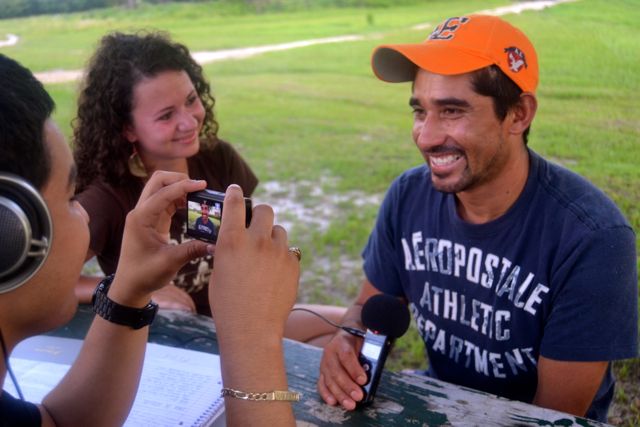
Interview_miniThe interview went off without a hitch and was followed by friendly banter inside a screened-in porch where I took in the surroundings: Clean tables. A swept floor. A bright clean kitchen with a professional stove—a Viking, the kind you see in restaurant kitchens.

Why was this camp for migrant farmworkers so nice when so many are such filthy hovels?

This was a camp for workers on H-2A guest worker visas. The government requires housing at these camps to meet certain standards. I’m told these standards are not always enforced, but here I imagine the grower was well in compliance and maybe then some (I doubt the program requires Viking stoves and volleyball nets).

The H-2A program is not without controversy. Detractors say it doesn’t address the much bigger problem of poor living and working conditions for undocumented workers (only 10% or so of migrant workers are here on H-2As) and even its proponents decry the H-2A bureaucratic complexities. I’m still learning about the program and don’t have a strong opinion.

I just wish every migrant farmworker in America could come off the fields at the end of a day to a place like this.

cropped-sunsettractorman.jpg
A version of this essay appeared on the Farmworker Advocacy Network blog on July 12, 2014